The limit of a function f(x) as x approaches a equals L if for any positive ε one can point to a neighborhood of the point a such that the values f(x) differ from L by no more than ε whenever x falls into that neighborhood (except possibly the point a itself). The key point: we do not require that f(a) exists or equals L. The limit describes only the tendency, not the arrival.
History
The intuitive concept of a limit appeared in antiquity in the works of Eudoxus and Archimedes (method of exhaustion). In the 17th century, Newton and Leibniz used infinitesimals ('fluxions' and 'differentials') to create calculus, but were criticized for lack of rigor. Augustin-Louis Cauchy in 1821 proposed a definition in the ε-δ language, later refined by Weierstrass. This ended the era of infinitesimals and provided a foundation for modern analysis.
How it works
The classical ε-δ definition formalizes the intuition of 'approaching without reaching'. In practice, limits are computed using algebraic manipulations, the squeeze theorem (two policemen theorem), L'Hôpital's rule (for indeterminate forms), or asymptotic estimates. Limits are indispensable in defining continuity (f is continuous at c if lim_{x→c} f(x)=f(c)), the derivative ( lim_{h→0} (f(x+h)−f(x))/h ), and the Riemann integral ( lim_{n→∞} Σ f(x_i^*)Δx ). In functional analysis, the limit is generalized to normed spaces.
In practice
Without the limit, it is impossible to calculate the instantaneous speed of a car from the change in its coordinates—GPS navigators and autopilots rely on this concept constantly.
Fun fact
Long before formalization, Zeno of Elea formulated the paradox of Achilles and the tortoise: Achilles will never catch the tortoise because each time he reduces the distance by a fraction. The modern explanation of the paradox lies precisely in the concept of a limit: the sum of infinitely many segments can give a finite time.
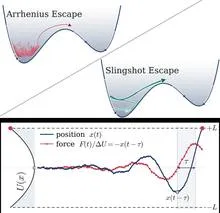
A particle sits in an energy pit like a pea in a dimple. To get out, it needs to go over the barrier, and usually this is rare: the higher the barrier, the longer the wait. The Arrhenius law says the waiting time grows exponentially, meaning doubling the barrier height increases the time by hundreds of times.
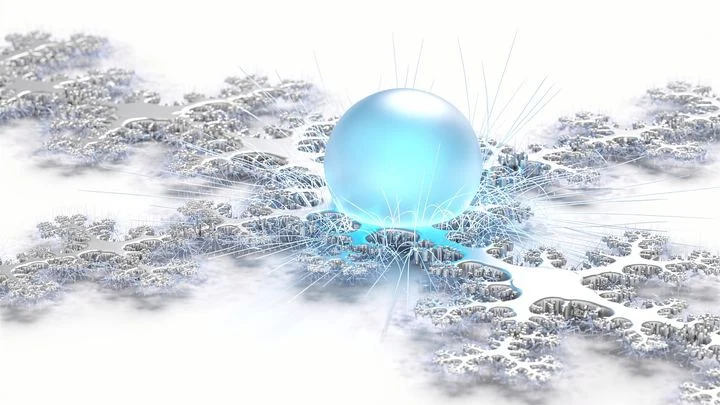
The frost pattern on a windowpane doesn't spread uniformly: it sprouts branches, captures new areas, sometimes sealing off voids. This growth is not a smooth expansion but a series of leaps. This image resonates surprisingly with a mathematical model devised by Charles Loewner a century ago.
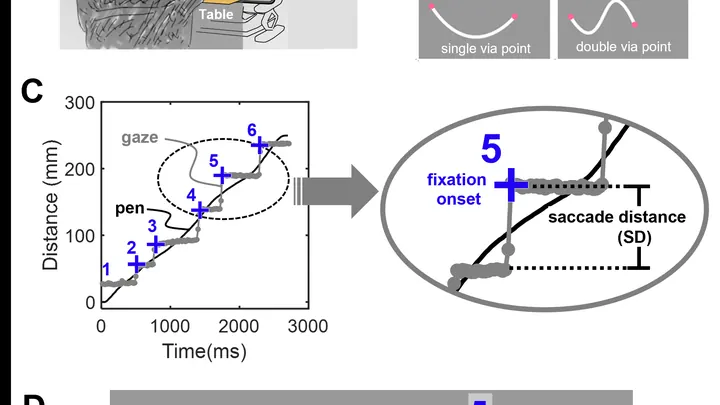
When the hand draws a line, the gaze almost always runs ahead, like a scout peeking around the corner before the column turns. But how far ahead? It turns out that each person has their own distance, and it does not change from attempt to attempt.
In the experiment, professional calligraphers and ordinary people traced a contour on a screen while instruments recorded eye and pen movements.
Spacetime at ultra-short distances resembles a digital screen: it's not smooth but made of tiny 'pixels.' This minimum length was calculated by Max Planck, and Heisenberg's uncertainty principle explains why the world cannot be continuous: precise measurement always…
A pendulum swings steadily until gusts of wind disturb it. Each push shifts the rhythm slightly, and soon the beats no longer match the metronome. Natural oscillators live the same way: the heart, populations, climate cycles—they all oscillate, but randomness constantly interferes.
Fog thickens over the line "def max(a: Int, b: Int): Int". What does it do? It returns the larger of two numbers, but how can you verify that? You could write a dozen tests with specific pairs: max(2,3)=3, max(5,5)=5, max(-1,0)=0. Still, a nagging doubt remains: what if it breaks for, say, a million and minus a million?