How Sentinel Cells Build a Trap for Cancer express
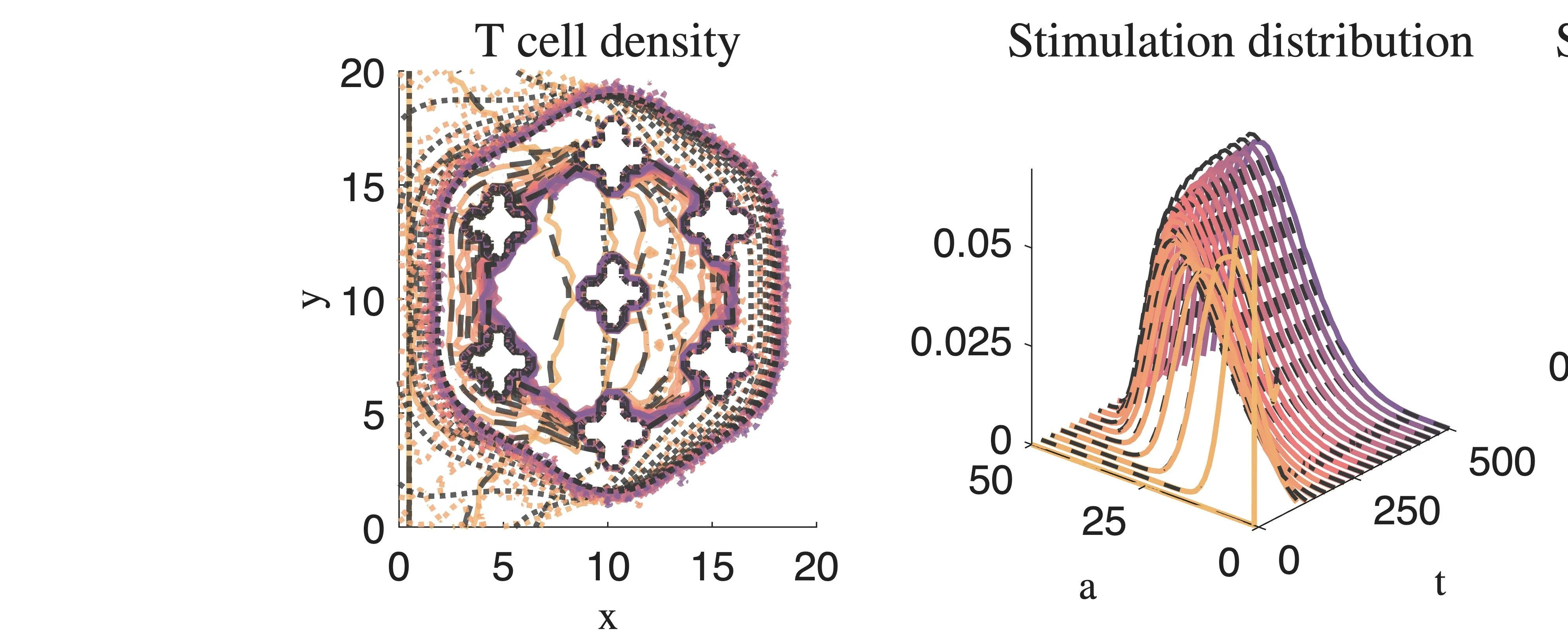
A lymph node is like a bustling command center. Here, dendritic cells, scouts that collect enemy debris, show T cells (the soldiers) fragments of invaders. If scouts stand alone, soldiers pass by barely noticing the signal. But when scouts huddle into tight groups, it's as if they light bonfires: the signal becomes brighter and more insistent.
The authors built a computer simulation of this process. In it, each T cell acts as an independent agent with its own 'appetite' for stimulation. From the simulation, they derived equations describing cell movement and activation depending on cluster density. It turned out that soldiers with intermediate sensitivity benefit the most. For them, a cluster becomes the decisive nudge to wake up. Weak ones still don't respond, while overly sensitive ones get excited even by a single signal.
The main takeaway: the spatial organization of cells changes not only the strength but also the diversity of the response. Clusters create a wide range of stimuli, bringing soldiers with different sensitivity thresholds into the fight. This explains clinical observations. In breast cancer patients, a high density of dendritic clusters in sentinel lymph nodes is associated with better survival. The immune system doesn't just get reinforcements: it learns to recognize the enemy more flexibly.
Original abstract
as written by the authors arXiv:2604.17786
The coordination of the immune system and its components is essential for the body to maintain a healthy status. Recent clinical studies show that breast cancer patients with high Dendritic cell clustering in tumour draining lymph nodes have improved survival outcomes, compared to those with a lower degree of clustering. These results suggest that a specific form of Dendritic cell clustering promotes T cell activation. However, the mechanistic effects of this spatial organisation is unclear. We develop a spatially dynamic model of T cells interacting with Dendritic cells within the lymph node. We present a novel probabilistic agent-based model (ABM) of T cells, and use it to derive the deterministic, phenotypically structured partial differential equation (PS-PDE) of T cell activation and motion. Using the PS-PDE, we derive analytic approximations of the expected T cell stimulation distribution, based on the topology and level of clustering of a given Dendritic cell population. Our analytic approximation enables us to identify T cell characteristics that benefit most from Dendritic cell clustering, to result in an enhanced stimulation distribution. We also perform a sensitivity analysis with our models to identify T cell characteristics that result in desirable T cell activation characteristics, such as rapid T cell activation, and robust heterogeneous T cell activation. Our key findings show that T cells with an intermediate level of stimulation uptake benefit most from higher levels of Dendritic cell clustering, activating with a comparable or greater abundance, and greater heterogeneity, when compared to T cells of a similar characteristic but with a lower level of Dendritic cell clustering.
A single lymph node the size of a bean contains about a billion lymphocytes, constantly moving at roughly 10 micrometers per minute, as if a person were walking across a football field in an hour.