Sensitivitythreshold is the smallest signal an instrument can pick out from the background noise that is always present. In any measurement, there is a fundamental limit set by random fluctuations — thermal jitter, quantum uncertainty, or electronic noise — below which a true signal is indistinguishable from the noise itself. This threshold determines what is detectable: a faint gravitational wave, a single electron's charge, or a subtle shift in an atomic energy level.
History
The concept emerged in the early 20th century with the development of sensitive electronic detectors, and was formalized in the 1940s by researchers like David Bohm and others working on signal detection theory. It became a central concern in particle physics and astronomy as experiments sought ever-fainter signals.
How it works
The threshold is set by comparing the signal's strength to the noise level, often quantified as a signal-to-noise ratio. To lower the threshold, physicists reduce noise (by cooling, shielding, or clever design) or amplify the signal. Quantum techniques, such as squeezing or entanglement, can also redistribute noise so that the signal stands out more clearly, effectively pushing the detectionlimit below the standard quantum limit.
In practice
It is crucial in gravitational wave observatories like LIGO, quantum sensors for magnetic fields, and single-photon detectors in quantum cryptography.
Fun fact
The sensitivitythreshold of the human ear is so low that it can detect sound waves that displace the eardrum by less than the diameter of a hydrogen atom.
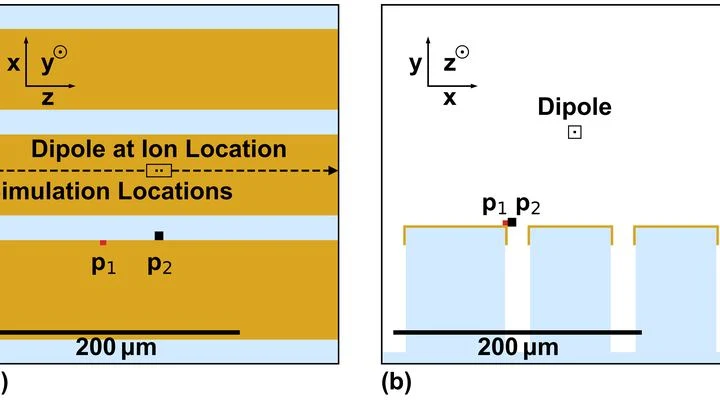
A tiny diamond, invisible to the naked eye, sits on a chip and senses heat like no ordinary thermometer can. Hidden inside it are two defects: places where a carbon atom is replaced by a nitrogen atom, with a vacancy nearby.
A superconducting quantum interferometer is a device that senses magnetic fields billions of times weaker than the needle of an ordinary compass. Inside it, there is a narrow bridge where superconductivity briefly breaks.
A laser beam passes through a glass cell filled with cesium vapor. The atoms in the vapor dart around chaotically, like a crowd at a train station: each one enters the beam, spends a moment there, and flies back out. Their internal state, something like the orientation of a tiny magnet, changes under the influence of light. If all atoms were identical and stationary, the signal would be steady.
A magnet weighing just a few grains of sand hovers in midair with no support. It doesn't touch the walls, doesn't rub against bearings — it just hangs in a magnetic trap like a speck of dust in a sunbeam. Researchers have turned this tiny object into an ultra-sensitive compass: the device detects changes in the magnetic field of 23 femtotesla.
A handful of pebbles drops into a pond: each one sends out ripples. If the pebbles are different, the ripples will be different too: some sharp, some smooth. But when you look at the water from a distance and see only a small part of the ripples, all those differences blur together.
A pendulum weighing a few grains of sand swings on a hair-thin glass fiber. Its motions are so faint that the thermal jostling of air molecules seems like a hurricane. Yet such a pendulum is the key to witnessing quantum wonders in the world of large objects.
Traditional hearing aids resemble a chef who cooks from a recipe blindly. They analyze the sound chaos from the microphone and amplify speech based on it. In a noisy café, this approach often errs. The new system behaves like an experienced cook: first processes the signal, then samples the result.
A laser is like a tuning fork that rings at a single note. But even in complete silence, its sound trembles slightly. Previously, it was thought that this tremor, random kicks from spontaneous emission of light by atoms inside the laser, was the main limit to precision.
The 120 residents of Montelago are not people but digital characters. Each, besides a name and biography, has three hidden coordinates: trust in municipal authorities, assessment of source credibility, perceived adequacy of information. These numbers are known to the creators but not to the system itself.
A laser beam in a multi-kilometer tunnel trembles as a gravitational wave passes, but the tremor is barely perceptible, on the scale of fractions of a proton's diameter. To hear this cosmic whisper, physicists squeeze every last bit of performance out of light.
A laser isn't just about light. If you make a particle oscillate like a pendulum and those oscillations sustain themselves, you get a phonon laser. Sounds complicated, but the idea is simple: instead of light waves, the device emits orderly waves of mechanical vibrations — phonons.
A quantum computer is like an orchestra where each ion is a musician and laser pulses are the conductor's baton. But if someone in the audience rustles, the delicate melody of quantum states goes off key.
Atomic nuclei are rarely perfect spheres. More often, they resemble a slightly squashed ball — the electric charge inside is unevenly distributed, and protons may shift a bit, creating a tiny 'pear-shaped' bulge.
An ultra-sensitive microphone tries to catch the whisper of a distant galaxy. But the microphone itself trembles from heat: its atoms jitter like popcorn in a pan. Physicists call this jitter thermal noise, and it often drowns out weak signals.
An ordinary antenna picks up radio waves, but there are fields it barely feels. We're talking about slow electric fields: those that change once a second or less. For them, physicists built a sensor from a beam of rubidium atoms.
Atomic clocks are pendulums that tick at the frequency of light. Inside a trap, an aluminum ion hangs, and a laser probes it like a tuning fork. If the laser's frequency matches the atom's natural frequency, the atom responds. The clock's rate is checked against this response.
A detector that hunts for rare particles is like an ear trying to catch a whisper in a noisy room. The quieter the signal, the harder it is to tell apart from random noise. In the NUCLEUS experiment, such detectors, cryogenic calorimeters, are cooled to near absolute zero so they can pick up even a faint pulse of heat from a single particle.
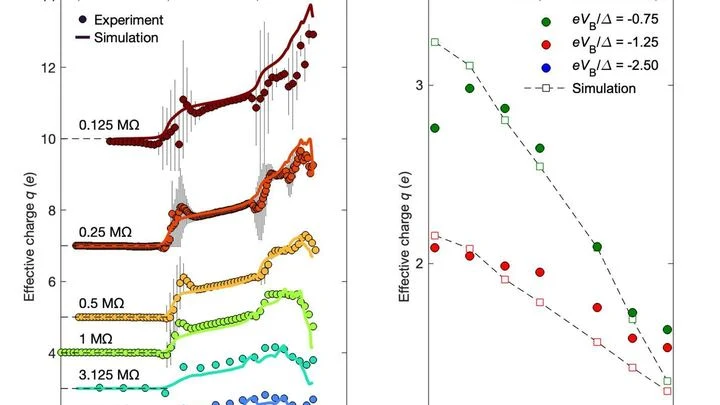
Current flowing through a wire is never perfectly smooth. If you listen closely enough, you hear a rustle — shot noise. It arises because charge is not carried as a continuous stream but in discrete portions, like raindrops on a roof. From the character of this noise, you can tell how much charge each 'drop' carries.
A seismometer is the planet's ear. It picks up the faintest tremors in the ground and turns them into an electrical signal. But this ear isn't perfect: its sensitivity depends on temperature. In the cold and in the heat, the instrument hears slightly differently, and that introduces error into measurements.
Ultra-precise scales that catch the slightest changes in gravity work like a keen ear: they hear even the whisper of distant underground voids or the tremors of the Earth's crust. But such instruments have a hidden enemy: their own internal clocks. Time inside the sensor also jitters, and this jitter smears the picture.
A speck of glass floats in a laser beam. Air molecules, photons, even Earth's gravity give it little pushes, and by watching its jitter, you can tell what pushed it. But every measurement has a limit: the particle's own noise hides weak signals. Quantum mechanics sets that limit, but it can be bypassed.
An ordinary sensor is like a scale that always shakes a little on its own. Even in total silence and at zero temperature, every particle jitters — this is quantum jitter, and it limits the precision of any measurement.
Inside the receiver of a telescope aimed at the oldest glow in the universe sits a tiny thermometer chip. It's so sensitive that the heat from a single photon can warm it noticeably. But to hear that whisper of heat, you need a middleman — an amplifier that doesn't add its own noise.
Light hits a silicon wafer, and a single electron is born inside it. An ordinary instrument wouldn't notice — the signal is too faint. The new detector not only hears it but also determines its energy with an accuracy of 589 millielectronvolts. That's like distinguishing the footsteps of an ant at arm's length.
Inside the detector, a particle knocks an electron out of a silicon atom. This takes 0.
The calm вода of a lake: the slightest ripple blurs the depth. In quantum sensors, noise — random jitters — generates энтропию (disorder) and kills precision. Physicists found a solution: scramble the order of events.