Computer simulation is the practice of using a computer program to imitate the behavior of a real or hypothetical system. Instead of physically building and testing something, you create a mathematical model of its rules and let the computer step through time, calculating how the state of the system evolves. This allows scientists and engineers to explore scenarios that are too slow, too fast, too dangerous, or too expensive to reproduce in a laboratory.
History
The modern practice began in the mid-20th century with the advent of electronic computers, notably with the Manhattan Project's use of Monte Carlo methods in the 1940s. The term 'computer simulation' became common in the 1960s as mainframes allowed for the first large-scale weather and physicsmodels.
How it works
The core idea is to represent the system's state with numbers (positions, velocities, temperatures, etc.) and then apply the known laws of physics as update rules. The computer repeatedly applies these rules in tiny time steps, producing a trajectory of the system's evolution. The accuracy depends on how faithfully the model captures the essential physics and on the computational power available to make the time steps small enough.
In practice
Simulations are used everywhere: from predicting weather and climate, to designing aircraft and drugs, to understanding blood flow in medical devices and modeling the behavior of quantum systems that are impossible to solve analytically.
Fun fact
The first computer simulation of a physical system is often credited to Enrico Fermi, John Pasta, and Stanislaw Ulam in 1953, who simulated a vibrating string on the MANIAC I computer to study thermalization.
A navigator with a paper chart plots the route before setting sail. If the ocean changes—the current shifts, the wind picks up—the chart stays the same. The ship follows an outdated path, and the crew has to correct the course by hand.
When a fluid flows around an obstacle, it spawns vortices and shock waves. Describing their behavior means solving a nonlinear equation in which the flow velocity depends on itself. Classical supercomputers spend days on this, while quantum computers have barely been used: their native language is linear operations, but fluids are inherently nonlinear.
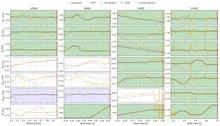
A perovskite solar cell is like a young athlete: it performs brilliantly at first, but tires with age. Over eight hours, its performance drops noticeably, with no visible cause like cracks or dust. Scientists took one cell and recorded its performance at 0, 90, 280, and 480 minutes of its life.
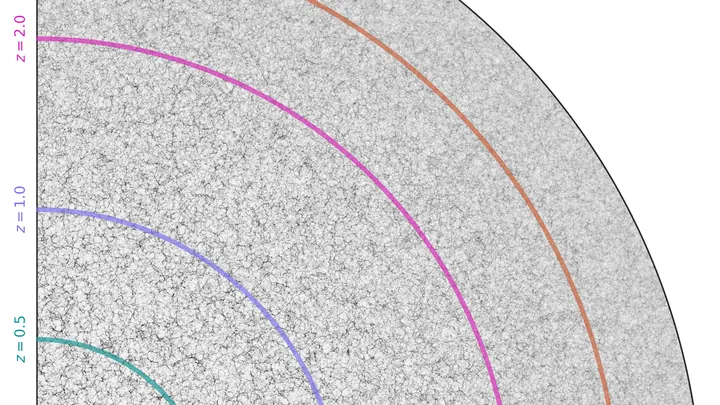
In a dark room, music plays. Powder is scattered on the floor — fine, almost invisible. Low frequencies make it gather into intricate patterns: filaments, clumps, voids. In much the same way, gravity over billions of years weaves galaxies into the cosmic web — except here, attraction does the work instead of sound waves.
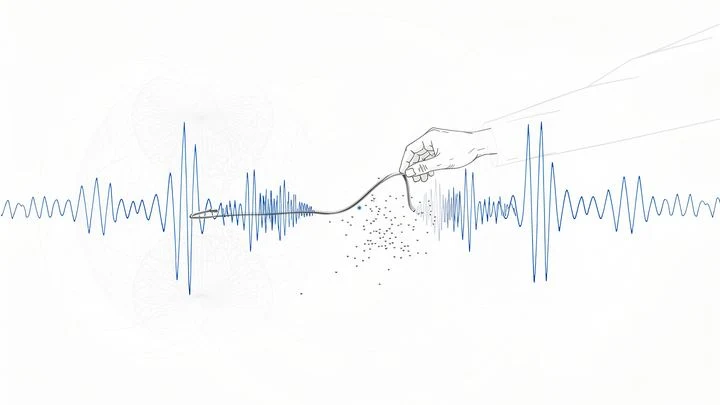
Statistical models are an attempt to stretch a perfect mathematical web over the uneven landscape of data. When a model resists, it emits tension, but we've grown accustomed to ignoring it. Researchers spend hours staring at residual plots, trying to guess where the model is 'coming apart at the seams.' Squealer translates this resistance into sound.
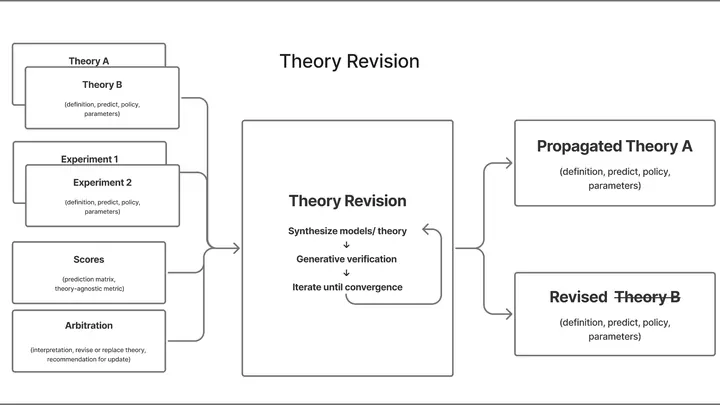
A closed loop: the machine proposes an idea, tests it on people, sees the failures, and spawns a new, more accurate guess. That's how AutoCog works — an automatic cognitive scientist. Previously, in the science of thinking (cognitive science), the hardest part, coming up with a theory, was done only by humans.
A cell is like a library where thousands of books are copied every day. Molecular machines, polymerases and ribosomes, slide along a template chain and assemble a copy, link by link. These machines have several states: they can slow down, make mistakes, or switch. Previously, calculating such a process took hours.
In the 1990s, philosopher John Searle devised a thought experiment: a person sits in a room and, without knowing Chinese, follows instructions to produce correct answers in Chinese. From the outside, it seems they understand the language, but inside, it's just mechanical rule-following.
A plumber clears a clog in a narrow, winding pipe — by feel, without seeing inside. That's roughly how a surgeon feels during mechanical thrombectomy, the operation to remove a blood clot from a brain vessel. Time is short, and every move can either save a life or damage the vessel wall.
Your arm lifts a cup from the shelf — a familiar motion you don't notice until muscles tire. Then the trajectory changes: the elbow shifts slightly, the hand trembles. A doctor usually catches these changes by hand, feeling the patient's muscles.
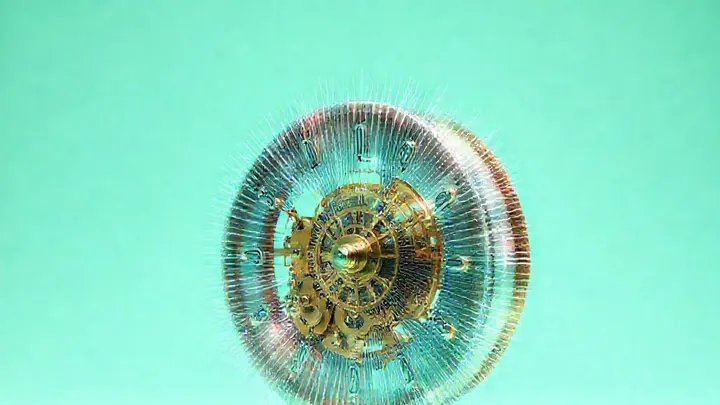
A time crystal resembles an eternal clock: its atoms spontaneously perform rhythmic movements. In ordinary clocks, a pendulum is driven by a spring or battery, but here the motion arises without an energy supply — the system simply returns to its initial state at regular intervals. This idea was proposed by Frank Wilczek in 2012.
An X-ray tomograph is like a carpenter who examines a log from all sides to see where the void is inside. It takes dozens of flat shadow images, rotating the source and detector around the object. Then a 'reconstruction' program glues these shadows into a 3D model. The quickest reconstructor is the FBP algorithm (filtered back projection).
Inside every cell, life is bustling: tiny protein machines tirelessly haul cargo, read genes, and fix errors. But their work is far from perfect: they often 'spin their wheels,' take backward steps, or get stuck in futile cycles. It's like a city traffic jam where cars dart around aimlessly, burning fuel.
A radio picks up a broadcast through crackle and hiss. That's roughly how modern quantum computers work: the useful signal drowns in noise. The longer the computation runs, the more the interference distorts the result.
A quantum computer is a finicky instrument. Each measurement of its state is like photographing a fast-moving object: the shorter the exposure, the higher the chance of getting a blurry shot. But if you skillfully process a series of such snapshots, you can reconstruct a clear picture.
That's exactly what the researchers did.
Physical systems can compute. If you build a landscape of hills and valleys so that the lowest point corresponds to the answer, the system will roll there by itself, like a ball. The problem is that the bottom is often flat, and the ball crawls around for a long time before settling.
The authors propose nudging the ball to the right place before it even starts.
A radiation sensor in the city is like a street musician: it has to hit the right notes even when fingers go numb from cold or the instrument is baked by the sun. Usually, such devices are kept in greenhouse conditions, with heating or cooling, otherwise the energy scale (which distinguishes harmless potassium in concrete from dangerous cesium) starts to lie.
At night, the brain doesn't switch off. Instead, it sorts through the day's events like a librarian arranging books on shelves. But where do those strange, sometimes nonsensical dream images come from? Many have assumed they're just random noise with no meaning.
A new computer model shows that randomness doesn't hinder: it helps.
In a heart-lung machine, blood flows through narrow tubing and past rapidly spinning pump blades. Sometimes red blood cells can't take it: their membranes rupture, and hemoglobin spills into the plasma. For a patient, this is like pouring sand into a car's fuel system — small damages accumulate and wreck the whole mechanism.
There's always a risk that someone will peek at your ballot during an election. Physicists have come up with a solution: anonymous voting safeguarded not by people, but by the laws of nature.
Their 'magic ballot box' operates with light particles — photons.
Plants employ an army of perfect couriers to deliver energy. Each photon of sunlight is absorbed, and its energy is instantly, with almost no loss, transferred to reaction centers where nutrient synthesis occurs.
Intelligent action begins with a plan. Just as an architect needs blueprints to evaluate options, any agent with will needs to repeatedly copy data about reality.
An orchestra of two musicians plays from the same score, but each hears only their own line. The atmosphere and ocean in a climate model resemble such a duet: they exchange heat and moisture every few hours, yet until recently their neural network counterparts could not keep a common rhythm.
A laser pulse lasting one and a half nanoseconds hits a nonlinear crystal, and a stream of squeezed light is born. That is how an experiment on the Jiuzhang 4.0 quantum processor in China begins.
In 2019, a group of theorists asked a simple question: what would happen if you embedded a single irreversible element into an ordinary quantum computer, a gate that slightly "eats" probability? The answer was devastating. Any such gate, no matter how weak, instantly turns the machine into a device capable of solving problems in the class PostBQP = PP.
A translator at a high-stakes negotiation doesn't just render words quickly; they make sure the meaning doesn't get lost. CAMulator does the same: it takes the complex climate model CAM6 and translates it into the language of a neural network that runs hundreds of times faster, without losing the physical essence.
In 2023, a group of researchers at Oak Ridge National Laboratory ran a simulation of a 61-qubit quantum circuit on the Theta supercomputer. Storing its state vector would have required 32 exabytes of memory, more than the total capacity of all hard drives on the planet. But thanks to data compression, they fit it into 768 terabytes.
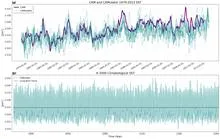
Every winter, the Pacific Ocean warms slightly off the coast of Peru, and every summer it cools. This rhythm is set by the gears of the climate machine, but some turn fast, others slow, and still others speed up or stall. Linear inverse models have helped us glimpse these gears in data for decades, but they were blind to seasonal changes in pace.
In 1982, physicist Richard Feynman proposed a simple idea: to understand a quantum system, you need to build another quantum system that behaves the same way. Thus was born the quantum simulator, a device that does not calculate equations but reproduces them in its own behavior.
Fog thickens over the line "def max(a: Int, b: Int): Int". What does it do? It returns the larger of two numbers, but how can you verify that? You could write a dozen tests with specific pairs: max(2,3)=3, max(5,5)=5, max(-1,0)=0. Still, a nagging doubt remains: what if it breaks for, say, a million and minus a million?