Therapy in this context refers to medical treatment, specifically involving genetically modified cells. This approach, often called cell therapy or gene therapy, involves altering a patient's own cells to fight disease, such as cancer. The technique has gained prominence with the development of CAR-T cell therapy, where a patient's T-cells are extracted, genetically engineered to recognize cancer cells, and then reintroduced into the body. This personalized treatment has shown remarkable success in certain blood cancers and represents a major shift from conventional treatments like chemotherapy.
History
The first successful gene therapy was performed in 1990 on a patient with severe combined immunodeficiency (SCID). The field advanced significantly in the 2010s with the approval of CAR-T cell therapies, with tisagenlecleucel (Kymriah) approved by the FDA in 2017 for acute lymphoblastic leukemia.
How it works
The process typically involves isolating immune cells from the patient's blood, using a virus or other vector to insert a gene that encodes a receptor specific to the cancer cell surface, and then multiplying these modified cells in the lab. Once infused back into the patient, the engineered cells seek out and destroy cancer cells. The genetic modification can also involve editing genes to make cells resistant to disease or to produce therapeutic proteins.
In practice
CAR-T cell therapy is used to treat certain types of leukemia and lymphoma, and ongoing research is exploring its application to solid tumors and other diseases.
Fun fact
The first gene therapy treatment was performed on a four-year-old girl with SCID in 1990, and her modified cells remained functional for over a decade.
Stated relations:part of →DNA · part of →RNA · part of →protein · part of →cell
A watchdog that yawns and turns away instead of barking at an intruder is a bad guard. That is roughly how CD8+ T cells behave in people with type 2 diabetes. These cells are professional killers: they patrol the body, find infected or cancerous cells, and destroy them. But in diabetes, something breaks in the recognition system itself, and the watchdogs stop recognizing the enemy.
In the nucleus of every cell, DNA is twisted into a double helix, but sometimes it forms loops and knots. One such knot is the G-quadruplex: four DNA strands fold into a square stack, like cards in a deck. Tumor cells have more of these knots than healthy ones because their DNA is constantly rearranging. If you jam these knots, the cell can't copy its genes and dies.
A sheet of paper tears where tension exceeds strength. Epithelium, the cell sheet lining our organs, behaves similarly, but until recently models could not show how tears appear in it. The classical vertex model describes tissue as a network of polygons tightly packed together and forbids cells from detaching.
Construction is in full swing: neurons are laying down their processes the way bricklayers stack up walls. But an error has crept into the blueprints. The protein tau, which normally serves as scaffolding for the cellular framework, in its mutant form starts dictating the wrong dimensions.
In a lab where patient data resemble a scattering of gold dust, every test is a speck, and Alzheimer's disease is a river washing away the precious metal. Scientists set a task for the neural network: to tell whether a person received rapamycin, a drug that slows cellular aging, or not.
In a fibrotic liver, as in a city after a long siege, neighborhoods appear where life has stalled: working cells are replaced by scar tissue, and hiding inside it are senescent macrophages. These cells have stopped dividing but have not retired. They release substances that push their neighbors to build even more scar and drive off immune patrols.
At the end of every chromosome sits a cap made of repeating DNA letters: the telomere. For a long time it was measured as an average length across all chromosomes, as if judging a library by the average thickness of its books. But in humans, three ends, 17p, 20q, and 12p, are consistently shorter than the rest, and they are the ones more often linked to genome damage.
After a big police raid in a city, a few criminals remain. Some hide in dark alleys, others slowly gather strength for a new job. The police need not only to catch them now but also to prevent them from taking over the streets again. This is roughly how blood cancer treatment with hunter cells works.
These cells are created from the patient's own immune cells.
A low-dose X-ray image looks like a view through a fogged-up window: outlines are there, but details drown in a hazy veil. Doctors need such images during radiation therapy — to aim the beam precisely at the tumor and spare healthy tissue. But saving on radiation comes at the cost of noise, streaks, and artifacts that obscure what matters.
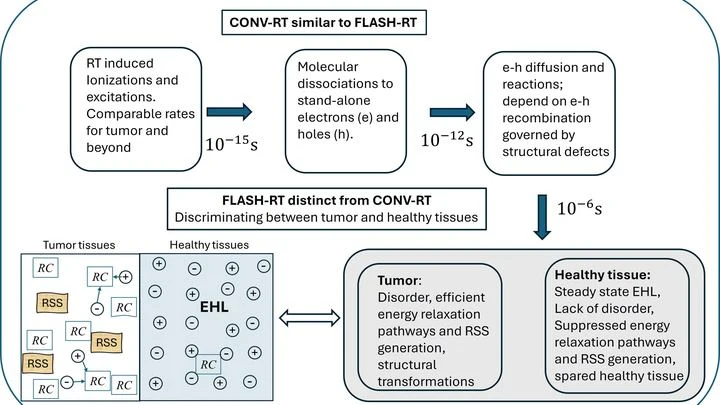
A camera flash that fires in a thousandth of a second doesn't heat the subject — unlike a regular flash that lasts a full second. A similar trick has been found in radiotherapy: when a radiation dose is delivered in milliseconds instead of minutes, healthy tissues suffer less. This is called the FLASH effect.
Blood stem cells are like spare keys to a house: they open the door to any room, but over time they wear down and start to stick. In an elderly person, such keys handle the locks worse, and the blood renews itself more slowly. Scientists have long been searching for a way to make a duplicate that stays new even after heavy use.
Genes are like houses in a city: in some, life bustles; in others, silence reigns. This 'urban' genetic landscape was analyzed in a thousand women with breast cancer.
When biologists measure the activity of thousands of genes, they usually just see a list of coincidences, like two ingredients in a soup that often end up together. The standard method looks for such pairwise connections but doesn't show who influences whom.
A new approach, like a detector of dark matter, uncovers hidden threads of causation.
Every tumor writes its own cosmology. Its cells are galaxies, and mutations are stellar flares marking the branches of a genealogical tree. The key to its history is the rhythm of accumulating genetic typos.
Inside every cell, a complex network of genes determines what it will become — a nerve cell, a muscle cell, or part of the skin. This choice often resembles flipping a toggle switch: two stable positions, and the cell decides which way to tip. But cells have a feature rarely considered in such models: they divide.
An engineer tunes an antenna: pull one segment, the frequency drifts; change the angle, the gain drops. Developing therapeutic peptides (short protein chains) works much the same way.
In a car, the steering, brakes, and accelerator gradually fail. At first, you can still swerve around a pothole, but each year the maneuver takes more effort. At some point, even a perfect road becomes impassable — the car no longer obeys the driver.
That's exactly how the authors describe aging: not as the accumulation of rust or wear and tear, but as the loss of "controllability" of the body.
A drop of ink in a glass of water spreads quickly and evenly. But if the water is squeezed between tightly packed spheres, the ink cloud crawls slowly and erratically: it dodges obstacles and gets stuck in narrow necks. Water molecules in living tissue move in much the same way.
After a heart attack, the dead section of heart muscle can be replaced with living cells grown from stem cells. But a common problem arises: the fresh transplant starts acting as its own pacemaker, and the heart falls out of its proper rhythm. Doctors see the arrhythmia on an ECG, but what exactly happens at the junction between 'self' and 'foreign' remains hidden.
A tongue tumor is like a stranger in a crowd. On the surface, they all look much alike, but beneath the surface hide very different personalities. Some tumors behave aggressively, others grow slowly. Doctors need to understand who they're dealing with before surgery.
Usually, this means taking a tissue sample — a biopsy.
Two specialists look at the same breast image. One is an experienced doctor, the other is an artificial intelligence program. Sometimes their opinions match, sometimes they diverge. How often they agree determines how accurately they can together distinguish healthy tissue from a tumor.
A lymph node is like a bustling command center. Here, dendritic cells, scouts that collect enemy debris, show T cells (the soldiers) fragments of invaders. If scouts stand alone, soldiers pass by barely noticing the signal. But when scouts huddle into tight groups, it's as if they light bonfires: the signal becomes brighter and more insistent.
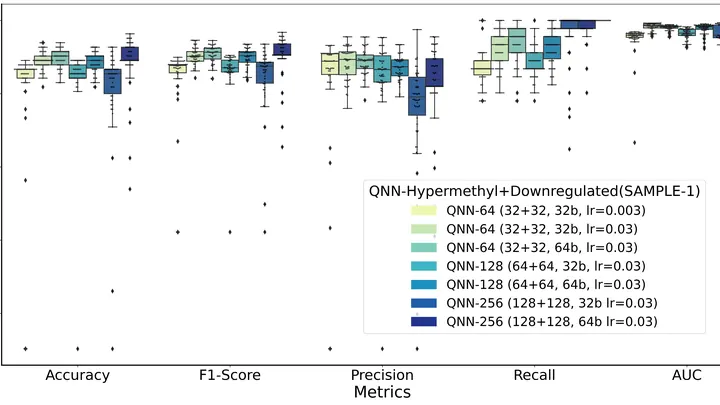
Two nearly identical locks are opened by the same pick. They look alike on the outside, but inside the mechanisms differ. Much the same can be said for the two main types of non-small cell lung cancer — adenocarcinoma and squamous cell carcinoma. Under a microscope, they can be confused, yet they require different treatments. That's where the quantum "magnifier" comes in.
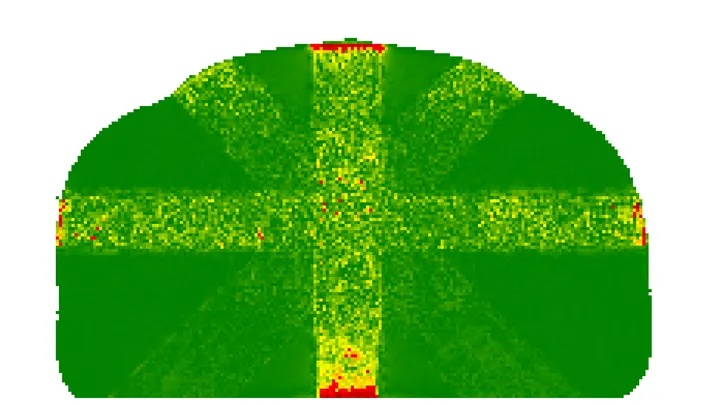
Prostate cancer radiation therapy requires precise calculation of the radiation dose at every point in the body. The classic Monte Carlo method simulates millions of particles and takes hours, while adapting the plan to daily anatomical changes needs seconds.
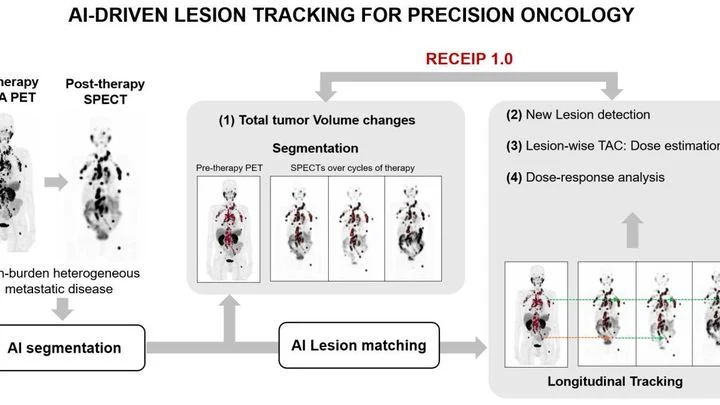
When treating prostate cancer, doctors often see not one tumor but many lesions in bones and lymph nodes. Each lesion can respond to therapy differently: one shrinks, another stays the same, a third grows. Previously, the disease was assessed as a whole, like judging the weather by the average temperature over a year.
Two cities: one with neat, straight streets, the other with a tangle of alleys. If you send a powerful flood of water through both, in the first the water quickly drains away through channels, while in the second it swamps everything. That's roughly how tissues behave under ultrafast radiation therapy, known as FLASH.
A lightning bolt strikes an anthill. Some ants die instantly, some freeze, and a few days later the survivors start rebuilding the tunnels. That's roughly how a tumor behaves after electroporation — a method where short electric pulses are passed through tissue to poke holes in cancer cell membranes and kill them.
Alzheimer's disease is like a tangled ball of yarn: thousands of genes are intertwined, and it's hard to tell which ones snap first. Previously, scientists looked for important genes by simply counting how many connections each node in the network had. But that approach is like judging a person by the number of acquaintances they have — the most sociable isn't always the most influential.
When you cut your finger, skin cells start working in concert: some divide, others crawl toward the wound, and still others pause. But exactly how a cell decides what to do next depends on its internal "schedule"—the cell cycle.
Inside every cell, work is constantly underway: proteins communicate, genes turn on and off, and glitches in this system lead to disease. To find the culprit behind an ailment, scientists used to manually comb through research papers and databases, like a detective interviewing witnesses one by one. But there are so many connections that no one can handle it alone.
A tumor doesn't stay put. Individual cells or whole groups break off and set off on a journey through the body. Some crawl solo, like scouts; others stick together, like a flock. Scientists built a computer model to understand how these cells pick a direction.
In the model, cells respond to two signals.
A brain tumor is like a traveler trudging through a dense forest: trees and bushes are the different types of brain tissue, some easier to traverse than others. Glioma cells don't move in a straight line; they constantly loop around, bumping into obstacles and going around them.
When a person receives radiation for a tumor in the head or neck, the rays pass through healthy tissue as well. Sometimes the jawbone starts to die afterward — a severe complication called osteoradionecrosis. The question isn't whether it happens, but how much the radiation dose itself increases the risk.
Primary human cells, taken straight from the body, are the most honest material for studying diseases and testing drugs. But getting foreign genetic material into them is tricky: cells don't like intruders. Standard methods either damage the cell or work unevenly, especially when the sample is heterogeneous — which it almost always is.
The new platform tackles this with a vortex flow.
Every cell is a miniature tuning fork. A sharp magnetic pulse makes it 'ring', and the decay of that sound depends on what's inside: viscosity, density, composition. A tiny diamond with a structural defect acts like a hypersensitive microphone, picking up magnetic echoes from individual cells.