Simple

Cosmic Deck: How Shuffling Numbers Creates the Universe ⚡ экспресс

Original: "The emergence of (3+1)-dimensional expanding spacetime from complex Langevin simulations of the Lorentzian type IIB matrix model with deformations"
arXiv:2604.19836 · 2026-04-21 · CC BY · ⏱ 1 min · HEP Theory General Relativity HEP Lattice
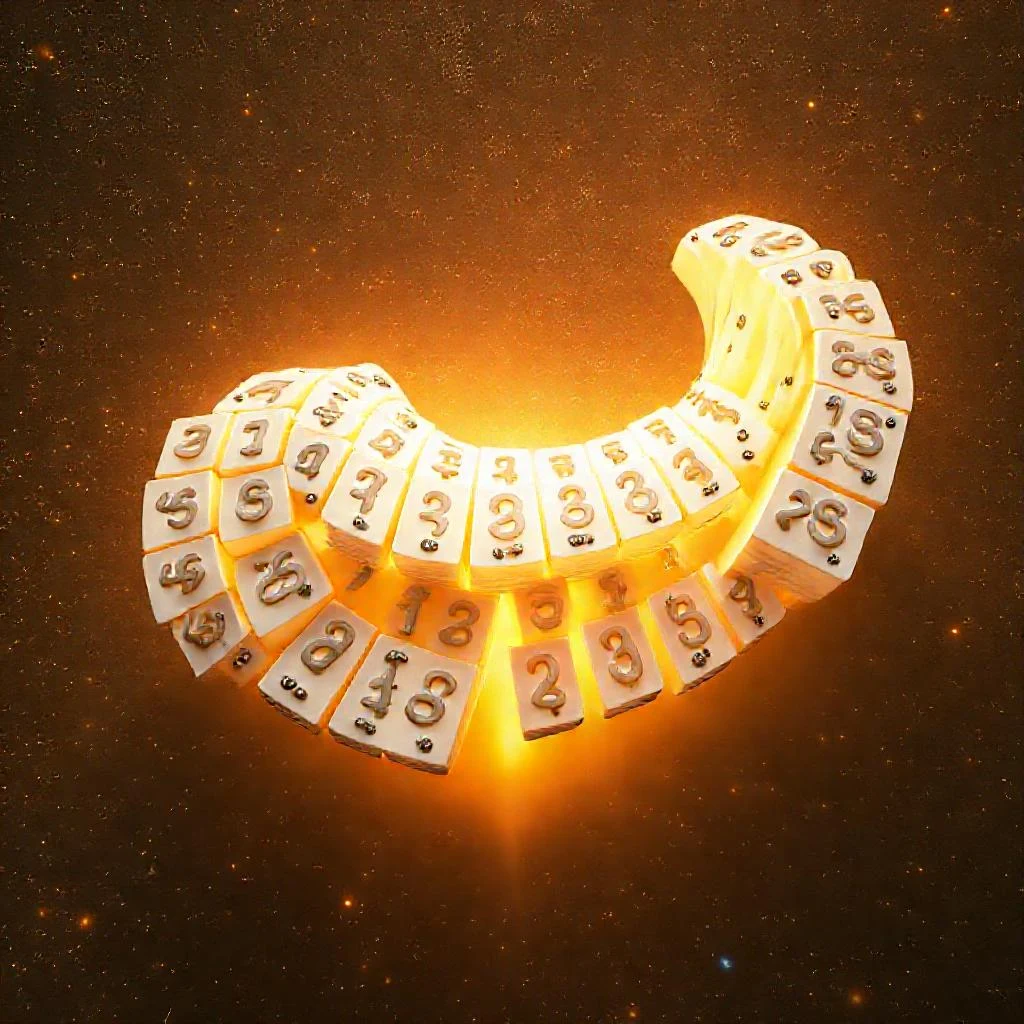
Scientists have simulated for the first time how an expanding universe with our familiar three dimensions and time emerges spontaneously from a giant table of numbers.
Abstract

Physicists used computer simulations to show how an expanding universe with three spatial dimensions and time can arise from microscopic strings. This world turns out smooth, without tears, just like a perfectly stretched film that stretches itself. Incredibly, perhaps our reality began with a vibration.

Links in the knowledge graph 1

To understand how the universe emerged from the Big Bang, physicists look to Georges Lemaître's idea of expansion, which rests on the laws of Hendrik Lorentz. One daring approach replaces elementary particles with giant tables of numbers — as if instead of the usual roulette balls, you use numbered cards.

Direct calculations long gave absurd results: negative probabilities kept popping up. This puzzle was sidestepped by borrowing a trick from seasoned players — changing the way odds are recalculated.

For the first time, a numerical simulation of 128×128 tables showed how, at a certain moment, a smooth, continuously expanding spacetime with three spatial dimensions and one time dimension 'falls into place' — exactly our world. Astonishingly: no one preset these parameters; everything emerged from the rules of the game. Thus, the birth of the universe begins to look like the luckiest combination in a cosmic casino.

🎯 A 128×128 table holds 16,384 numbers. Their cross-interactions are like a colossal game of cosmic roulette, with the structure of our world at stake.

🎬 It recalls 'The Matrix': reality as a numerical pattern. But in this version, the code doesn't flash green on a screen; it lives inside tables that constantly recalculate probabilities.

Scientists
Alan GuthAndrei LindeGeorges LemaîtreJames PeeblesAdam RiessBrian Schmidt
Tags
expansion of the universe big bang spacetime curvature
Laws
Friedmann equationsHubble's lawEinstein field equationsPlanck's lawequivalence principleLense–Thirring effect
Original: arXiv:2604.19836 · CC BY · bridge42worlds