Popular

HEP Lattice hep-lat

6 articles

Lattice field theory: phenomenology, algorithms and hardware for lattice field theory.

articles

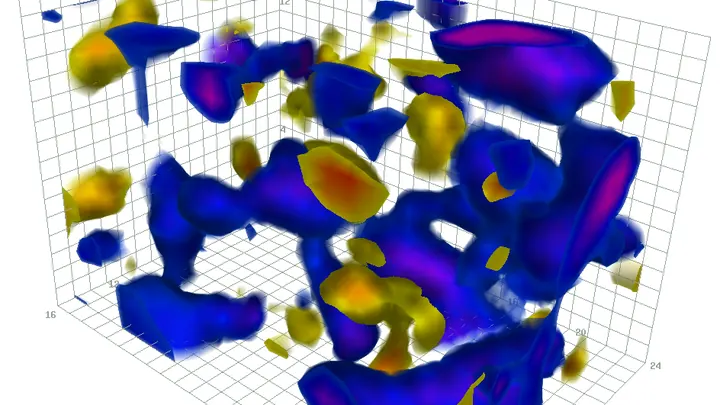
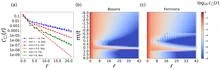
Dance of Bosons: From Chaos to a Checkerboard Pattern

Traditional models of fundamental forces rely on fermions—particles that avoid their neighbors. An experiment with bosons, which, on the contrary, are drawn to each other, unexpectedly revealed a structure with perfectly alternating vortices. This discovery reduces computational costs and brings the
arXiv:2504.17000 · 2025-04-23

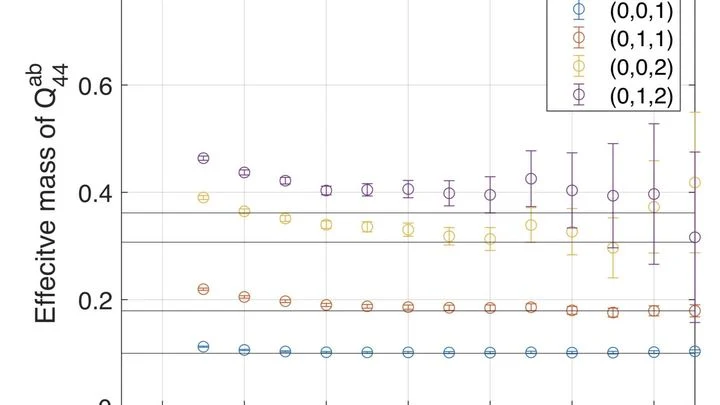
Quark Captivity: The Secret of the Invisible String's Snap

Using a simulation, scientists studied how the force strings connecting quarks break. The rupture turned out to be more complex: entire families of particles are born, and in a dense environment the process slows down. This discovery will help understand the microworld and can be tested on special d
arXiv:2509.08868 · 2025-09-10

Quantum Simulator Discovers Plasma Memory

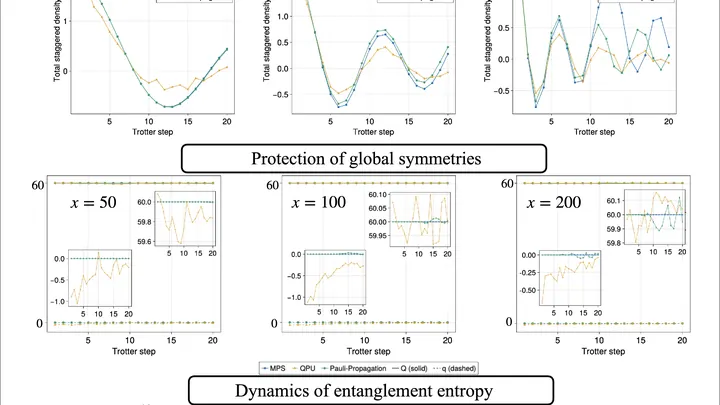
Physicists simulated a collision of charged particles. Contrary to expectations, instead of chaos, a plasma emerged, expanding as a shock wave and retaining memory of the initial charge clumps. The reason — plasma oscillations akin to a pendulum. This discovery helps understand matter under extreme
arXiv:2510.11679 · 2025-10-13

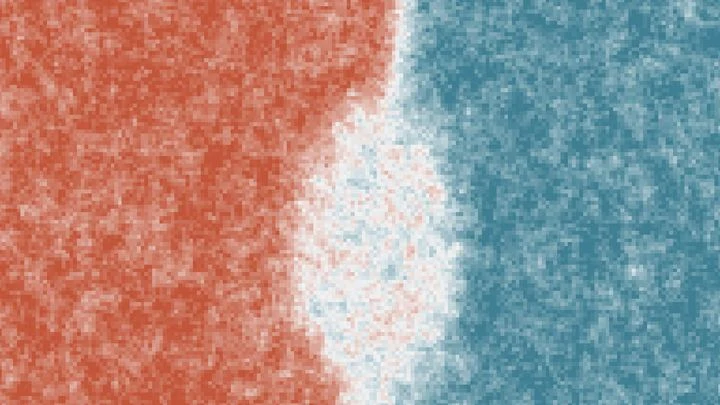
Chimeric Materials: Magnetic Expulsion Without Superconductivity

The discovery shows that the expulsion of a magnetic field, the hallmark of superconductors, can occur in ordinary conductors and even insulators. In such 'chimeric' materials, opposite properties coexist. Experiments on networks of superconducting switches promise practical magnetic shields.
arXiv:2511.00146 · 2025-10-31

Particles Play Shy in an Expanding Universe

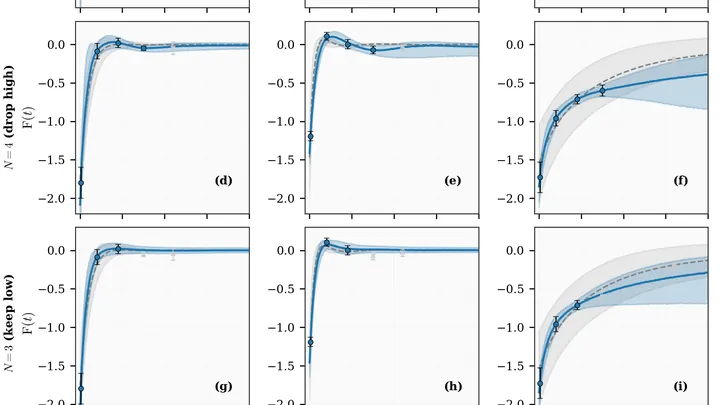
The stretching cosmos can conjure particles from nothing. But new simulations find that if those particles tug on each other, they slam the door on further creation—challenging the idea that more expansion means more particles. The early universe may have been far less crowded than we thought.
arXiv:2601.02331v2 · 2026-01-05

Cosmic Deck: How Shuffling Numbers Creates the Universe

Physicists replaced particles with numerical tables and ran a simulation. Following quantum rules, the tables arranged themselves into an expanding universe with three spatial dimensions and time — with no external guidance whatsoever. This result is like a winning jackpot: it explains how the Big B
arXiv:2604.19836 · 2026-04-21