How Genes and Environment Weave Brain Networks express
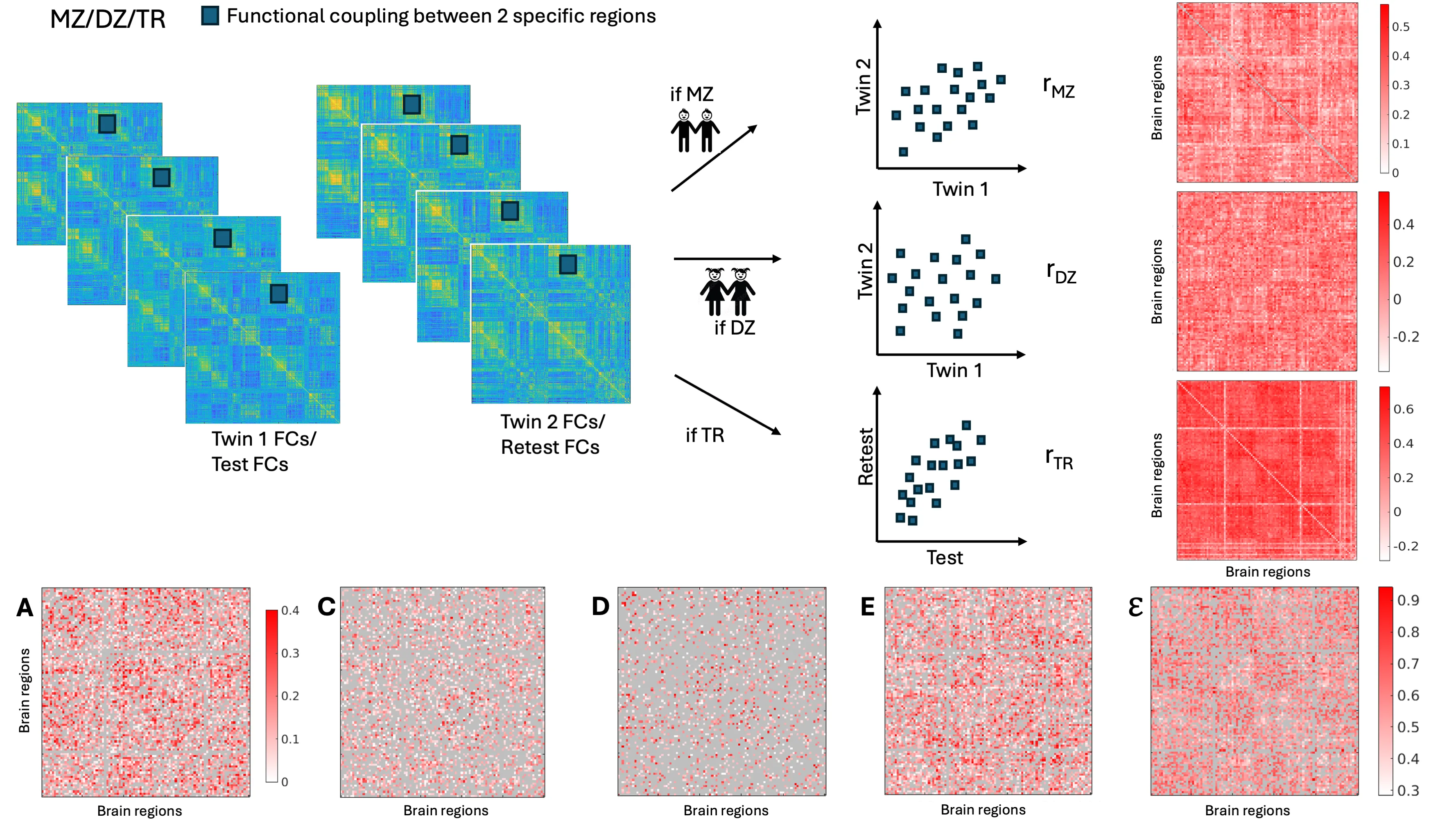
The brain is like a city: regions are neighborhoods, and nerve pathways are roads, each with its own traffic intensity. Each person's transportation network is as unique as a fingerprint. What builds these routes — blueprints laid down at birth, or daily commutes that wear new paths? Scientists have long studied this question using twins, comparing how similar the 'road maps' are between people with identical genes and those raised in the same family. But there was a catch: the scanner itself (fMRI) makes small errors each time, and this error was mistaken for the influence of personal experience.
The authors of the new study sidestepped this pitfall. They used data from the Human Connectome Project: a group of 206 twins underwent MRI twice at rest and twice while performing tasks. The repeated scans allowed them to calculate the scanner's 'noise' and subtract it, as if we measured road roughness not with one pass but with several. For the first time, they could cleanly separate the contributions of gene expression noise and stochastic modeling for each pair of connected brain regions.
The result resembles a layer cake. Some connections are almost entirely determined by shared genes, like the width of major highways, set in the city plan. Others depend on the environment shared by twins (upbringing, nutrition)—like neighborhood streets laid out according to a common design. Still others are shaped by each individual's unique experiences, like footpaths worn where only one resident finds it convenient to walk. But the most interesting part is that these categories are not scattered randomly; they cluster into coherent networks: genetically driven connections form one set of functional brain systems, while environment-driven ones form another. This is visible whether the brain is at rest or solving tasks. Such a multi-layered approach, like analyzing a transportation network during rush hour and at night, shows that genes and environment do not simply mold the brain separately: they create a complex, hierarchically organized architecture where each floor has its own blueprint and its own construction history.
Even identical twins with the same genes have different fingerprints. Likewise, unique life experiences leave an unmistakable 'pattern' on the brain's connection network that cannot be confused with anyone else's.
In William Gibson's novel 'Pattern Recognition,' the protagonist is painfully sensitive to brands due to a peculiar brain wiring. New methods could reveal how genes and environment create such unique neural 'lenses.'