Intensity, in physics, refers to the power transferred per unit area, typically for waves like light or sound. It is a measure of how much energy flows through a given surface per unit time. In the context of light, intensity is often related to the brightness perceived by an eye or a detector. The seed mentions '89% directionality,' which suggests a scenario where a light source emits most of its energy in a specific direction, rather than spreading uniformly.
History
The concept of intensity has been used since the early studies of optics and acoustics, with formal definitions established in the 19th century.
How it works
For a point source emitting light uniformly, intensity decreases with the square of the distance from the source. However, if the source is directional, such as a laser or a focused beam, the intensity can remain high over longer distances because the energy is concentrated in a narrow cone. The '89% directionality' would mean that 89% of the emitted power is contained within a small solid angle, making the beam highly collimated.
In practice
Intensity measurements are fundamental in fields like astronomy (to determine stellar brightness), medical imaging (ultrasound), and telecommunications (fiber optics).
Fun fact
The intensity of sunlight at the Earth's surface is about 1,000 watts per square meter on a clear day.
Units by system: SI: wm2 · CGS: ergscm2 · Planck: e pt pl p2
264 kilometres per second — that's how fast the Solar System hurtles through the cloud of dark matter. Its existence was given away by galaxies: they spun too fast to be held by visible mass, and Vera Rubin was first to suspect a hidden scaffolding.
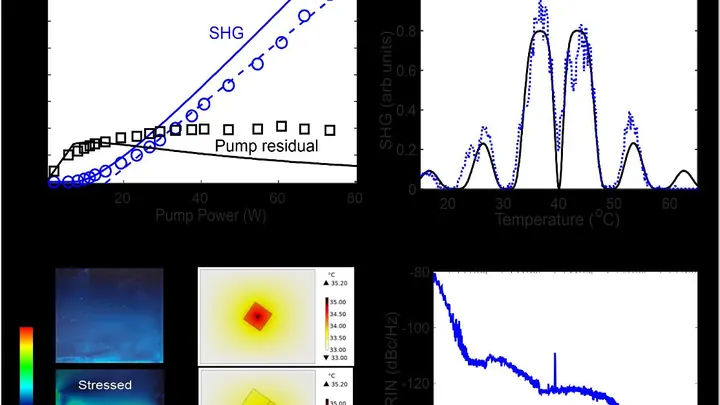
The laser based on diamond converts almost half of the pump energy into bright yellow light — an efficiency of 47.7%, a record for such devices. But the main advantage is not the power, but the exceptional purity of the color: the beam is so monochromatic that it can be compared to a musical instrument playing just one note without the slightest wavering.
You can squeeze light between two mirrors like a spring in a vise. It bounces back and forth, growing denser: that's how you get ultra-bright beams. But there's a limit: at too high a brightness, the mirrors start to shake. The light rocks them the way wind rocks a swing, and some energy leaks into that jitter.
In a dark matter detector, the gas acts like photographic film: a passing particle leaves a track of free electrons and ions. But how bright that track is depends on exactly how the particle loses energy in the gas. For light ions like fluorine, the data have been imprecise.
A laser pulse racing through plasma is like a runner carving a path through a crowd. It shoves electrons aside, leaving behind a rarefied channel, just as the crowd parts for a sprinter. In this channel, the crest of the light wave moves slightly faster than light in a vacuum, and it is this speed that determines how efficiently the pulse transfers energy to particles.
Light can draw patterns right inside your eye — no screen or glasses needed. When a specially shaped beam enters the pupil, it creates dark rays in your field of view, like the spokes of a spinning wheel. You see these rays because they are born in the retinal cells, not outside.