Measurement noise is the unwanted random fluctuation that obscures the true signal in any experimental measurement. In physics, every measurement is subject to noise, whether from thermal jitter, quantum fluctuations, or imperfections in the measuring apparatus. The titles in the corpus—'Гигантский шум в сэндвиче из сверхпроводника и магнита' (Giant noise in a sandwich of superconductor and magnet), 'Почему лазерный сенсор дрожит даже в идеале' (Why a laser sensor trembles even in the ideal case)—illustrate how noise appears in diverse systems, from solid-state devices to optical sensors. Understanding and mitigating noise is central to experimental physics, as it sets the limit on how precisely we can measure anything.
History
The systematic study of noise began in the early 20th century. Johnson and Nyquist characterized thermal noise in 1928, and Schottky described shot noise in 1918. The concept of quantum noise was formalized in the 1960s with the development of quantum optics.
How it works
Noise arises from multiple sources. Thermal noise (Johnson-Nyquist) is due to the random motion of charge carriers in a conductor, and its power is proportional to temperature. Shot noise comes from the discrete nature of charge carriers or photons arriving at a detector. Quantum noise, such as vacuum fluctuations, is intrinsic to the electromagnetic field. In a measurement, these fluctuations add to the signal, and the signal-to-noise ratio (SNR) determines how well the true value can be extracted. Techniques like lock-in amplification, averaging, and cryogenic cooling are used to reduce noise, but some noise, like quantum noise, is irreducible.
In practice
Noise analysis is used in materials science to detect defects, in gravitational wave detectors (like LIGO) to separate signals from seismic and thermal noise, and in all precision measurements to quantify uncertainty.
Fun fact
In gravitational wave detectors, the noise floor is so low that the mirrors are affected by the quantum vacuum fluctuations of light—a phenomenon called quantum radiation pressure noise, which sets a fundamental limit on their sensitivity.
Imagine a string stretched between two tuning pegs. The slightest touch makes it vibrate, and from the pitch you can guess exactly how it was plucked. Physicists at the University of Arizona have stretched a similar string — not on a musical instrument, but on a silicon membrane just a hundred nanometers thick.
A laser is like a tuning fork that rings at a single note. But even in complete silence, its sound trembles slightly. Previously, it was thought that this tremor, random kicks from spontaneous emission of light by atoms inside the laser, was the main limit to precision.
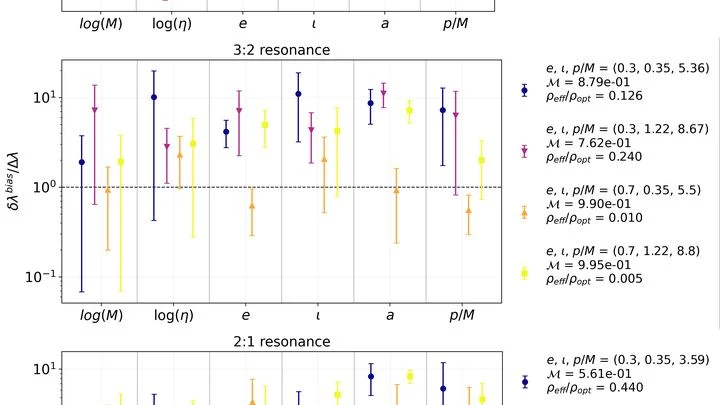
In absolute silence, you need to hear a feather drop. But someone keeps rustling a plastic bag. For the space-based LISA observatory, that 'rustling' will come from charged particles in space.
Trying to count people in a dark room by the sound of their breathing hits a wall of background noise — individual breaths are inaudible. Scientists working with quantum spins in solids face a similar challenge. Each spin (the electron's magnetic moment) has its own "voice," but it is drowned out by the technical noise of the instruments.
If you check where an electron is every second, its quantum properties change. It's like a child playing hide-and-seek but constantly being called by name: they freeze and stop running. In the particle world, such a "caller" is a measurement. It prevents particles from freely forming a shared quantum state, or entanglement.
A figure skater glides across the ice, gradually moving toward the center. Their trajectory isn't a perfect spiral: sometimes they catch the rhythm of the music and add an extra turn, slightly changing their speed. That's roughly how a small black hole behaves when it falls into a supermassive one.
The quantum world is like an orchestra where each musician, a particle, plays their part, and together they create a harmonious symphony. But as soon as noise, random clicks and interference, enters the hall, the melody starts to drift.
A semiconductor film one atom thick is like a tightly stretched membrane. Light makes it flash: luminous points (excitons) are born, which quickly fade. Where the membrane is torn or crumpled, the glow flickers and stutters, like a string with a knot sounding off-key.
Run a current through a contact between a superconductor and a ferromagnet, and you will hear the whisper of the quantum world. In the lab at 0.3 K, that whisper turned into a roar: the shot noise—electrical noise due to the discreteness of charge—was a hundred times louder than theory allows for ordinary contacts.