Lightning over the Horizon: The Collapse of Semiclassical Gravity in Black Hole Evaporation ✦
Original: "Breakdown of Semiclassical Gravity in Four-Dimensional Black Hole Evaporation"
Numerical simulation of black hole evaporation has revealed for the first time a catastrophic spacelike singularity — a thunderbolt — that refutes semiclassical gravity on macroscopic scales.
Links in the knowledge graph 1
The black hole evaporates, and with it, confidence in the semiclassical picture vanishes. The simulation uncovered an unexpected finale: a thunderbolt — a spacetime lightning — pierces reality where it was least expected. Semiclassical gravity predicted its own collapse. This demands a completely new approach to quantum gravity and forces a reexamination of the nature of information.
🎯 Hawking and Stewart called this phenomenon a "thunderbolt" in 1993, but considered it a mathematical curiosity. Four-dimensional modeling with quantum corrections turned the curiosity into an inevitability, showing that even the term's creator underestimated its reality.
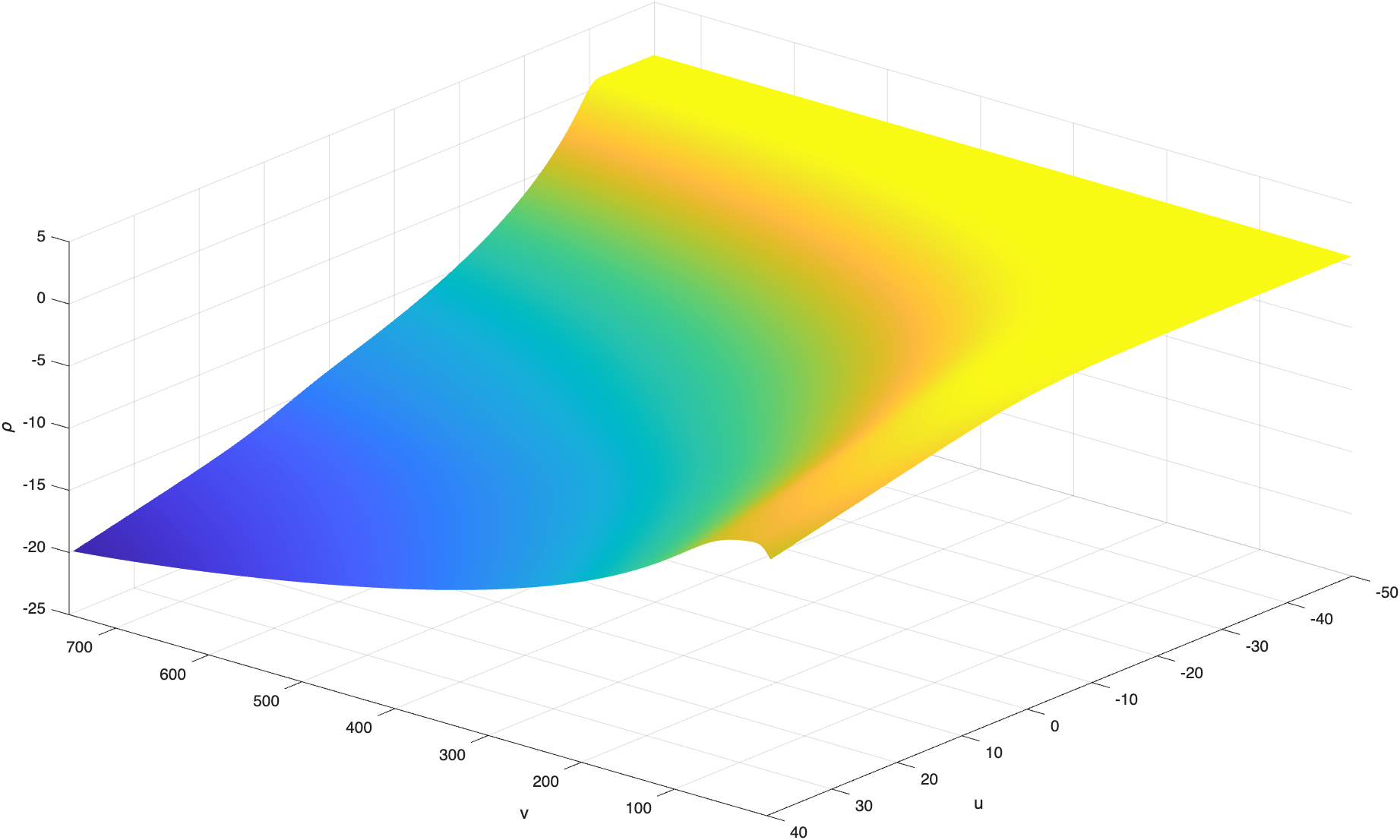
ds^2 = -e^{2\rho} du dv + r^2 d\Omega^2
Spacetime geometry: u and v are retarded and advanced time, r is the radial coordinate determining the area of the 2-sphere.
K = R_{\mu\nu\lambda\rho} R^{\mu\nu\lambda\rho}
Invariant measure of curvature: sum of squares of all components of the Riemann tensor; shows how strongly spacetime is curved at each point.
Scientists
Christian DopplerD. B. McLaughlinDidier QuelozMichel MayorR. A. RossiterNiels Bohrblack hole
spacetime curvature
Quantum Field
numerical simulation
entropy
quantum information
Time dilation
redshift
uncertainty principle
speed of lightLaws
second law of thermodynamicsDoppler effectHeisenberg uncertainty principleHawking radiationgravitational lensingprinciple of constancy of the speed of light