Curved Cosmos: The Secret Life of the Local Universe ✦
Original: "Backreaction and the Role of Spatial Curvature in the Cosmic Neighborhood"
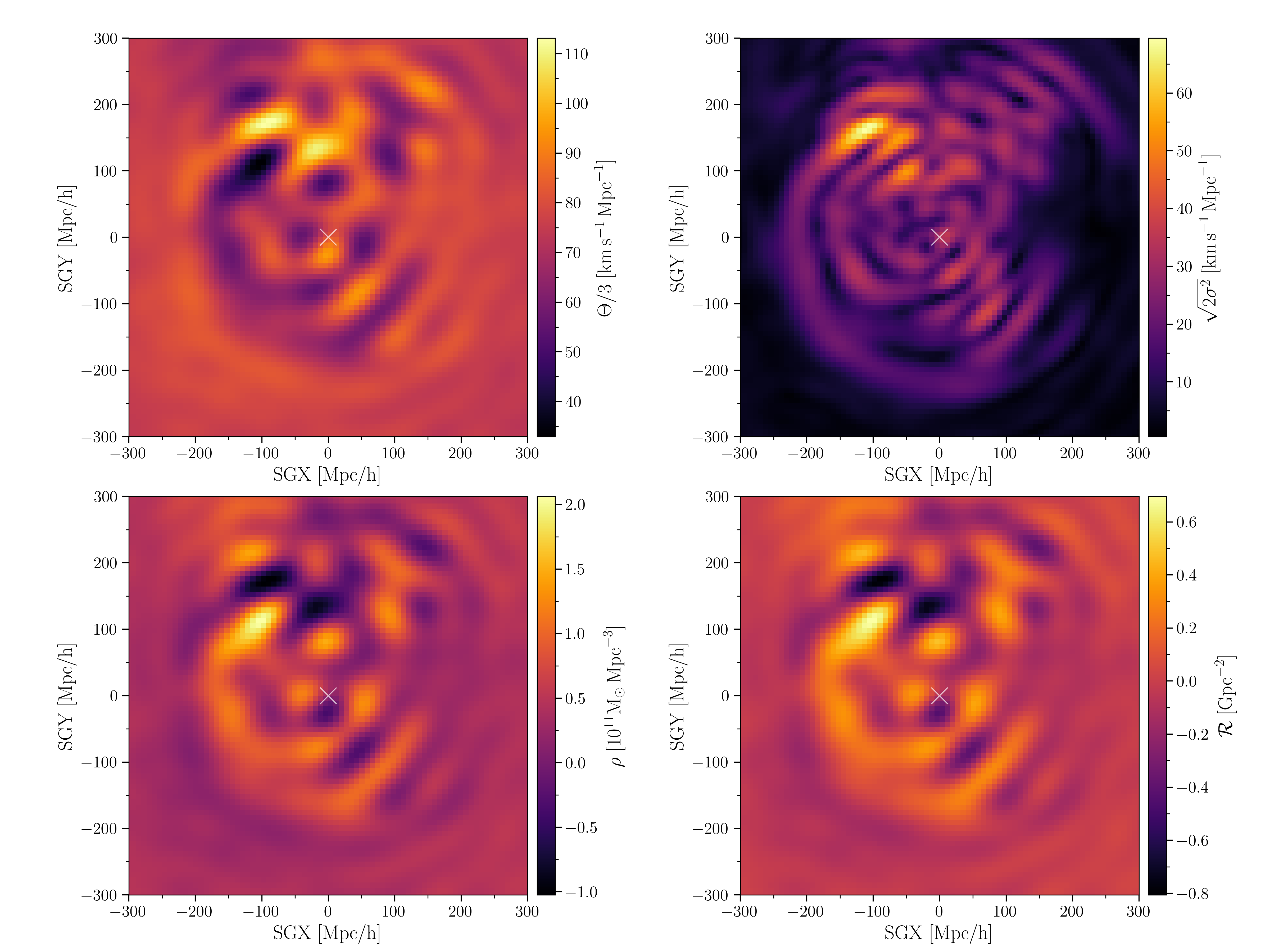
For the first time, measured curvature of space around the Milky Way reaches 10% of the local energy budget, refusing to converge to the standard model.
Links in the knowledge graph 1
Our galactic neighborhood is a cosmic matryoshka of voids and superclusters. We’re inside a bubble where space is curved outward, enveloped by a dense shell, and then emptiness again. This curvature eats up 10% of the local energy, ignoring the global model. What if the enigmatic dark energy is partly composed of such warped layers accrued over eons?
🎯 The space around us isn’t just curved—it resembles a landscape with hills and hollows. Inside the local void, it’s "bent" outward, accelerating the expansion, while in the shell of superclusters, it’s "dented," slowing galaxies down.
\Omega_M^{\mathcal{D}} + \Omega_\Lambda^{\mathcal{D}} + \Omega_R^{\mathcal{D}} + \Omega_Q^{\mathcal{D}} = 1
Local budget: matter + dark energy + curvature + backreaction = 1. No more, no less—a conservation law for curved space.
\mathcal{R} = 2\Lambda + 16\pi G \varrho + \Theta^i_j \Theta^j_i - \Theta^2
The link between curvature, matter, and motion: the density of galaxies and their velocity map directly sculpt the landscape of spacetime.
Scientists
Alan GuthAndrei LindeGeorges LemaîtreJames PeeblesAdam RiessBrian Schmidtspacetime curvature
expansion of the universe
dark matter
dark energy
galaxy
galaxy cluster
redshift
numerical simulation
Standard Model
gravity
cosmic microwave backgroundLaws
Friedmann equationsHubble's lawgravitational lensingNoether's theoremPlanck's lawequivalence principle