Curved Cosmos: The Secret Life of the Local Universe ✛ ✦
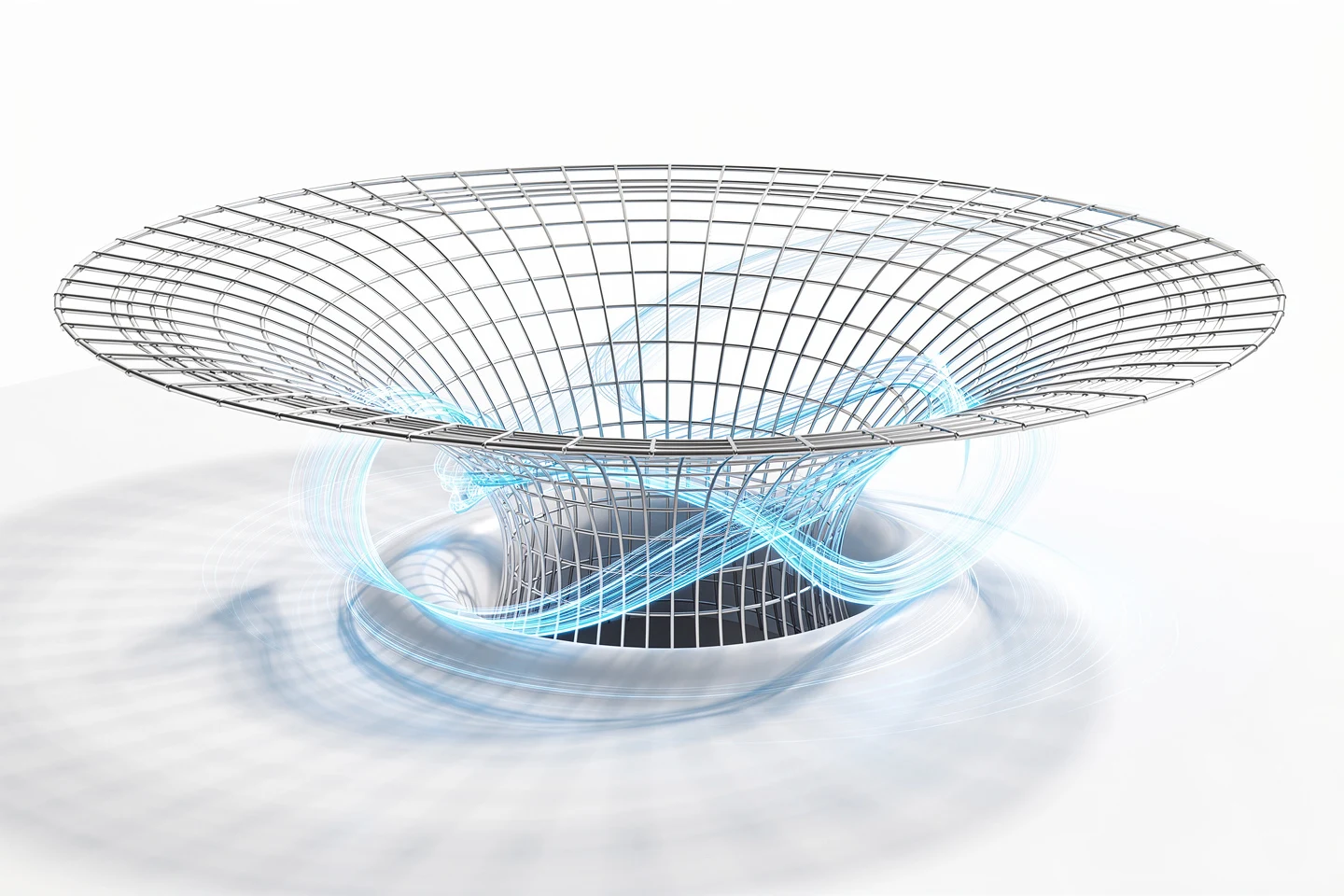
The universe abhors monotony. A century ago, Edwin Hubble and Georges Lemaître gave us an elegant picture: an expanding cosmos, smooth as the surface of an inflated balloon. Today, the velocity maps of galaxies from Cosmicflows-4++ shatter this illusion: our galactic neighborhood is an intricate matryoshka doll of voids and superclusters, where each layer curves spacetime in its own way. We dwell in a bubble of negative curvature, wrapped in a shell of dense clusters with positive curvature, and farther out, beyond hundreds of millions of light-years, a rarefied abyss yawns again. This is no mere pattern — geometry dictates how time flows and galaxy clusters drift apart.
Armed with the Cosmicflows-4++ reconstruction, which weaves together redshifts and peculiar velocities of thousands of galaxies, scientists applied a covariant scheme of general relativity for the first time. The result: the average spatial curvature Ω_R contributes nearly 10% to the local energy budget, as much as dark matter, whose invisible hand was first discerned by Vera Rubin. Meanwhile, kinematic backreaction, meant to channel the energy of inhomogeneities into global expansion, barely reaches 1%—as if an architect assembled these voids and clusters into a filigree structure without disturbing the pristine backdrop of the outward rush.
This picture challenges the standard ΛCDM model. Global parameters forged from relic radiation don’t work here: the density of matter and dark energy fluctuate, and the total budget within a sphere of radius 300 Mpc/h never converges to flat geometry. Cosmographic rulers (standard candles, baryon acoustic oscillations) may suffer systematic errors if local curvature is not subtracted. Moreover, a daring question ripens: could mysterious dark energy be hiding in stubborn backreaction, accumulated over billions of years? So far, its kinematic part is small, but nonlinear effects still lurk in the wings. The next acts (nonlinear modeling and fresh data from DESI, 4MOST) promise to turn the cosmic matryoshka into a precise topographic map of our gravitational cradle.
The space around us isn’t just curved: it resembles a landscape with hills and hollows. Inside the local void, it’s "bent" outward, accelerating the expansion, while in the shell of superclusters, it’s "dented," slowing galaxies down.