Warped Cosmos: The Secret Life of the Local Universe ✛ ✦
Context
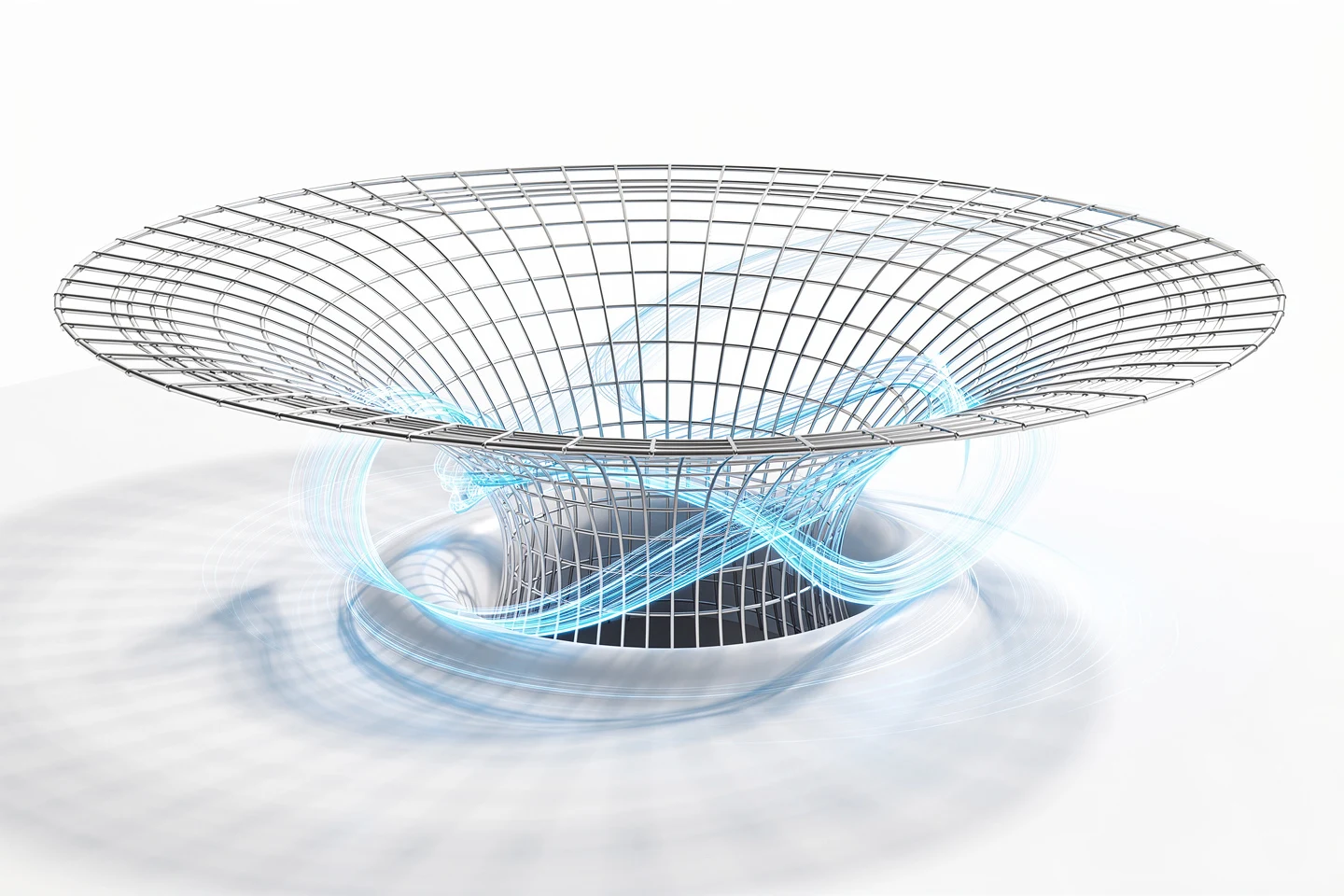
Modern cosmology rests on the idea that the expansion of the Universe is homogeneous and isotropic on large scales. However, the local distribution of matter, resembling a cosmic web of galaxies and clusters, can disrupt this idyll. Georges Lemaître and Edwin Hubble laid the foundations, but only now, with detailed velocity field reconstructions, can we measure how inhomogeneities affect local dynamics through gravity and spacetime curvature. Whether small-scale ripples accumulate into global effects is known as the backreaction problem, and the answer could change our understanding of dark energy.
Methods
The researchers used the latest Cosmicflows-4++ reconstruction—a three-dimensional map of the local Universe built from redshift data and peculiar velocities of thousands of galaxies using numerical simulations. By applying a covariant averaging scheme for scalars in general relativity (Buchert's formalism), they computed the average density, expansion rate, and scalar spatial curvature within spherical domains. A key insight was the algebraic correspondence between the Newtonian and Einsteinian pictures, which allowed interpreting the effective 'Newtonian curvature,' calculated from density and flow kinematics, as genuine curvature in general relativity.
Results
It turned out that the contribution of the averaged spatial curvature ΩR consistently stays around 10% on all scales studied—from 30 to 300 Mpc/h. Moreover, the sign of the curvature changes: in the immediate vicinity (up to ~50 Mpc/h) space has negative curvature, corresponding to a local void; then (50–200 Mpc/h) it becomes positive, outlining a giant shell of superclusters; and again negative at larger distances, pointing to a vast emptiness surrounding the local cosmic web. In contrast, the kinematic backreaction ΩQ does not exceed 1% even at the smallest radii. Remarkably, the total energy budget within a 300 Mpc/h volume never approached the global ΛCDM model values: matter density ΩM and the ΩΛ parameter fluctuate noticeably, and the cosmic microwave background only sets distant boundary conditions.
Implications
These findings mean that the local Universe is still far from statistical homogeneity, and using global cosmological parameters derived from the cosmic microwave background could systematically bias data analysis in the nearby cosmos. The averaged curvature acts as the main carrier of information about the backreaction history accumulated over billions of years, and its contribution to dynamics does not vanish with increasing scale. Consequently, precise cosmographic tests, including standard candles, must account for regional variations in curvature and expansion.
Future development
In the future, with new peculiar velocity surveys (DESI, 4MOST) and the development of relativistic Lagrangian reconstruction methods, we will be able to map the scale dependence of ΩR more accurately and possibly go beyond linear approximations. This will not only refine the boundaries of local inhomogeneity but also test alternative cosmological scenarios where dark energy is partially or fully replaced by backreaction effects.
Impact
The results will impact observational cosmology (standard candles, baryon acoustic oscillations), the interpretation of low-multipole CMB data, and numerical simulations of large-scale structure.
Next steps
Immediate next steps include applying nonlinear reconstructions in the Lagrangian formulation and analyzing data from new spectroscopic surveys to test the robustness of the observed pattern.
Key open problems
This work directly ties into the unsolved problem of dark energy: if backreaction and curvature can explain the accelerated expansion on local scales, it would reduce the need for a cosmological constant. It also raises the question of the correct averaging procedure in general relativity.
The knowledge machine's view
This section is addressed to the author of the paper and their colleagues. Neighbouring works were found by meaning-based search across our archive, not by word overlap. We do not review: we show the field around the work.
What the work does
The study applies the Buchert covariant averaging formalism to the Cosmicflows-4++ reconstruction to compute local mean density, expansion rate, and scalar curvature. It shows that the curvature contribution is stable (~10%) on scales of 30–300 Mpc/h, while the kinematic backreaction is negligible.
Where its strength is
The strength of the work lies in directly computing the averaged spatial curvature from peculiar velocity data, which provides a concrete local correction to the global model and reveals the structure of voids and superclusters.
Where it could go next
- It might be interesting to compare the obtained local parameter values with constraints from topological analyses of the large-scale structure: in our archive, there is a nearby work that searches for signs of nontrivial global geometry via correlations in the galaxy distribution.based on: Topology of the Universe: Listening to the Cosmic Drum arXiv:2606.24886
- There is also a nearby work on the influence of the local void on the interpretation of cosmological data—perhaps your curvature calculation inside the bubble could help clarify how such an inhomogeneity distorts global conclusions.based on: Cosmic Mirage: How the Solar Bubble Is Reshaping the Map of the Universe arXiv:2607.07741
- The archive also contains a study where inhomogeneities are considered as a source of effective 'friction' affecting the expansion dynamics; your result of small kinematic backreaction but significant curvature might be of interest for comparison with their approach.based on: Cosmic Friction: How Disorder Fixes the Universe arXiv:2605.28797
Worth trying
- Test how accounting for the found local curvature changes the Hubble constant estimate from nearby supernovae.
- Compare the averaged curvature profile with predictions from numerical simulations of the local Universe under different cosmological parameters.
- Use the obtained curvature map to correct baryon acoustic oscillation measurements in the local volume.
Why this may matter
If local deviations from the mean geometry indeed reach 10%, this could systematically affect the accuracy of cosmological tests that rely on local objects, and it must be accounted for in future surveys.
Nearby works in our archive
- The Universe Refuses to Agree on the Numberssimilarity 0.65
- The Universe Checks Its Own Honestysimilarity 0.64
- The Breathing Universesimilarity 0.64
- How to Weigh the Universe Without a Scalesimilarity 0.64
- Topology of the Universe: Listening to the Cosmic Drumsimilarity 0.64
- Cosmic Mirage: How the Solar Bubble Is Reshaping the Map of the Universesimilarity 0.64
- Cosmic Friction: How Disorder Fixes the Universesimilarity 0.63
The closest work in the archive sits at 0.65 by meaning — the usual level for our corpus.
Original abstract
as written by the authors arXiv:2605.05454v1
We present the first direct computation of spatially averaged dynamical quantities in the local Universe, employing the Cosmicflows-4++ reconstruction and a covariant scalar averaging formalism. We extract the domain-averaged density, expansion rate, spatial curvature, and kinematical backreaction over cosmologically relevant domains around our Galaxy, extending up to a comoving radius of $$300~\mathrm{Mpc}/h$$. The resulting domain-averaged present-day energy budget features nontrivial variations with scale that reflect a nested structure within the cosmic neighborhood, including a large-scale void shell encompassing the local cosmic web. Remarkably, we find significant contributions to this energy budget from the average spatial curvature at the $$\mathcal{O}(10\%)$$ level on all probed scales. By contrast, the kinematical backreaction remains much smaller throughout the surveyed volume, reaching at most a $$\mathcal{O}(1\%)$$ contribution on the smallest scales considered, i.e., $$30~\mathrm{Mpc}/h$$. Convergence to the global $$\Lambda$$CDM background is not observed within this range of scales.
It's like a cosmic nesting doll: we live in a local bubble nested within a supercluster, which in turn is embedded in an even larger void stretching hundreds of megaparsecs.
Key numbers
- contribution of average curvature Ω_R: ≈ 10% on all scales (30–300 Mpc/h)
- maximum contribution of kinematic backreaction Ω_Q: ≈ 1% at 30 Mpc/h
- radius of outer void: > 200 Mpc/h
- reconstruction resolution: ≈ 8 Mpc/h
- data redshift: z ~ 0.1 (approximately 300 Mpc/h)