When Gravity Knits Quantum Lace: Lessons from the Schrödinger–Newton Model ✦
Original: "Entanglement generation in a two-body Schrödinger--Newton model"
New research reveals: direct gravitational attraction entangles particles, but self-interaction does not — much like a dance creates an invisible bond, while a gaze into the mirror leaves each with only their own reflection.
Links in the knowledge graph 1
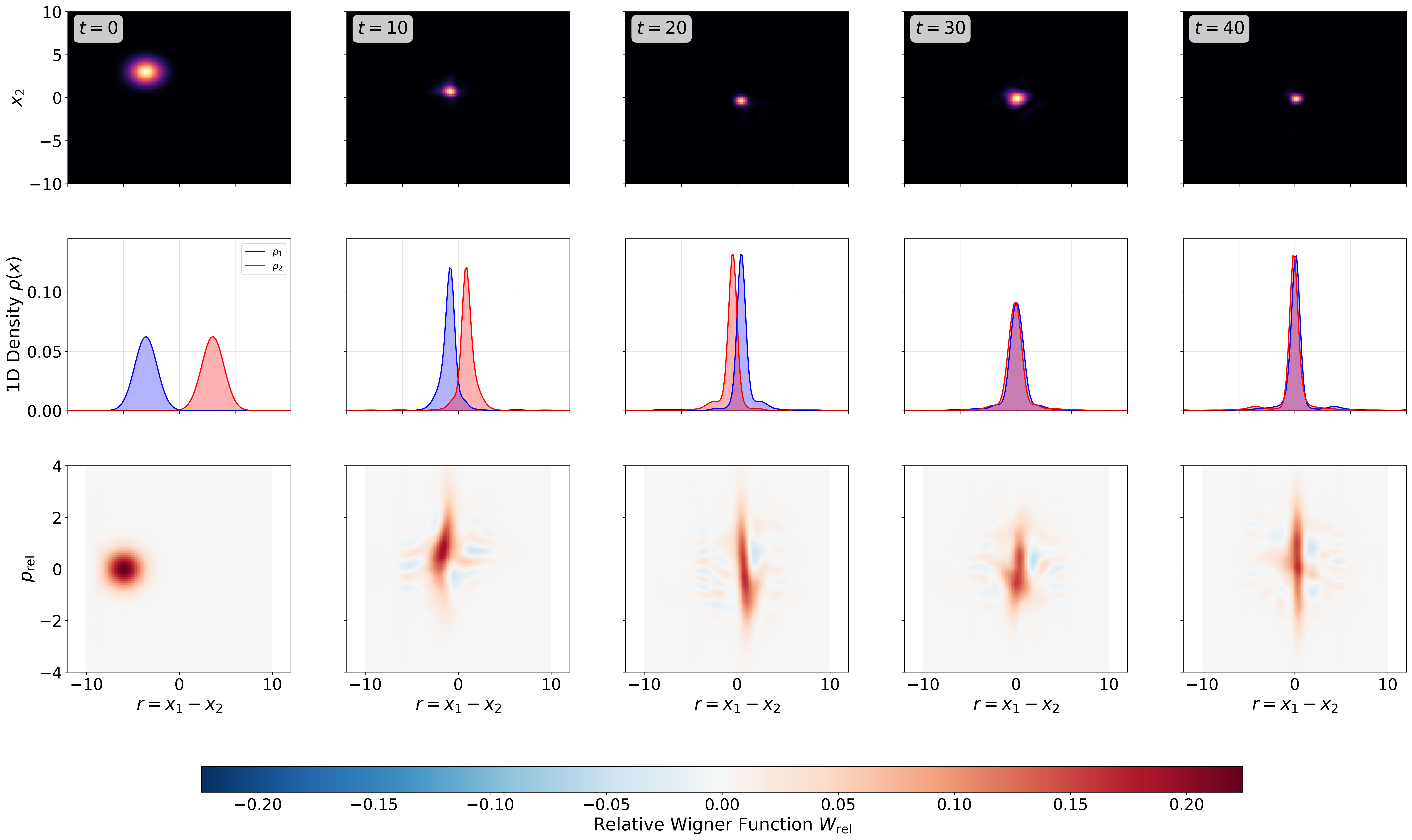
Stationary solitons hardly entangle — they are like frozen figures. Dispersing packets, however, gravitationally weave into a single pattern, like dancers improvising in step. It all comes down to the nature of the motion. Future experiments will test whether the quantum stage is born from the very fabric of spacetime.
🎯 The Schrödinger–Newton equation was originally proposed as a mechanism for spontaneous wavefunction collapse: it was thought that above a certain mass, a superposition would 'collapse' under its own gravity. Today the same model is used to simulate dark matter halos made of Bose condensate.
i\hbar\partial_t\psi = \left[-\frac{\hbar^2}{2m}\nabla^2 - Gm^2\int\frac{|\psi(y)|^2}{|x-y|}d^3y\right]\psi
Nonlinear Schrödinger equation where the potential is created by the particle's own probability density.
S_{vN} = -\sum_k \lambda_k \ln \lambda_k
Measure of entanglement in a bipartite system, computed via the eigenvalues of the reduced density matrix.
Scientists
Erwin SchrödingerHugh Everett IIINiels BohrPascual JordanWerner HeisenbergStephen Hawkingquantum entanglement
gravity
superposition
Wave Function Collapse
numerical simulation
entropy
quantum information
quantum measurementLaws
second law of thermodynamicsSchrödinger equationHeisenberg uncertainty principleHawking radiationBekenstein-Hawking entropyBoltzmann distribution