Mini

Cosmic Instrument: Resonant Songs of Rotating Wormholes

Original: "Resonant transmission of scalar waves through rotating traversable wormhole"
arXiv:2605.09426v1 · 2026-05-10 · CC BY · ⏱ 1 min · General Relativity
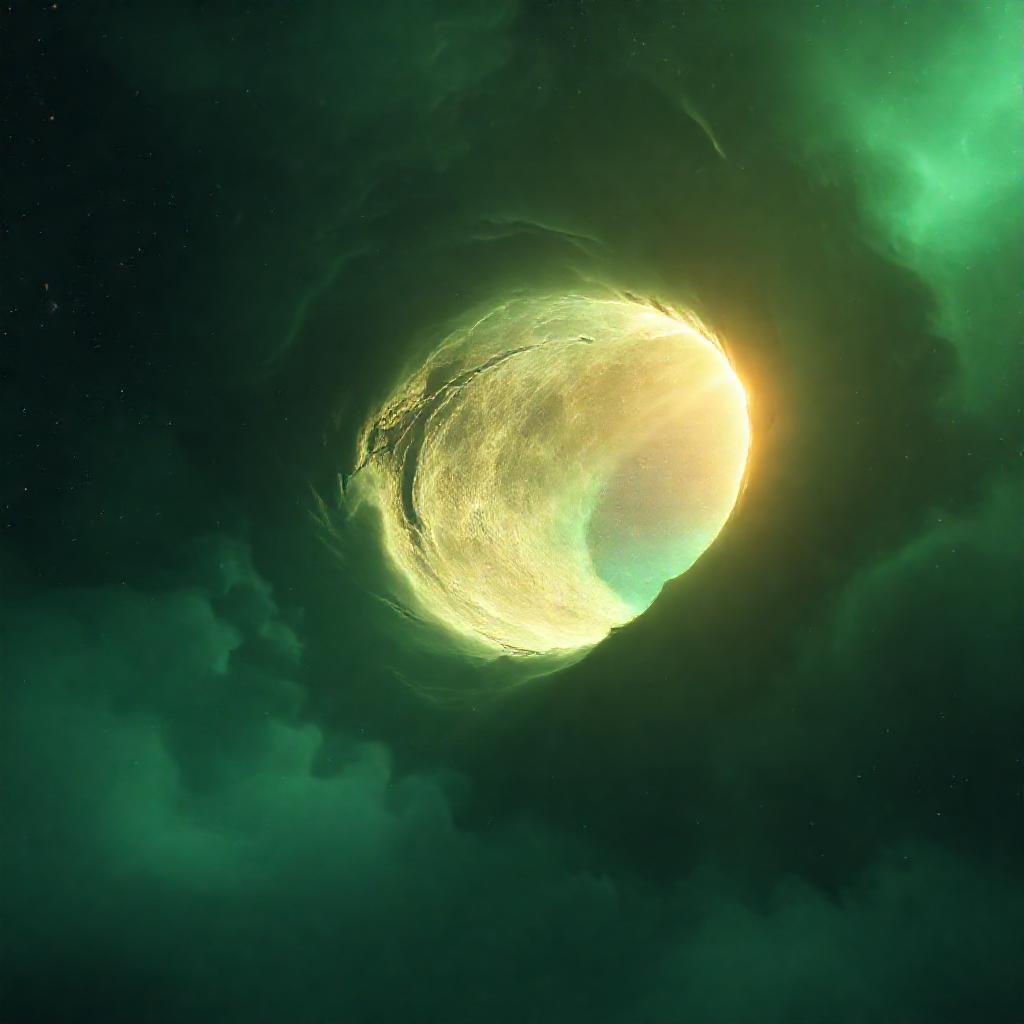
Rotation turns a wormhole into a tuning fork, tuned to selected frequencies: sharp resonant peaks appear in the spectrum of scalar waves — the music of a horizonless object.
Links in the knowledge graph 1

At the center of a galaxy lies not a silent black hole, but a sounding wormhole. Scalar waves resonate in its throat like a tuning fork. Pure tones are the spectral signature of a horizonless object. Telescopes will soon learn to read this score, and we will hear the music of secret passages.

🎯 The Breit-Wigner resonances found in the wormhole spectrum operate on the same principle as those used to discover new particles in colliders. A cosmic monster millions of kilometers across obeys the same resonance laws as subatomic systems — as if nature plays a single string from the microcosm to the megacosm.

🎬 A traversable wormhole became the core of Carl Sagan's "Contact" and the blockbuster "Interstellar." It seems we've found a way to tell a real tunnel from cinematic props without peeking inside.

\frac{d^2u}{dr_*^2} + \left(\omega^2 - V_{\text{eff}}(r)\right) u = 0
u — the wave profile, ω — its frequency, V_eff — the potential determined by rotation and throat shape, r_* — the tortoise coordinate stitching together both sides of the tunnel. Resonance occurs when V_eff creates a deep potential well trapping the wave — like an acoustic resonator.
Scientists
Alan GuthAndrei LindeGeorges LemaîtreJames PeeblesChristian DopplerD. B. McLaughlin
Tags
Wormhole black hole Accretion disk gravity spacetime curvature numerical simulation spectroscopy dark energy redshift JWST
Laws
Friedmann equationsDoppler effectHawking radiationgravitational lensingBekenstein-Hawking entropyEinstein field equations
Original: arXiv:2605.09426v1 · CC BY · bridge42worlds