Cosmic Instrument: Resonant Songs of Rotating Wormholes ✛ ✎ ✦
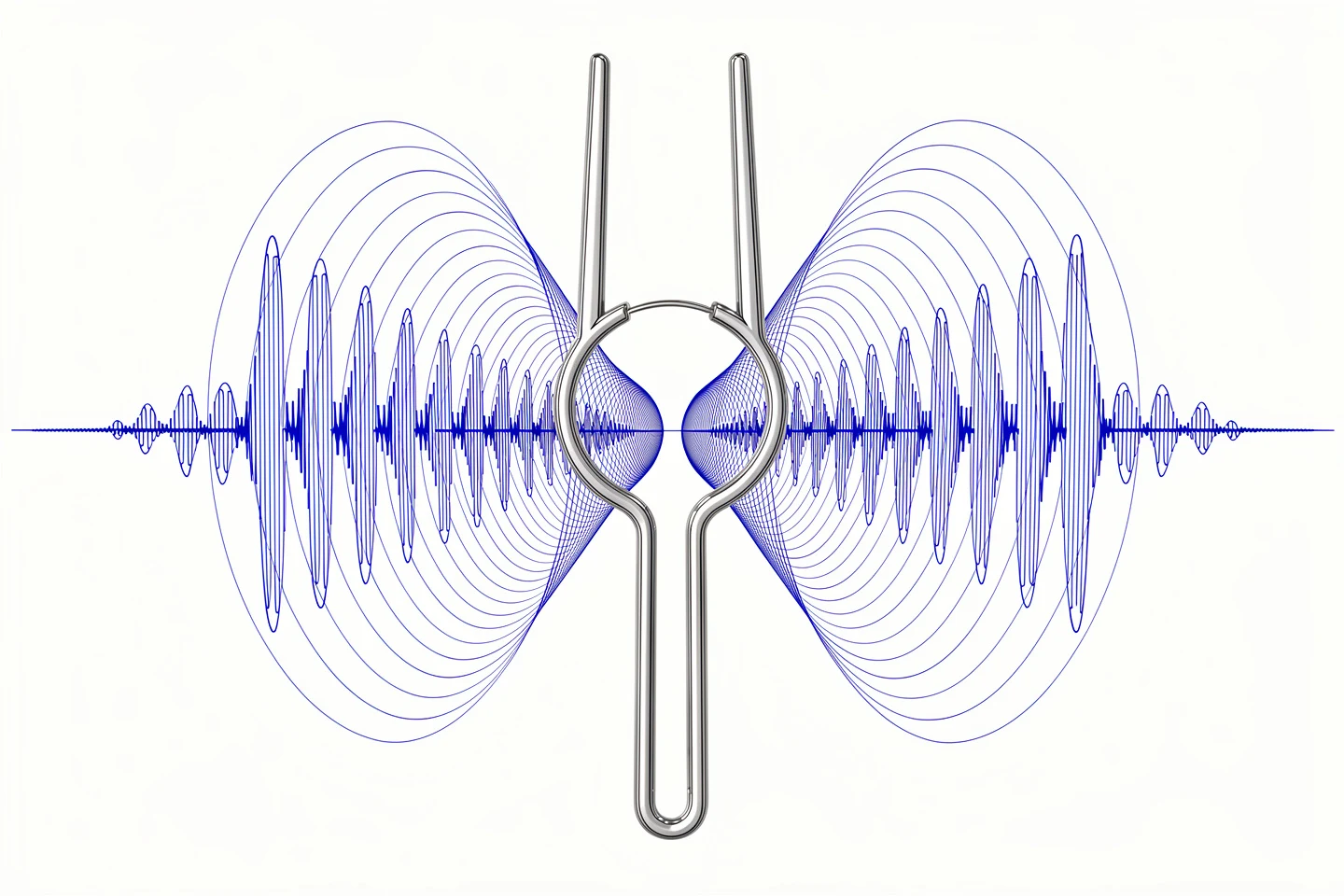
Einstein and Rosen imagined a bridge connecting two sheets of reality. Wheeler gave it a name — wormhole, and Thorne with Morris proved: the tunnel is traversable if you fill it with exotic matter. Today we know: rotation, an almost mandatory attribute of compact objects, turns a wormhole into a cosmic instrument. Not only a hypothetical traveler passes through its throat, but also a scalar field wave — and it sounds.
The secret lies in the effective potential, a gravitational landscape that the wave feels on approach. For a static wormhole, there's only a gentle slope, and resonances are barely noticeable. But rotation digs a deep well with steep walls. Counter-rotating modes (with azimuthal number m < 0) get trapped in this well, accumulating energy and erupting in sharp peaks. For spin a=0.7, mode l=1, m=-1 peaks at frequency ωM ≈ 0.22, while the co-rotating one peaks at ωM ≈ 0.54. This is not chaos, but pure tones, and their pitch directly depends on spacetime geometry — on the curvature of the throat and the gravitational redshift induced by rotation.
The astrophysical prospect is mesmerizing. If the center of a galaxy hides not a black hole but a rotating wormhole, its accretion disk lacks an inner cutoff. The radiation of infalling matter is modulated by resonant frequencies. Spectroscopy in X-rays, radio, and gravitational waves will allow us to "hear" these notes. The Event Horizon Telescope is already drawing shadows, JWST peers into the infrared twilight of galactic nuclei — and for the first time, we can directly test an idea recently considered a mere theorist's toy. Even the mystery of dark energy could be tied to the exotic matter holding the throat open.
Thus numerical simulation extracts a melody from the Klein-Gordon equations. Now observers must tune their instruments to the right key — and hear the music of hidden passages. Curiously, the same resonances help discover new particles in colliders: the cosmic giant and the subatomic world sing in the same language.
The Breit-Wigner resonances found in the wormhole spectrum operate on the same principle as those used to discover new particles in colliders. A cosmic monster millions of kilometers across obeys the same resonance laws as subatomic systems — as if nature plays a single string from the microcosm to the megacosm.
A traversable wormhole became the core of Carl Sagan's "Contact" and the blockbuster "Interstellar." It seems we've found a way to tell a real tunnel from cinematic props without peeking inside.