How Nuclear Fragments Agree on Spinning express
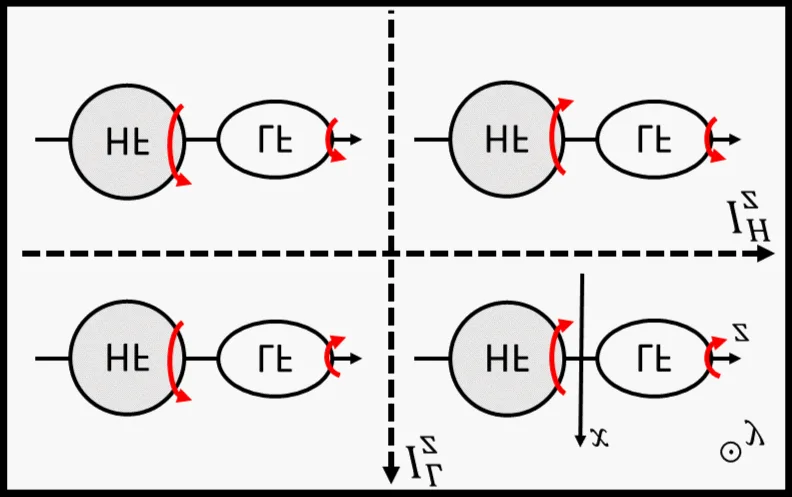
A heavy atomic nucleus of californium-252 can spontaneously split into two large fragments — much like a water droplet bursting apart. But inside such a droplet, quantum laws are at play, and each fragment acquires its own rotation — a spin. Physicists have long suspected that fragment spins are not random but are linked to each other, like dance partners who must move in sync.
In the new study, the researchers calculated how exactly the nucleus's shape at the moment of scission affects this dance. If the nucleus remains symmetric, like a perfect rugby ball, the fragment spins are tightly correlated: along the fission axis they rotate in opposite directions, like two gears meshing together, while perpendicular to the axis they can bend or wiggle with equal probability. But if the nucleus loses symmetry (say, becoming slightly flattened on one side) the rules change. Along the fission axis, the spin correlation weakens, but new, previously forbidden types of collective rotation emerge.
To measure the degree of correlation, the authors used mutual information analysis — a method that estimates how much knowing the spin of one fragment reduces the uncertainty of the other's spin. It turned out that correlations perpendicular to the fission axis are surprisingly robust to symmetry breaking, while those along the axis quickly fade away. This paves the way for understanding how quantum entanglement manifests in one of the most energetic processes in nature.
Original abstract
as written by the authors arXiv:2605.24466
Nuclear time-dependent density functional theory is used to investigate spin generation and entanglement of fission fragments in spontaneous fission of $$^{252}$$Cf, incorporating both axial and non-axial deformations. Axially symmetric fission trajectories enforce strict constraints: counter rotation (twisting mode) along the fission axis and equiprobable bending/wriggling modes perpendicular to it. Non-axial modes broaden the distributions of fission fragment spin projection on the fission axis, and allow for axial (tilting) collective rotations, which are forbidden on axially symmetric trajectories. Mutual information analysis reveals that axial-symmetry breaking reduces spin-spin correlations along the fission axis of symmetric cases, while perpendicular correlations remain more resilient. The effect of triaxial degrees of freedom on the opening angle distribution between the spins of the fission fragments is analyzed.
The spin of a fission fragment can reach enormous values — up to 10-12 units of Planck's constant. For comparison, the spin of an electron is always 1/2, and so is the proton's. That means a nuclear fragment can spin dozens of times more intensely than elementary particles.
In Neal Stephenson's novel 'Anathem,' an alien civilization uses quantum entanglement of nuclear fragments for instantaneous communication across space — much like the spin correlations described here.