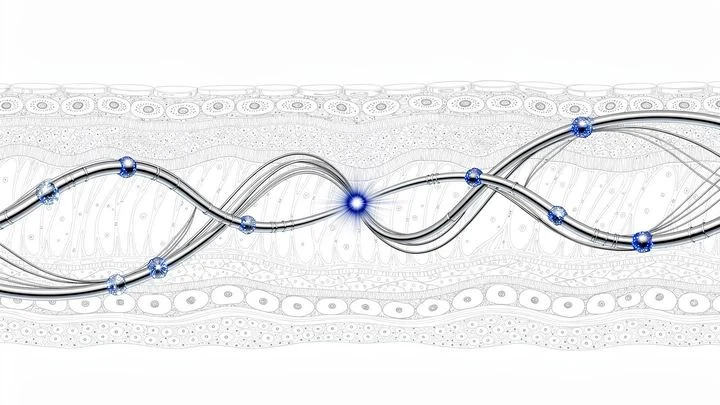
Quantum entanglement is a phenomenon where particles remain interconnected regardless of distance, as seen in quantum networks and energy teleportation.
15 related articles · 2 formulas · 6 who worked here
Imagine two twins who always dress alike, even if they are in different cities. If one puts on a red shirt, the other instantly puts on a blue one, and vice versa. Quantum entanglement is like such an invisible bond between particles: if one particle changes its state, the other changes immediately, no matter how far apart they are. This is not information transfer, but simply a surprising property of the quantum world.
History
In 1935, Albert Einstein, Boris Podolsky, and Nathan Rosen formulated a paradox pointing to the incompleteness of quantum mechanics. Erwin Schrödinger introduced the term 'entanglement' that same year and emphasized the fundamental importance of this phenomenon. In 1964, John Stewart Bell derived a theorem showing that any local hidden variables cannot reproduce all predictions of quantum mechanics; Bell's inequalities became a testable criterion. Experiments by Alain Aspect in 1981–1982, using polarized photons, for the first time unequivocally demonstrated the violation of Bell's inequalities and confirmed the non-locality of entangled states. Subsequent work by Zeilinger, Clauser, and others closed possible loopholes, strengthening the understanding of quantum non-locality.
How it works
Entanglement arises from particle interactions if their joint wave function does not factorize. The Schrödinger equation describes the unitary evolution of such a superposition, and measurement leads to collapse and instantaneouscorrelation of states — this is consistent with Heisenberg's uncertainty principle. Bell's inequalities mathematically constrain correlations for local realistic theories; their violation proves non-locality. Entanglement measures such as von Neumann entropyquantify it, and the no-communication theorem is consistent with the constant speed of light. Entanglement is a resource for quantum information science, but decoherence limits its application.
Fun fact
Entangled particles can be separated by an entire galaxy, yet they still 'feel' each other instantly. Einstein called this 'spooky action at a distance'. And what's more: quantum entanglement is used in quantum computers for ultra-fast calculations.
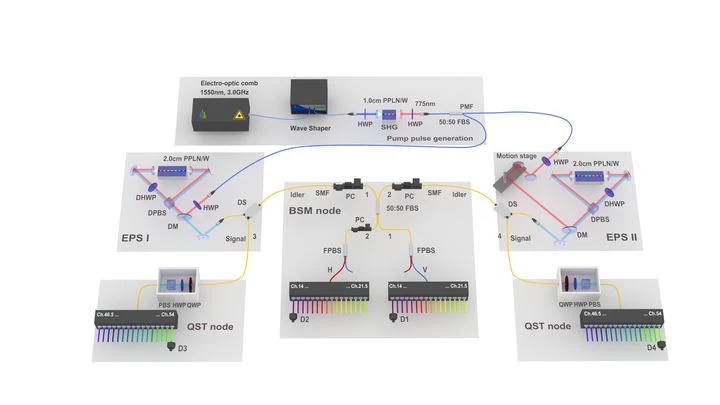
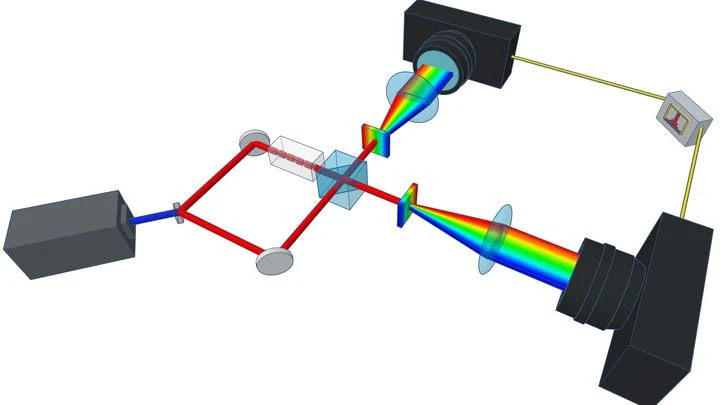
Quantum communication is like sending a secret letter that tears apart at any attempt to peek. So far, such a letter can only be sent along one road, and that's slow. Scientists have figured out how to send 16 couriers along 16 parallel roads, different frequencies of light, and verified that the letters arrive intact.
Quantum systems made of many particles are the basis of future computers and secure networks. But the more particles there are, the harder it is to understand how they are arranged: the number of possible states grows like an avalanche. The usual approach, measuring everything, takes an incredibly long time.
A quantum computer isn't just a bunch of qubits: it's a whole city, where each resident is one of the machine's possible states. Residents get to know each other through weak interactions between qubits: if one state can transition to another, a thread of acquaintance is drawn between them.
A handful of coins drops onto a table — heads and tails land wherever they please. The same goes for an instantaneous snapshot of a quantum chain: in some places a particle is present, in others it is not. But behind the disorder lurks a precise angle.
In this work, a chain of particles closed into a ring was considered. It was divided into four arcs: two were measured, two were left untouched.
When a heavy atomic nucleus splits into two fragments, an invisible quantum thread remains between them. This thread is entanglement: the state of one fragment is instantly linked to the state of the other, as if they were still a single whole. For the first time, physicists have precisely calculated how long and strong such a thread can be, tracing the fission process step by step.
When a heavy atomic nucleus splits into two fragments, an invisible quantum thread remains between them. This thread is entanglement: the state of one fragment is instantly linked to the state of the other, as if they were still a single whole. For the first time, physicists have precisely calculated how long and strong such a thread can be, tracing the fission process step by step.
An ordinary random network is like a road map: to connect four cities with a complex interchange, you need to lay down many highways. In the quantum world, things are different.
Two tiny diamonds float in a vacuum, separated by a distance that light cannot cross during the experiment. Inside each, like a frozen spark, resides an entangled spin — a quantum state linking them into a single whole. Now the diamonds begin to move, but not just any motion: each one seems to split, existing in two places at once.
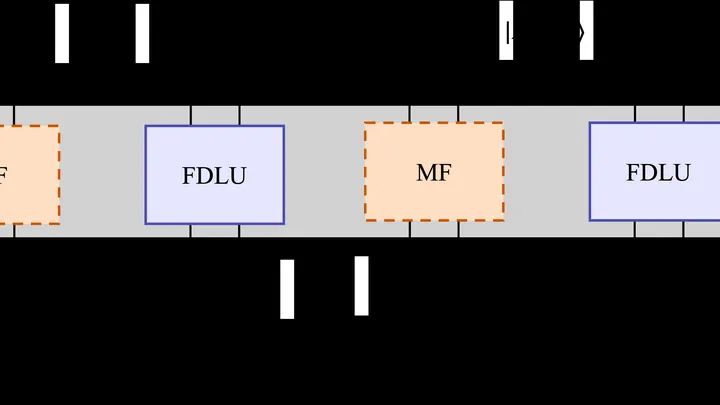
Imagine a huge puzzle where each piece is a quantum particle. To complete the picture, you don't just fit the pieces together: you need to entangle them in a special way. Usually, this is done by carefully applying operations one after another, like assembling the puzzle strictly by the instructions, row by row.
Coffee beans alone don't make a drink, but take two, and the cup fills. In the quantum world, there are similar states: from one copy, you can't extract pure entanglement, but from several, sometimes you can. For a long time, it wasn't known if such a thing existed at all.
Scientists took a family of states specifically designed as a testing ground for this question.
Two pebbles drop into water at a distance. The waves from them run toward each other and at certain spots they cancel out — the water becomes smooth, even though each stone alone would create ripples. Much the same happens with a pair of photons (light particles) born in a single crystal and flying off in different directions.
Quantum entanglement, when particles are linked so that the state of one instantly determines the state of another, is usually a fragile thing. Any disturbance, like heat, tears the connection apart. But what if the observer's own time is limited?
Hot water sometimes freezes faster than warm water: this odd fact is known as the Mpemba effect. Now something similar has been found in the quantum world: a state with weak entanglement (a special quantum connection between particles) can beat a more entangled one to the finish line.
A quantum particle moves in a circle, passing through several stations. At each station, something happens to it — for example, its properties change slightly. After completing a full circle, the particle returns, but its state is no longer exactly what it was at the start.
A camera looks at two distant sparks. They're so close together that they merge into a single fuzzy blob. It seems impossible to tell them apart — the classic limit of optical microscopy has been reached.
But quantum mechanics hints that the light field still holds a secret about where each spark sits.
In a tight row of atoms, spaced closer than the wavelength of light, a remarkable state hides. The excitation is distributed among all particles so that their radiation cancels itself out. This quantum 'silence' is an ideal vault for a photon: it can be stored there hundreds of times longer than usual.
The wind carries pollen, and each grain moves as if on its own. But once the air swirls into a vortex, the pollen trajectories can no longer be separated: they are tangled. This is roughly how electrons behave in a strange metal: their motion is so strongly coupled to soft fluctuations of the medium that the usual particle carriers disappear.
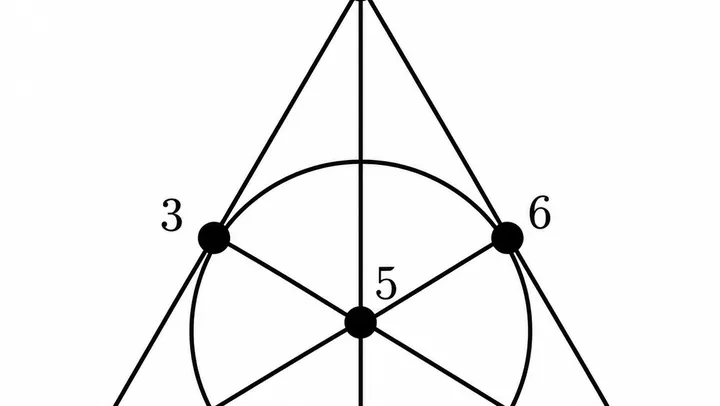
Seven dancers step onto the stage. They join hands so that any trio or quartet moves in perfect harmony with the rest — no group falls out of the overall rhythm. In the quantum world, this is called an absolutely maximally entangled state (AME for short). It's a perfect knot where every part knows everything about the whole.
Imagine a postal service where couriers suddenly stop moving. It would seem that letters would stop arriving and communication between cities would break down. But what if the envelopes themselves suddenly gained the ability to change shape and transmit messages through a shared web without moving an inch?
The quantum vacuum is not empty: it is permeated by entanglement linking distant regions. But when physicists tried to compute this entanglement, it turned out to be infinite. The culprit: particles with very low energy that can smear out over arbitrarily large volumes. They are like waves with no shores to contain them.
The quantum networks of the future resemble the Tower of Babel: each node speaks its own dialect. Some store information in the polarization of a photon — the direction of oscillation of the light wave. Others use time bins: that is, when exactly the pulse arrives.
A quantum chain is like a string of lights, where the bulbs are the spins of particles. Ideally, all bulbs glow in sync, following a common rhythm: that's symmetry. But if you cut off a piece of the string, the rhythm can get out of step: within that segment, symmetry is broken.
Physicists study a chain of strongly interacting particles (the XYZ model).
In the quiet of the quantum world, there is no emptiness. Particles are intertwined by invisible threads — entanglement. The authors of the work proposed that the very fabric of spacetime is woven from these threads. This is not just a metaphor: they built a mathematical framework where the distance between points is determined by how much shared information they hold.
An interpreter gets distracted by every rustle in the hall, and a one-hour meeting stretches into two. That's roughly how scientists have spent years searching for special states in tiny electrical chains: they watched the total current but missed how the signal was corrupted by noise.
The quantum world is full of strange connections. Two particles can become “entangled”: the state of one instantly affects the other, even if they are kilometers apart. But how do you know if they are truly entangled? It's like a ball of yarn: at first glance, you can't tell whether it's a single tangled ball or just a mess of loose threads.
Water turns to ice at zero degrees — sharply, with no intermediate states. Something similar happens to complexity when we take a random quantum state of an entire system and look only at a part of it. As long as that part occupies less than half the system, its complexity grows smoothly. But as soon as the fraction crosses 50%, a jump occurs.
Gravity in our world is curved spacetime. That's how Einstein's general theory of relativity describes it. But what happens to gravity at the level of atoms and particles, where quantum mechanics rules? This question has remained unanswered for nearly a century.
Three laser beams intertwine into a triangle. Each is linked to the other two: this is the structure of the new scheme that physicists call "fully connected three-mode squeezed vacuum." This is not just three independent light sources: inside a special crystal, triples of entangled photons are born, and the connection between them resembles a complete graph of…
A translator gets distracted by every rustle in the hall, and a one-hour meeting stretches into two. That's roughly how thermal noise disrupts quantum teleportation: the carrier particles lose synchronization, and the message gets corrupted.
Inflate a balloon, and the dots on its surface move apart from each other. Our universe expands in much the same way. The mathematical model of this process is called de Sitter space — where scientists study how the tiniest 'building blocks' of matter, elementary particles, behave.
But in a curved, constantly expanding space, the usual description of particles breaks down.
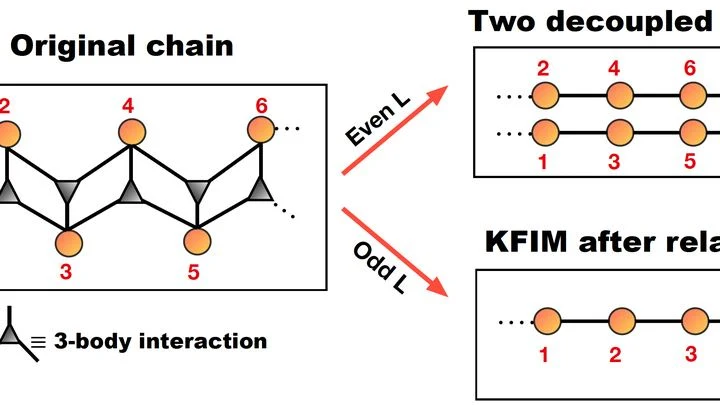
A chain of a hundred tiny magnets lies on a table. Each one can point up or down, like a coin landing heads or tails. But these are not ordinary magnets: they sense each other not just individually but in threes. Three neighboring particles seem to negotiate which way to turn. Once a second, the experimenter shakes the table, and the whole system gets a short kick.
Two photons meet at a half-silvered mirror. If they arrive at exactly the same time, they always leave together — side by side, like twins who refuse to be parted. This effect, discovered in 1987, became the basis of a quantum ruler for measuring tiny delays.
Each positron annihilation is like the birth of a pair of dancers, connected by an invisible thread of polarization. Two gamma quanta fly apart, but their states remain entangled: measuring one instantly determines the other — as if one partner senses every movement of the other, no matter the distance.
For a long time, identifying quantum phases was like interrogating a witness: you had to reach every corner of the system to uncover its secret. In the era of Landau, order was tied to symmetry breaking and a local parameter — everything plain as day.
Quantum devices are no longer lab curiosities. They are assembled, tuned, and repaired like ordinary hardware — except inside them, it's not just current but intricate tangles of particles that can exist in multiple states at once. Engineers draw schematics, programmers write code, physicists calculate effects.
The quantum world is often compared to a musical instrument. Each system, whether an atom or a chain of particles, sounds at its own frequencies, which physicists call energy levels. In chaotic systems, like an orchestra without a conductor, these frequencies usually fill the entire available range without gaps.
A quantum computer relies on two forces: entanglement (particles behaving as a single whole) and "magic"—a measure of how far a state is from familiar classical physics. But how these two resources relate as a many-particle system evolves in time has remained a puzzle.
The authors approached the problem through time.
In the world of two-dimensional materials, states sometimes emerge that are as extraordinary as they are fragile. One of them — the fractional anomalous Hall crystal (FAHC)—is like a quantum centaur: half ordered lattice, half topological liquid.
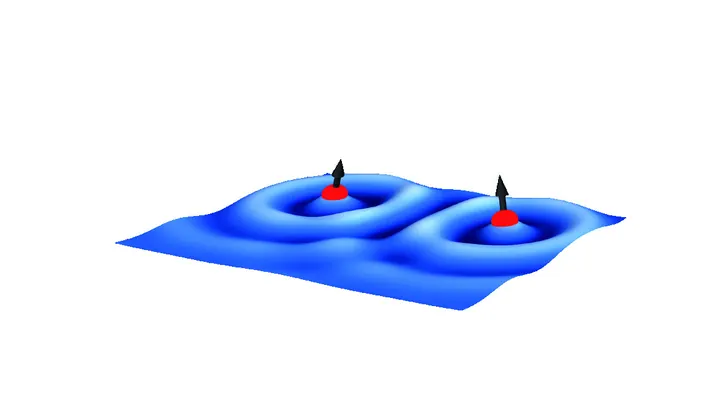
Quantum entanglement — a phenomenon where the states of two or more particles become interconnected regardless of the distance between them — usually links intrinsic properties such as spin or polarization. However, a new experiment has for the first time realized entanglement of the positions of two atoms in space.