A nuclear fragment is a piece of a nucleus produced when a heavy nucleus breaks apart in a collision. These fragments arise in high-energy nuclear reactions, such as those in particle accelerators or cosmic ray impacts. Studying them reveals details about nuclear structure, the strong force, and the behavior of matter under extreme conditions.
History
Nuclear fragmentation was first observed in the 1940s and 1950s with the advent of particle accelerators, and systematic studies began in the 1970s with dedicated heavy-ion facilities.
How it works
When a heavy nucleus collides with another nucleus or particle at high energy, it can undergo fragmentation — breaking into smaller nuclei and individual nucleons. The distribution of fragment masses and velocities depends on the collision energy and the properties of the original nucleus. Detectors measure these fragments to reconstruct the reaction dynamics and infer nuclear properties like binding energies and shell structure.
In practice
Nuclear fragments are relevant in hadron therapy for cancer treatment, where heavy ion beams fragment in the body, and in understanding cosmic ray interactions with spacecraft shielding.
Fun fact
Nuclear fragmentation is also a key process in the production of rare isotopes used in medical imaging, such as those for positron emission tomography (PET) scans.
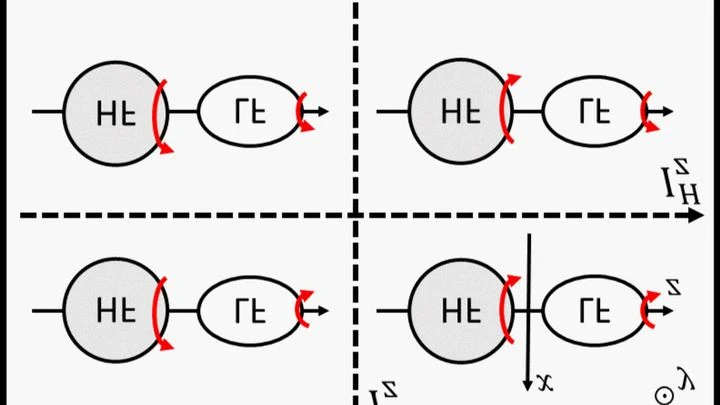
When a heavy atomic nucleus splits into two fragments, an invisible quantum thread remains between them. This thread is entanglement: the state of one fragment is instantly linked to the state of the other, as if they were still a single whole. For the first time, physicists have precisely calculated how long and strong such a thread can be, tracing the fission process step by step.
A speed of 7,5 kilometers per second is the threshold beyond which a cosmic collision turns dust grains into a chemical reactor. In the interstellar medium drift tiny cosmic dust grains — the legacy of dying stars.
A billiard ball clicks against another in complete darkness. The sound of the impact and the clatter of balls dropping into pockets: that's all you hear. This is roughly how physicists study the interactions of elementary particles at energies that no terrestrial accelerator can reproduce.
Atomic nuclei are rarely perfect spheres. More often, they resemble a slightly squashed ball — the electric charge inside is unevenly distributed, and protons may shift a bit, creating a tiny 'pear-shaped' bulge.
Hot tea in a freezer doesn't freeze all at once. First, tiny ice needles dart around — forming and melting until the temperature drops enough for the ice to set solid. The early universe behaved similarly as it cooled and changed its internal structure.
A heavy atomic nucleus of californium-252 can spontaneously split into two large fragments — much like a water droplet bursting apart. But inside such a droplet, quantum laws are at play, and each fragment acquires its own rotation — a spin.
If you toss a handful of coins into a box with dividers, each coin lands in its own compartment and stays there forever. Roughly the same happens to atoms in a special optical lattice when excited by a laser. These atoms are called Rydberg atoms: one electron in each is promoted to a very distant orbit, making the atom sensitive to its neighbors.
Neutrinos are almost elusive particles: they zip through planets without noticing atoms. So every catch is a stroke of luck. Recently, the underwater detector KM3NeT snagged a neutrino with energy millions of times greater than Earth's most powerful accelerators can produce.
When a heavy atomic nucleus splits, it doesn't break into even halves. First, two fragments form that look like pears pressed together at their narrow ends. Then the junction begins to smooth out, like two droplets merging and the surface quickly leveling.
In that brief moment, the surface moves inward, and particles inside the nucleus can bounce off it, like a ball off an oncoming wall.
An ordinary nuclear reactor is like a boiler where fuel burns evenly throughout the volume. Here the picture is different: a fission wave, a narrow zone where atoms split and release heat, slowly creeps along a cylindrical rod of uranium carbide. Ahead of the wave, the fuel is untouched; behind, it is already spent. So fire runs along a candle wick, leaving wax behind.
A dark matter detector is like a super-sensitive microphone listening for silence. It picks up tiny heat jolts, phonons, that occur when a particle grazes a crystal. But instead of silence, the instruments have been hearing noise for years: a slew of weak signals below a few hundred electronvolts.
In a metal crystal, atoms line up in neat rows like bricks in a wall. Knock out a single brick, and you're left with a void — what scientists call a vacancy. Under irradiation, these voids multiply and start merging into large holes, sapping the metal's strength. It's like holes in a brick wall joining up into a gaping breach.
Neutrinos are the most elusive of all known particles. Every second, trillions of neutrinos from the Sun fly through your body, but you never notice: they barely interact with matter. To catch even one, physicists build giant detectors — pools of water or liquid argon deep underground.
In the first moments after the Big Bang, space boiled. A superheated substance permeating the world gave rise to giant bubbles of a new phase – much like a liquid produces vapor. Collisions of these bubbles accelerated particles to energies unimaginable in Earthly accelerators.