Nuclearspin is the intrinsic angular momentum of an atomic nucleus, arising from the protons and neutrons that compose it. Even though the nucleus is tiny, this spin behaves like a miniature bar magnet, giving the nucleus a magnetic moment. This property is fundamental to many techniques that probe matter at the atomic scale, from medical imaging to quantum computing.
History
The concept of nuclearspin was proposed by Wolfgang Pauli in 1924 to explain hyperfine splitting in atomic spectra, and later measured experimentally by Otto Stern and Walther Gerlach.
How it works
Each proton and neutron has its own spin, and their combined quantum state yields the total nuclear spin. This spin can take discrete values, and when placed in an external magnetic field, the nucleus can occupy different energy levels. Transitions between these levels can be induced by radio-frequency pulses, which is the basis of nuclear magnetic resonance.
In practice
Nuclearspin is the foundation of MRI (magnetic resonance imaging) in medicine, as well as NMR spectroscopy in chemistry and physics for determining molecular structure.
Fun fact
The spin of a nucleus can be used as a quantum bit (qubit) in quantum computers, and some designs use the spin of a single phosphorus atom in silicon.
Earth's magnetic field is not constant: it trembles from the solar wind, from distant thunderstorms, and from the subway running nearby. To notice these tremors, you need an instrument that doesn't tremble itself. Physicists have built such an instrument from ytterbium atoms cooled to nearly absolute zero.
Two stars circle each other, gradually drawing closer. Their dance loses energy, and that energy escapes into space — in the form of gravitational waves, and sometimes other fields.
A carousel doesn't just spin you around in a circle — with each revolution, it also slightly screws itself into the ground. This corkscrew-like motion is the essence of the NUT charge, a special property of spacetime that physicists have been studying since the mid-20th century.
In June 2024, the CHIME radio telescope recorded over 700 radio bursts per hour from source FRB 20240114A. Such a hyperactive repeater releases in one hour nearly all the magnetic energy of a typical magnetar (a neutron star with an ultra-strong field).
In a world locked in a crystal lattice and cooled nearly to absolute zero, matter knows how to hide its deepest secrets. A quantum spin liquid is a state where electron spins never freeze, even at zero temperature, remaining in an eternally flickering superposition.
In 1905, Einstein showed that the chaotic motion of pollen in water results from the jostling of invisible molecules. A century later, physicists have learned not only to observe but also to control motion at the quantum level.
Trying to count people in a dark room by the sound of their breathing hits a wall of background noise — individual breaths are inaudible. Scientists working with quantum spins in solids face a similar challenge. Each spin (the electron's magnetic moment) has its own "voice," but it is drowned out by the technical noise of the instruments.
Atomic nuclei are rarely perfect spheres. More often, they resemble a slightly squashed ball — the electric charge inside is unevenly distributed, and protons may shift a bit, creating a tiny 'pear-shaped' bulge.
Two pebbles drop into water, and the ripples on the surface intersect, blending their patterns. Neutrinos behave much the same way: light particles that pierce us by the billions every second. They can transform from one type to another, like an actor changing masks. Physicists call this dance oscillations.
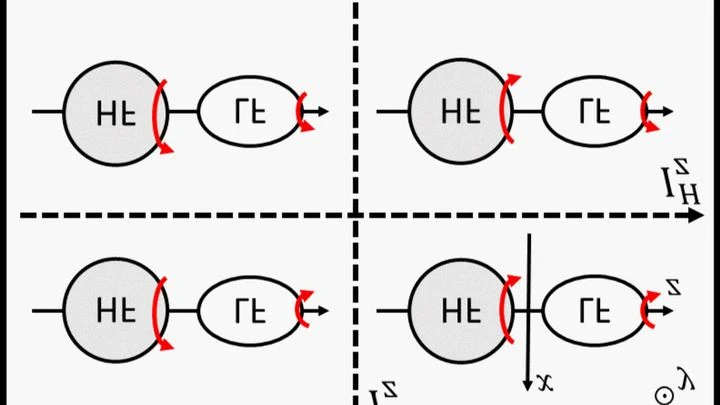
Two neutron stars whirl in their final dance. If their spin aligns with their orbital motion, the partners merge neatly, launching a narrow jet of superheated matter. If they spin in opposite directions, the dance breaks apart, scattering a thick shroud of debris.
A heavy atomic nucleus of californium-252 can spontaneously split into two large fragments — much like a water droplet bursting apart. But inside such a droplet, quantum laws are at play, and each fragment acquires its own rotation — a spin.
In a boron nitride crystal, the perfect atomic lattice is sometimes disrupted: an atom is missing here, or replaced by a foreign one there. Under a powerful microscope, these tiny imperfections appear as traps for electrons: they capture particles and start to emit light, and they also respond to magnetic fields.
In the orchestra of atoms, each instrument has its own score. But sometimes two musicians start playing in unison, and the sound amplifies many times over. In the quantum world, this 'harmony' is called a Feshbach resonance. It allows you to control atomic interactions with jeweler-like precision.
A spinning top whirls so fast it's about to fly apart. Add to it a super-strong magnet — one that, if placed on the Moon, would wipe data from every credit card on Earth. That's a magnetar: an ultra-dense remnant of an exploded star, a lump of matter where a teaspoon weighs as much as a mountain.
Tiny magnets inside atoms, nuclear spins, can 'freeze' for long minutes in a cold crystal. This hinders the quick tuning of quantum sensors: everything takes too long to reach the desired state. Physicists have found a way to nudge them with light.
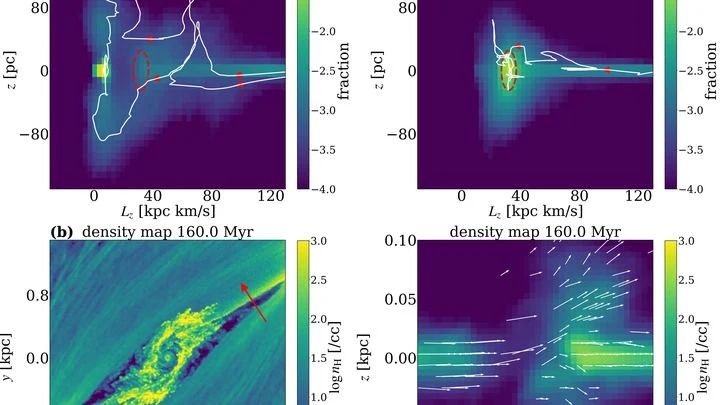
A river flows toward a whirlpool, but a dam with a notch blocks the way. Most water piles up before the dam, but some, gaining height, leaps over it and falls straight into the funnel. So it is with gas in a galaxy: it streams toward the center but hits a ring of stars and gas, like a dam. Usually, everything stops there, swirling into a dense vortex.
A neutron star is a spinning top with the mass of the Sun, crushed to the size of a city. It's born in the fire of a supernova and usually only slows its spin. But sometimes, for no apparent reason, it suddenly speeds up — such a jerk is called a glitch.
The atomic nucleus is not just a ball of protons and neutrons. Inside it, like a tiny magnet, there is its own distribution of magnetization. Until now, it has been difficult to see: nuclei live for tiny fractions of a second, and their magnetic field is weak. Now physicists at CERN have found a way to look inside.
The edge of a magnet works like a guitar fret: a string pressed near the edge sounds different, with a richer set of overtones. Magnetic waves in a thin strip of nickel and iron behave in much the same way.
The atomic nucleus isn't a frozen ball but a seething collective of protons and neutrons. They whirl, collide, and arrange themselves into patterns that physicists see as "bands"—ladders of energy levels. In niobium and technetium nuclei, four such ladders have been found, but the last one stubbornly refused to fit the calculations.
A chunk of nuclear fuel inside a reactor is not just a solid. When heated, the uranium atoms in it start to 'wiggle' their magnetic moments, and this motion changes thermal conductivity and other properties.
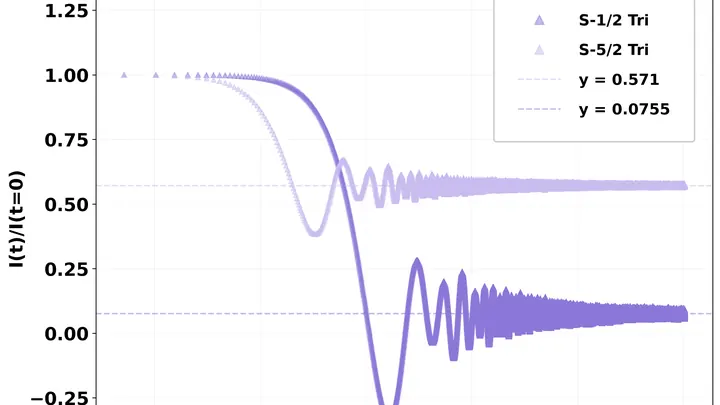
Scientists peered into a two-dimensional magnet made of nickel atoms arranged in triangles using a method created by Isidor Isaac Rabi — nuclear magnetic resonance (similar to MRI). Inside, they found magnetic arrows that, in a strong field, froze into an 'up-up-down' pattern, like a formation of soldiers: two steps forward, one step back.
A fridge magnet sticks because the tiny atomic arrows inside it are aligned in one direction. But quantum mechanics makes these arrows jitter, so the overall magnetization falls short of the ideal.
A bell doesn't ring with a single note — after being struck, it sounds with several harmonics at once. An atomic nucleus vibrates in much the same way: after a collision, it can oscillate, and these oscillations show up in the emitted gamma rays.
A magnetic compass in a test tube sounds like a magic trick, but it's pure physics. In a solution of fumarate (a salt of malic acid), carbon-13 nuclei behave like tiny spinning tops.
Inside a living cell, a tiny carbon spinning top whirls — a molecule billionths of a meter across. An ordinary top falls quickly, but this one behaves differently: it can spin in both directions at once, like a quantum coin perpetually frozen mid-fall. This superposition of motions is key to its strange selectivity.
A crowd of thirty-one quantum sensors whispers within a diamond slab. Previously, this whisper was drowned out by the roar of floodlights: the random photon bursts used to read out the spin states masked the ensemble's own quantum noise. Now physicists have learned to switch off the floodlights and listen to the crowd itself.
A century ago, quantum mechanics gave the world a neat picture: a particle rotating around a point can only have certain discrete amounts of angular momentum, integer multiples of Planck's constant. This rule seemed as solid as the law of gravity, and it followed from simple algebraic arguments.
Hidden within the bulk of a diamond are tiny flaws — places where a carbon atom is replaced by nitrogen, with a vacancy gaping nearby. These defects, like beacons, can store and transmit quantum information. But around them rages a magnetic storm: the nuclei of atoms in the crystal jostle, creating interference.