Spin is like a tiny top that every particle has, but it doesn't actually spin. It's just an intrinsic property, similar to rotation, but without motion.
History
The experimental discovery of spin is linked to the Stern–Gerlach experiment (1922), where a beam of silver atoms split into two components in an inhomogeneous magnetic field, contradicting classical physics. The theoretical explanation was given by George Uhlenbeck and Samuel Goudsmit in 1925, proposing an electron’s own momentum. Later, Pauli introduced spin matrices, and Dirac in 1928 naturally incorporated spin into the relativistic equation for the electron. Subsequently, the concept of spin became key for all quantum field theory and particle physics.
How it works
Spin is described by operators obeying the commutation relations [Ŝ_i, Ŝ_j] = iħ ε_{ijk} Ŝ_k. For spin-1/2 particles, the Pauli representation with matrices σ_x, σ_y, σ_z is often used. The Hamiltonian for interaction with a magnetic field: H = –μ·B, where the magnetic moment μ = g (e/2m) S. Quantum spin correlations (entanglement) are tested in Bell's inequalities, demonstrating the nonlocality of quantum mechanics. Spin is also responsible for the fine structure of spectra and plays a central role in spin electronics (spintronics).
Fun fact
An electron behaves as if it's spinning, but it really isn't – it's just its inherent property, like eye color.
A vacuum cleaner sucks in dust even if there is more of it near the nozzle. The same happens in a tokamak: plasma particles are drawn toward the center, even though their density is higher at the edge. This phenomenon is called particle pinch, and it contradicts the usual rule that everything tends to move from dense regions to sparse ones.
In some crystals, electrons are not spread uniformly but arrange themselves into a strict checkerboard: one cell has more electrons, the neighboring cell has fewer. Such a pattern is called charge order, and for a long time it was considered something frozen, like a pattern on frosty glass.
In nature's workshop, there is a strange lathe: it cuts threads on screws but forbids left-handed ones. You can tighten a screw as much as you like, in any clockwise direction, but counterclockwise is not allowed. This lathe is not a fantasy but an exact quantum rule that physicists have just built for magnetic materials.
The hanmilite crystal, resembling a layered cake of copper and boron, behaves like a ladder: the copper spins are arranged in two parallel rails connected by rungs.
The magnetic framework of the EuMnSb2 crystal resembles scaffolding: manganese atoms form rigid vertical pillars, while europium atoms act as movable crossbars. Until now, there was no consensus on the angle at which these crossbars rest and how they rotate when a magnetic field presses on the scaffold.
Earth's magnetic field is not constant: it trembles from the solar wind, from distant thunderstorms, and from the subway running nearby. To notice these tremors, you need an instrument that doesn't tremble itself. Physicists have built such an instrument from ytterbium atoms cooled to nearly absolute zero.
A magnetic vortex is like a tiny whirlpool in the sea, except that instead of water, it's magnetization that swirls. Such vortices could become memory cells in future computers, but to write and read information, you need to be able to move each vortex individually. So far, this is done crudely — shifting a whole bunch at once.
The crystal is like a city with different streets: on some, cars drive fast and far, on others, they crawl and get stuck. In the layered material CrPS₄, magnetic waves that carry spin (a particle's intrinsic angular momentum) behave the same way.
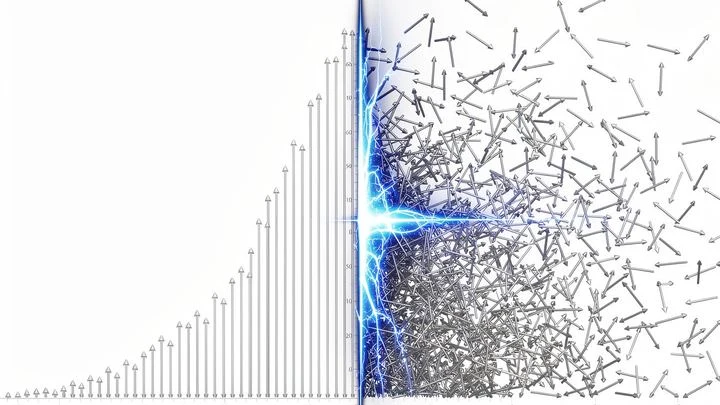
A magnet is slowly heated. At low temperatures, all its microscopic arrow-like spins point in the same direction: that's order. At high temperatures, they dart about chaotically. But there is a special point, the critical point, where order is just about to vanish and the system freezes in indecision.
In an ultracold cloud of atoms cooled to near absolute zero, regions with different spin orientations emerge, like patches with different magnetization. The boundaries between them are called domain walls. Usually they are stationary, but in this experiment the walls started moving on their own.
A lone erbium atom sits on a silver substrate, and its spin, the electron's internal rotation, stores quantum information. Previously, flipping this spin required a magnetic pulse: a blunt tool that disturbs neighbors and works slowly. Now physicists from Germany and Korea have shown that a single electric voltage suffices.
A stone thrown at a wall bounces off. In the quantum world, a particle can pass right through, as if the wall were woven from mist. This is quantum tunneling: it lights up stars, works in microchips, and even operates in the cells of our bodies. But most particles have spin — an intrinsic rotation, like a spinning top.
A laser beam is like a swift vortex that briefly captures a passing electron. As the particle moves through the pulse, its spin (the intrinsic rotation, like a tiny top) experiences a weak kick. After leaving the beam, the top no longer points in the same direction; it has turned a little.
Ultra-sensitive scales try to detect the difference between two nearly identical grains of sand. One is a perfect mirror reflection of the other. In the world of elementary particles, such mirror reflection is called P-parity, and its violation is one of the great mysteries of physics.
The PbCuTe₂O₆ crystal resembles a three-dimensional web of copper, tellurium, and oxygen. Inside, the magnetic moments, tiny arrows tied to electron spins, are so entangled that they can't settle into an orderly arrangement even near absolute zero.
When two heavy nuclei collide in an accelerator, a tiny fireball of quark-gluon plasma is born — a special state of matter where quarks and gluons are not confined inside particles. As it expands and cools, the emitted particles often come out "spinning"—their spins align along the beam direction.
A translator gets distracted by every rustle in the hall, and a one-hour meeting stretches into two. A single wrong intonation changes the meaning beyond recognition. That's roughly how a particle with spin 3/2—the gravitino — behaves. It cannot exist in isolation: its "speech" must be perfectly coordinated with its surroundings, or the whole structure falls apart.
Two stars circle each other, gradually drawing closer. Their dance loses energy, and that energy escapes into space — in the form of gravitational waves, and sometimes other fields.
Lossless current is the dream of energy technology. Some materials become superconductors, but usually only at extreme cold. Recently, in the family of nickelates, compounds based on nickel, candidates were found that work at higher temperatures.
A quantum wire is like a high-speed highway where electrons race in a dense stream. Each electron has its own rotation, spin, and until now it was thought that splitting this stream into two lanes, for 'left' and 'right' rotation, without losing quantum order was nearly impossible. You'd need either strong magnets or complex tricks that waste energy.
A cloud of cold atoms is trapped between two mirrors. Light is shone through it, and the atoms start to emit collectively: this effect is called superradiance. But the atoms don't just 'glow': their spins (internal magnetic arrows) interact with light in two distinct ways.
A quantum chain is like a string of lights, where the bulbs are the spins of particles. Ideally, all bulbs glow in sync, following a common rhythm: that's symmetry. But if you cut off a piece of the string, the rhythm can get out of step: within that segment, symmetry is broken.
Physicists study a chain of strongly interacting particles (the XYZ model).
Ordinary electric current heats up wires — anyone who has touched a phone charger knows that. But there's another kind of current: instead of electrons rushing in a crowd in one direction, they spin in sync, like figure skaters in a pairs routine. This coordinated rotation is called a spin current, and it produces almost no heat.
The ring was assembled from several different segments. In each segment, particles behave in their own way, like musicians playing different notes. The most interesting part begins at the junctions: here particles often get stuck, like an echo trapped in a narrow corridor. This phenomenon is called the skin effect — particles pile up at the boundary, like a crowd at an exit.
But the authors noticed something new.
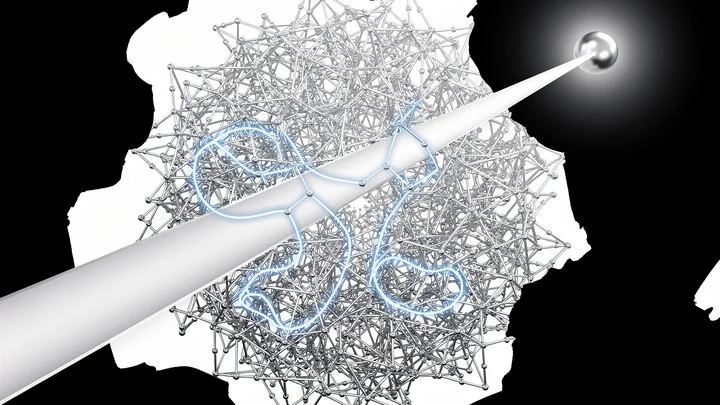
Space is not a void but a mosaic of tiny cells. In loop quantum gravity, spacetime curvature is transferred from a smooth sheet to a network of 'atoms' of volume — spin networks. Each node of such a network is a quantum of space, and the links between them are quanta of area.
But how does this mosaic change over time?
In 2022, physicists described a new type of magnetism — alternagnetism. In it, electrons with different spin directions are split in energy depending on their direction of motion, like runners who speed up on one track and slow down on another. But spin is not the only degree of freedom particles have.
Electrons in a solid usually either run freely (metal) or are locked in place (insulator). But sometimes strong mutual repulsion locks them into a halfway state: charges stand still, while spins, tiny magnetic arrows, continue to live their own life. This is called a Mott insulator.
Every atom in a magnet is like a tiny compass needle. These needles can point in different directions, and their collective dance determines the material's properties. But calculating this dance directly, atom by atom, is a task too heavy even for supercomputers.
The new model, named STEP, takes on the role of a conductor.
Imagine a spiral staircase with balls rolling down. Some are twisted to the right, others to the left. The steps are arranged so that right-twisted balls slip through faster, while left-twisted ones get stuck. Something similar happens inside helical molecules — for example, in the double helix of DNA.
A tiny magnetized sphere floats in a vacuum, held by invisible fields. It starts to spin around the axis of the magnetic field, just like a top that's been given a gentle nudge. That's precession. But when the sphere becomes really small, quantum laws come into play.
A parquet floor where every other plank is turned the opposite way looks symmetric. But if you run your hand over it, in one direction your fingers glide along the grain, and in the other they catch. That's roughly how the new type of magnetism studied in the crystal AgCrP2S6 works.
In 1915, Albert Einstein and Wander Johannes de Haas demonstrated that when an iron rod is magnetized, it twists slightly — the angular momentum of electrons is transferred to the crystal lattice.
For a long time, identifying quantum phases was like interrogating a witness: you had to reach every corner of the system to uncover its secret. In the era of Landau, order was tied to symmetry breaking and a local parameter — everything plain as day.
Searching for the global minimum in the Sherrington–Kirkpatrick spin glass model resembles climbing a glacier, where every crevasse is a treacherous local optimum, and the true bottom lies buried beneath a chaos of ice blocks. A classical climber, trudging along the gradient, would almost certainly freeze in the nearest crevice.
In a world locked in a crystal lattice and cooled nearly to absolute zero, matter knows how to hide its deepest secrets. A quantum spin liquid is a state where electron spins never freeze, even at zero temperature, remaining in an eternally flickering superposition.
In the grand symphony of magnetism, a duo long reigned: boisterous ferromagnetism and silent antiferromagnetism, where spin-soloists cancel each other out. But recently, a third voice joined the ensemble — altermagnetism.
In the conventional Heisenberg picture, spins at low temperatures are supposed to line up in a strict pattern. But there are crystals — like pyrochlore — where geometry has its own way. Each ion sits at a vertex of a tetrahedron, and the main interaction enforces a rule: two spins point inward, two outward.
In a crystal that for centuries was called 'fool's gold,' physicists have spotted genuine treasure. The compound MnTe2 with a pyrite structure has become the stage for a quantum ballet: spin waves here twist into left- and right-handed vortices, with the twist direction firmly tied to momentum.
Building a quantum network node is like teaching a dancer to balance on a carbon thread over an abyss. One leg must spring lightly from the wire, hurling photon-messengers into the external world. The other must grip the rope tightly, guarding precious quantum information.
The mergers of black holes, first predicted by Karl Schwarzschild, are the main source of gravitational waves picked up by LIGO detectors. Over the years, 259 events have accumulated, each one an encrypted birth story of a pair. But is there a hidden system in this data?