Theory of nuclear structure, from models of hadron structure to neutron stars. Nuclear equations of state, theory of nuclear reactions including heavy-ion reactions at low and high energies.
Researchers found that if Higgs particle collisions are required to always produce maximally entangled states, the Higgs potential automatically extends its global symmetry. This leads to an exact symmetry U(2)×U(2), spontaneously broken to U(1)×U(1), giving rise to six massless Goldstone bosons. A
In particle theory, there’s a puzzling phenomenon that usually calls for a new particle. But the authors found that this role falls to ordinary hydrogen and antihydrogen, forming a special combination. The discovery brings the atomic world and fundamental forces closer together.
Like a stadium emptying, a fluorescent dye dims quickly, then slows to a trickle. The lingering glow isn't uniform: its pace depends on which color you watch. This quantum oddity reveals hidden exit routes for escaping light.
After neutron stars merge, a ringing clump of ultra-dense matter remains. Analyzing how fast this gravitational chiming fades relative to the spin-down rate allows, for the first time, measurement of matter’s elasticity in the interior, where densities are 5–6 times nuclear. Paradoxically, it can be
ArgoLOOM is an AI-based program that builds a bridge between calculations from cosmology, particle physics, and nuclear science. It combines different computational methods into a single platform, enabling scientists to construct a unified picture of fundamental forces. Early tests suggest that this
An electric dipole moment has been spotted in the tantalum nucleus — like a spinning top’s center of mass suddenly shifting. This imbalance, measured with record precision, sheds light on the mystery of missing antimatter and aids the hunt for dark matter.
In thorium-229 nuclear clocks, one 'tick' lasts 641 seconds — like a pendulum in syrup. The hardest part is eliminating interference from the crystal. If successful, the clocks will surpass everything created before and pave the way for testing fundamental theories.
Physicists have revisited the idea of neutrino superradiance—a laser-like effect where these ghost particles escape not randomly but in a coordinated stream. For a long time, atomic noise was thought to prevent this. New work shows how to tweak a cold atomic cloud to make the collective effect emerg
Solar neutrinos change their type on the way to Earth — theory predicted this, but directly observing the transition has been elusive due to background noise. A new filtering method in the JUNO detector will make it possible to see this process for the first time, strengthening our current picture o
Scientists improved a model of neutron star mergers by including heating. This cut the error by a factor of 10 and showed that the main burst frequency shifts by 150 Hz depending on the star's composition. The finding will help next-generation detectors study ultra-dense matter.
In a neutron star, matter is compressed to the limit. But even that limit has a limit: physicists have calculated that the ratio of pressure to energy density never exceeds 0.385. This law holds for any ultra-dense matter in the universe.
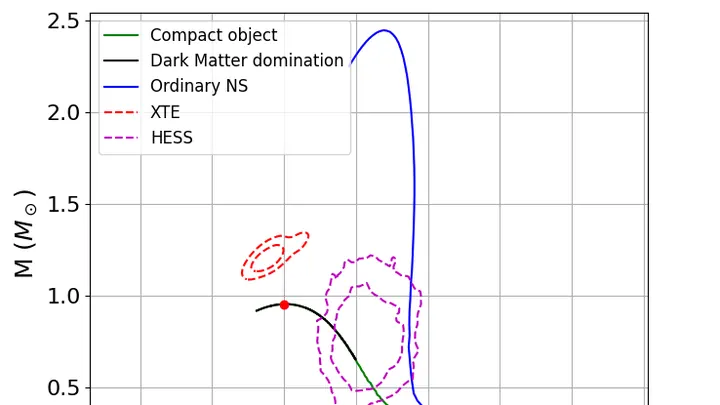
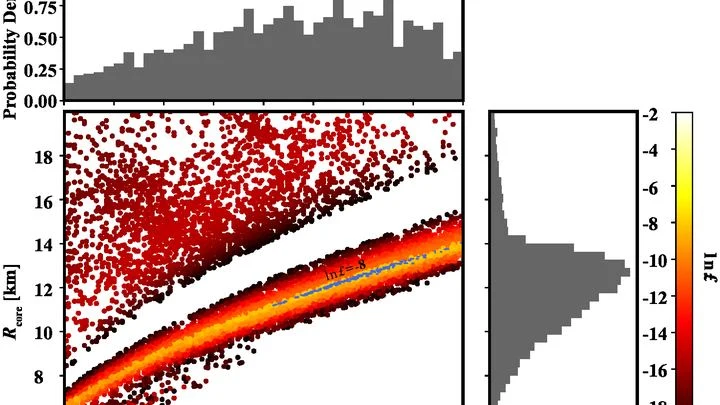
Neutron stars are the densest objects in the universe. Their internal makeup has long been a mystery. A new approach uses mass and radius to pinpoint what’s inside, without relying on assumptions.
Scientists have shown that atom-sized black holes might be dark matter. With their gravity, they rip apart hydrogen atoms, leaving flashes. These traces can be found in ancient radio waves and chemical anomalies — that's how the invisible mass will be discovered.
Neutron stars are among the densest objects, but their exact size long remained a puzzle. Now physicists have found a universal link: the easier it is to deform a lead nucleus in the lab, the softer the matter inside a neutron star and the smaller its radius. Using lab data, scientists calculated th
The diffusion equation was seen as a violator of relativity due to the instant spread of signals. It turned out to be an artifact of a rough approximation. On the micro level, everything is lawful, and paradoxes vanish with the right 'focus': track the particles, not the blurry picture.
When the neutron star MAXI J1752–457 cooled down in 4 days instead of weeks, scientists suspected a draft. It turned out to be the nuclear 'Urca process': in an ocean of atomic nuclei, neutrinos are born and instantly fly away, carrying heat off.
By modeling a neutron star's crust, scientists discovered that deep down, atomic nuclei stretch into strands and sheets resembling pasta. These layers occupy only 14% of the thickness but account for nearly half the crust's mass. The star's trembling, caused by this pasta, was matched to actual puls
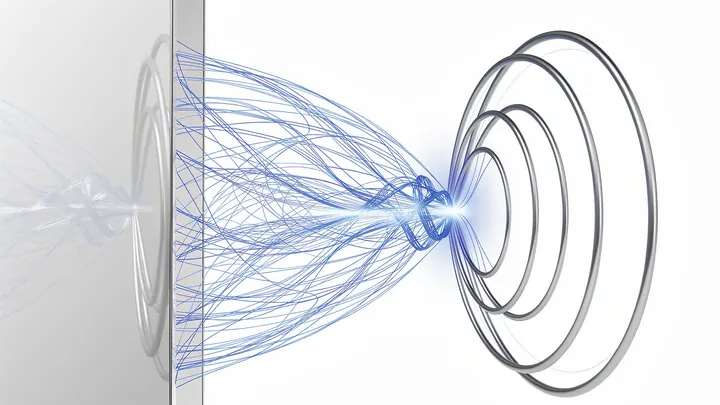
Scientists have found a way to lower the electric barrier preventing a proton and boron from fusing. A muon temporarily ‘stuck’ to the proton shields its charge, and the reaction probability skyrockets thousands of times. This paves the way to nearly waste-free fusion energy.
Just as a strong electric field rips electron-positron pairs out of the vacuum, steep density "steps" deep inside neutron stars create neutrinos and antineutrinos. By catching these messenger particles, scientists can probe superdense matter beyond the reach of any telescope.
Black hole collisions transform the quantum whisper of spacetime into a roar that LIGO detectors can catch. Analysis shows that multi-particle graviton emission organizes into a generalized squeezed coherent state, exponentially amplifying fluctuations. Thanks to the double copy between QCD and grav
Schwinger pair production in gauge fields reveals the unexpected depth of the vacuum: instead of simple entanglement, nonlocal magic arises—correlations that cannot be described without a full-fledged quantum computer. Holographic duality links this magic to the geometry of strings and black holes,
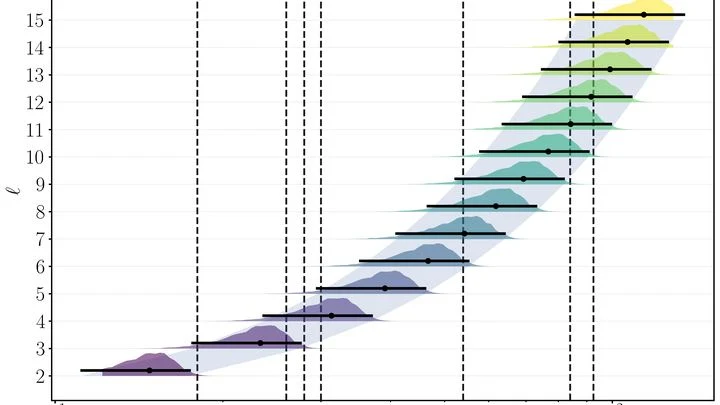
Байесовский ансамбль уравнений состояния, построенный на гауссовских процессах, восстанавливает термодинамику холодной сверхплотной материи без предвзятых параметризаций. Ограничения от рентгеновских наблюдений NICER и гравитационно-волнового сигнала GW170817 заставляют скорость звука сначала взлете
Scientists are studying muon-catalyzed fusion: swapping light electrons for muons squeezes atoms so much that hydrogen nuclei fuse at room temperature. The main problem is that muons often stick to the newly formed helium. New ideas, such as an additional electric field, could boost the number of re
By colliding xenon and lead nuclei at the Large Hadron Collider, physicists reconstructed the true shape of the xenon-129 nucleus from the debris scattering, like splashes from an impact. It turned out to be a lumpy body, stretched in three directions—almost like an ordinary potato. The method turns
Electrons and muons act like tiny magnets. Their magnetic properties differ slightly from the predictions of a simple theory. Scientists have figured out how to combine these two numbers into a new one, where many complex interferences cancel out. Only the contribution from unknown forces or particl
Atomic nuclei can perform a double somersault: shooting out an alpha particle and an electron in a single act. This process links two fundamental interactions into a new probe for testing the Standard Model. Physicists have already found six examples of such decay, hidden in experimental data for de
It was once thought the carbon nucleus was a uniform ball. Revisiting old experiments revealed three distinct helium blocks inside. Without this cluster model, the data didn’t add up. This discovery changes our understanding of carbon’s birth in stars and its importance for life.
Scientists turned a thorium atom into a quantum battery: the electron shell and nucleus swap energy like two pendulums on a shared string. A laser charges the shell, and the energy slips into the nucleus on its own. No wires—just light and the atom.