Mini

Ghost Wind of the Cosmic Dawn: How Lyman-alpha Destroys Stellar Cradles

Original: "Lyman-alpha Pressure Strongly Enhances Pre-Supernova Feedback at Cosmic Dawn: The First Multi-Dimensional Lyman-alpha Radiation Hydrodynamics Simulations"
arXiv:2606.02711v1 · 2026-06-01 · CC BY · ⏱ 1 min · Galaxies Cosmology
Multiple scatterings of ultraviolet photons turn them into an invisible force capable of dispersing gas clouds in the early universe.
Links in the knowledge graph 1

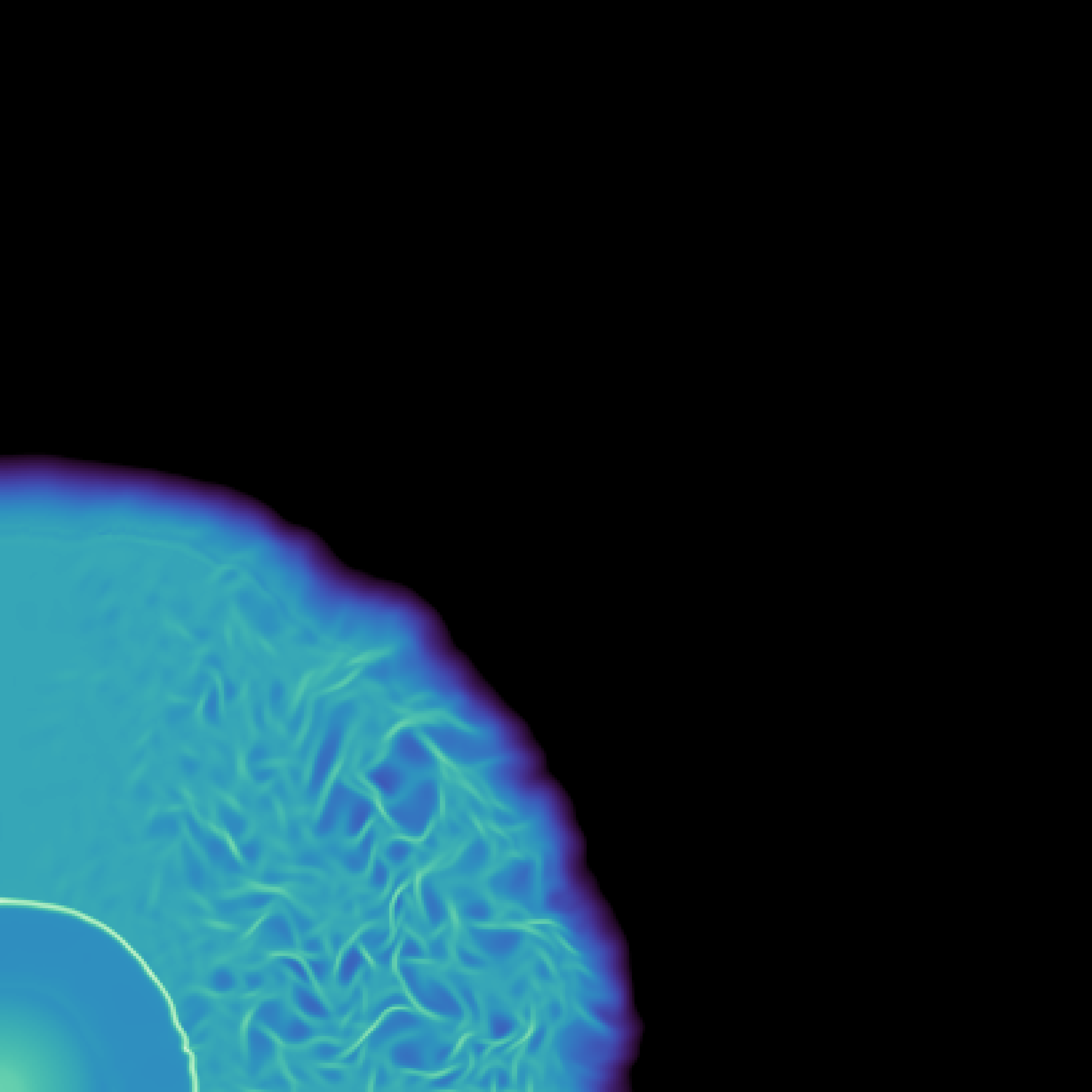
A Lyman-alpha photon in dense gas is not just light. Trapped in an atomic maze, it darts about, pushing matter with each bounce. Thousands, millions of times. Thus is born a ghostly wind capable of sweeping away entire stellar nurseries. The first simulations showed: this wind is tens of times stronger than direct light. Perhaps it was this wind that sculpted the first galaxies.

🎯 The Lyman-alpha line is the brightest spectral line of hydrogen. In optically thick clouds, a single photon can scatter millions of times before escaping. With each scattering, it transfers momentum to the gas, and in a dust-poor environment, the total pressure becomes comparable to that of all other stellar photons combined!

🎬 The idea of using light pressure isn't new: in Arthur C. Clarke's novel 'Rendezvous with Rama,' a solar sail catches photons. Lyα feedback is a natural 'supersail,' where multiple scattering amplifies the effect tens of times, but here it can both accelerate and destroy gas clouds around stars.

F_{\mathrm{Ly}\alpha} = \mathrm{MF} \cdot \frac{L_{\mathrm{bol}}}{c}
The Lyman-alpha radiation pressure force exceeds the direct stellar light force many times over due to countless scatterings; the multiplication factor MF can reach tens depending on the cloud's optical depth.
\tau = N_{\mathrm{HI}} \cdot \sigma_{\mathrm{Ly}\alpha}
The optical depth indicates how many scatterings a photon undergoes on average; it equals the product of the column density of neutral hydrogen and the interaction cross-section—exceptionally large for Lyα.
Scientists
Alan GuthAndrei LindeGeorges LemaîtreJames PeeblesAdam RiessBrian Schmidt
Tags
hydrogen cosmic dust galaxy JWST big bang expansion of the universe black hole supernova nebula spectroscopy
Laws
Friedmann equationsHubble's lawDoppler effectHawking radiationgravitational lensingBekenstein-Hawking entropy
Original: arXiv:2606.02711v1 · CC BY · bridge42worlds