Dark Matter's Invisible Sparks: Tiny Black Holes as Stellar Detonators ✦
Original: "Primordial Black Hole Triggered Type Ia Supernovae II: Comparison with Supernova Remnants and Galactic Chemical Evolution"
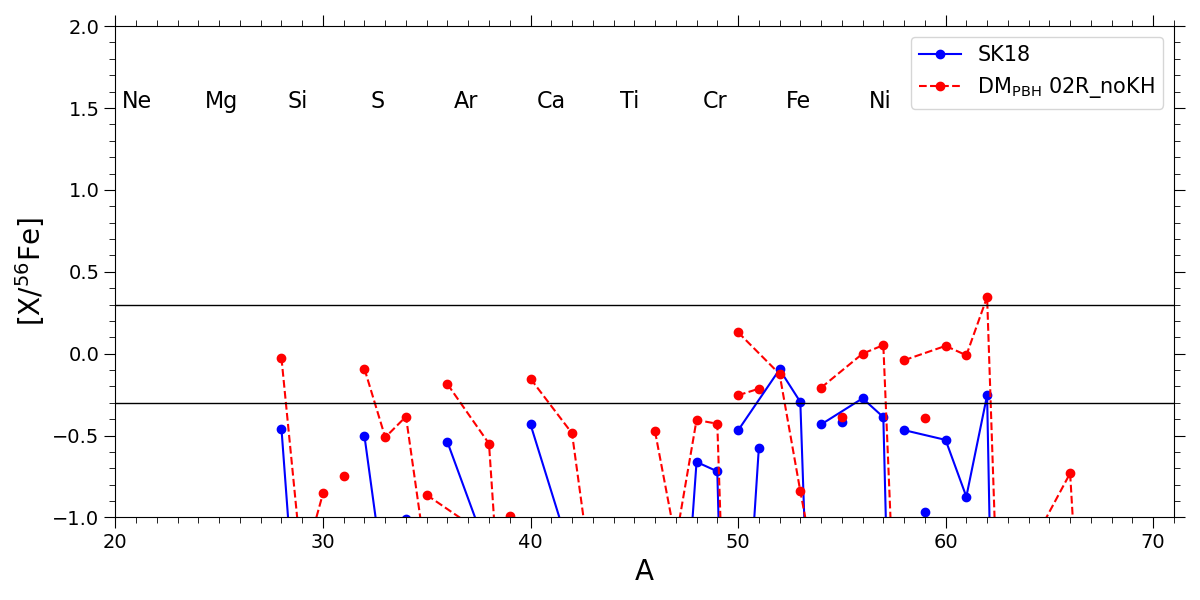
Asteroid-mass primordial black holes are not just invisible dark matter, but also triggers for Type Ia supernovae, rewriting the chemical history of galaxies.
Links in the knowledge graph 1
A ghost asteroid pierces a star—and it flares brighter than a hundred billion suns. Perhaps primordial black holes not only hide in dark matter but also act as a detonator for white dwarfs. Their invisible trails are preserved in the chemical chronicles of stars. Someday, decoding it, we will map the unseeable itself.
🎯 An asteroid-mass primordial black hole, piercing a white dwarf, releases so much heat that it triggers a thermonuclear explosion, yet emerges unscathed from the stellar inferno and continues wandering the galaxy.
T_{\text{ign}} \approx 5 \times 10^8 \, \text{K}
Carbon ignition temperature: half a billion kelvins—the price of starting a thermonuclear fire in a white dwarf.
10^{-17} M_{\odot} \lesssim M_{\text{PBH}} \lesssim 10^{-12} M_{\odot}
PBH detonator masses: from asteroid to small moon—these are the “bullets” capable of blowing up a star.
Scientists
Alan GuthAndrei LindeGeorges LemaîtreJames PeeblesAdam RiessBrian Schmidtdark matter
black hole
supernova
white dwarf
galaxy
carbon
oxygen
dark energy
expansion of the universe
spectroscopy
big bangLaws
Friedmann equationsHubble's lawDoppler effectHawking radiationgravitational lensingBekenstein-Hawking entropy