Mini

A Lens in the Depths: Why the Axion Limit Isn't Afraid of Exotics

Original: "Core Composition Effects on the QCD Axion Mass Limit from Neutron Star Cooling"
arXiv:2606.07742v1 · 2026-06-05 · CC BY · ⏱ 1 min · HEP Phenomenology High Energy
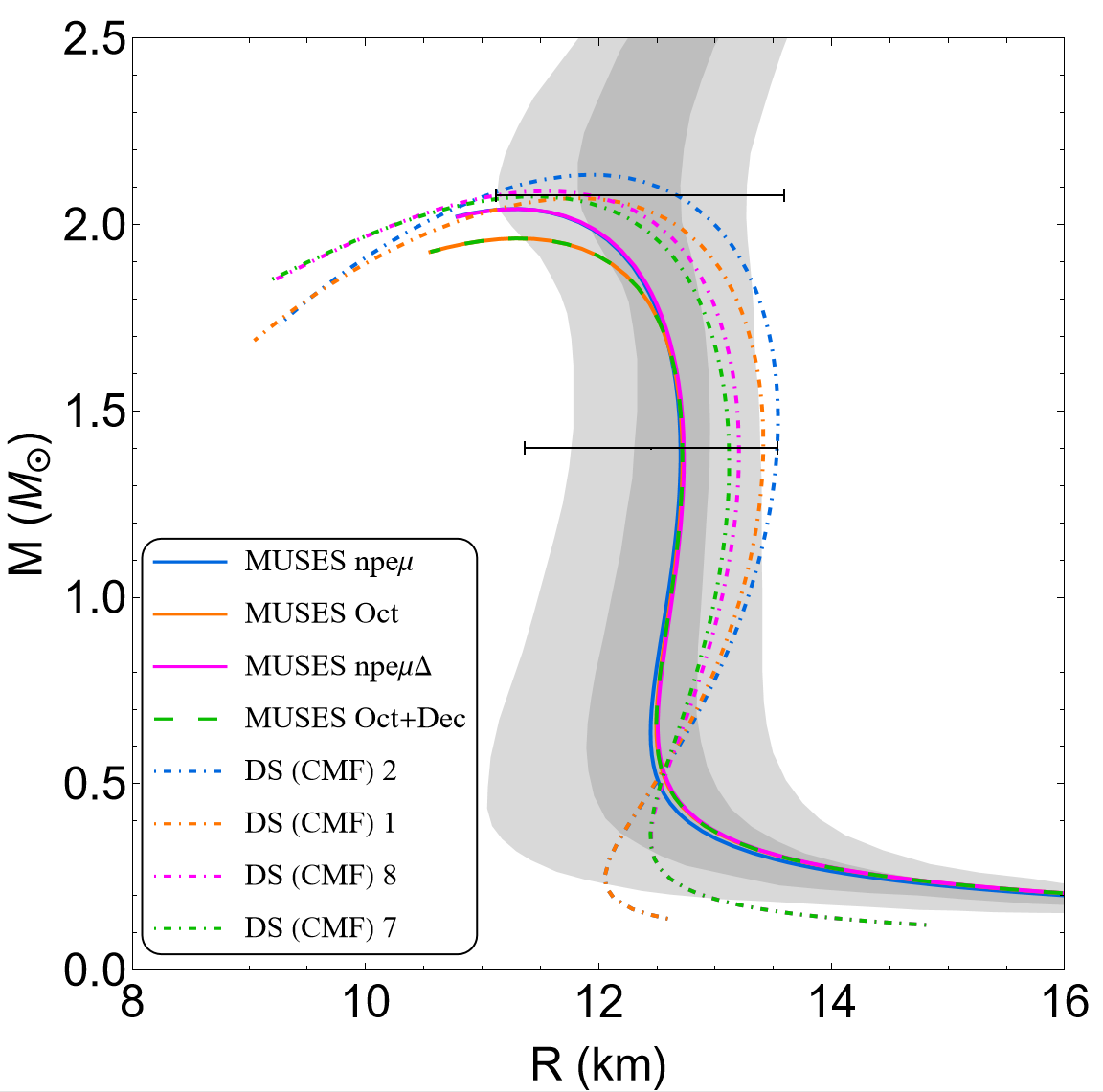
Hyperons and delta resonances in a neutron star's core barely shift the upper bound on the axion mass, confirming the reliability of the astrophysical search method.
Links in the knowledge graph 1

The neutron-star lens passed the purity test: exotic hyperons didn’t smear the axion-limit focus. The bound is rock-solid, and its precision strikes right into IAXO’s field of view. Once we detect the axion, its mass will let us read off the recipe for the most extreme matter in the universe.

🎯 If the axion is discovered within this predicted mass window, it will become the first elementary particle detected not in a laboratory detector, but by the thermal handwriting of dead stars.

🎬 In science fiction, neutron stars often serve as exotic backdrops: for instance, Robert Forward’s novel Dragon's Egg imagines intelligent life on the surface of an ultra-dense star, while Larry Niven’s short story ‘Neutron Star’ features tidal forces as a deadly threat.

m_a \simeq 5.7\,\mu\text{эВ} \times \frac{10^{12}\,\text{ГэВ}}{f_a}
The higher the energy scale f_a of symmetry breaking, the lighter the axion.
Scientists
Albert EinsteinFritz ZwickyVera RubinEmmy NoetherJacob BekensteinStephen Hawking
Tags
neutron star dark matter supernova entropy gravitational waves spacetime curvature photometry Quantum Field
Laws
second law of thermodynamicsgravitational lensingNoether's theoremBekenstein-Hawking entropyEinstein field equationsStefan–Boltzmann law
Original: arXiv:2606.07742v1 · CC BY · bridge42worlds