The Quantum Doorway: How a Crowd Changes the Rules of Tunneling
Original: "Universal scaling of many-body effects in quantum tunneling"
A cold-atom experiment revealed that particle interactions rewrite the fundamental scaling law of tunneling, making it universal across a whole class of quantum systems.
Links in the knowledge graph 1
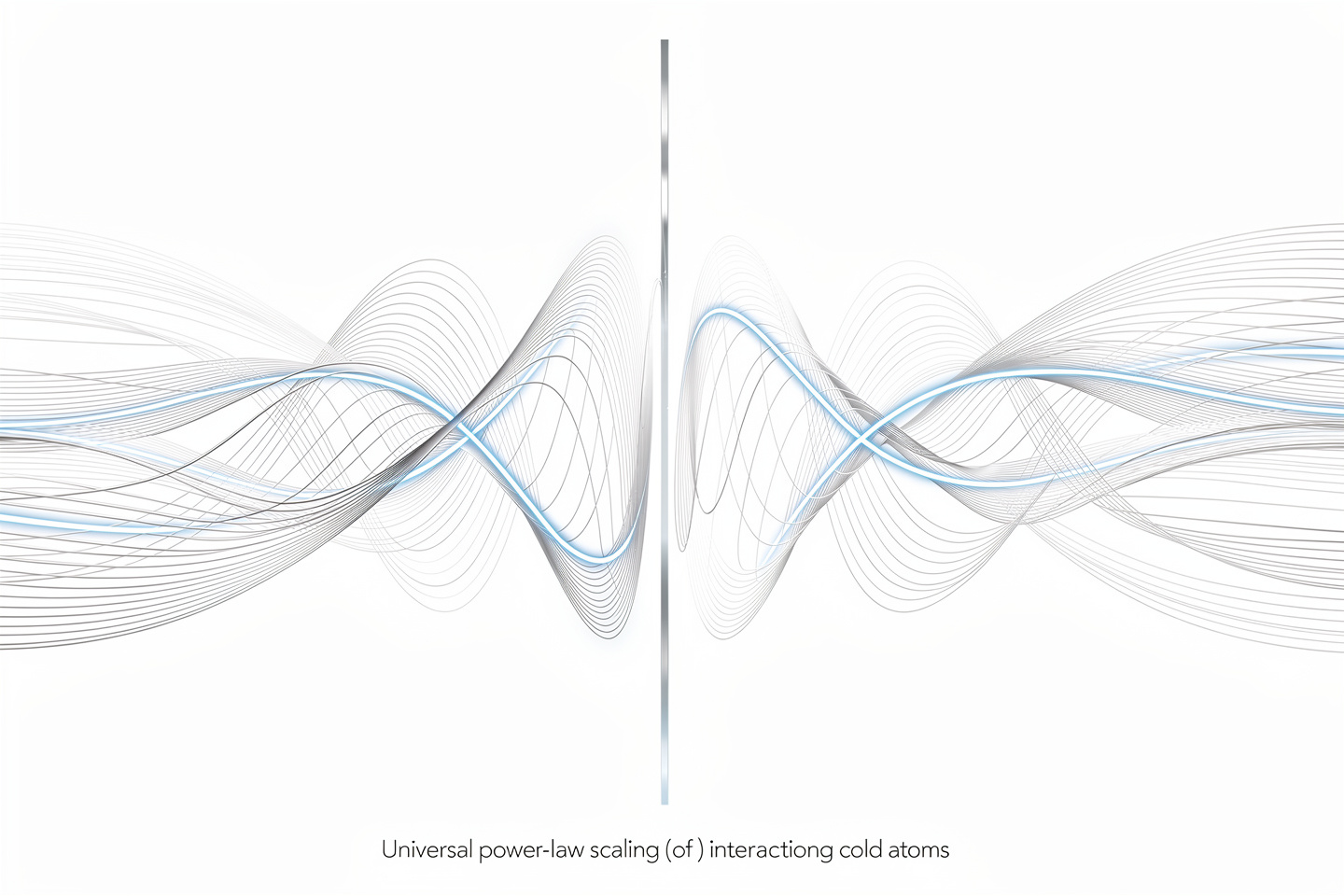
Quantum tunneling for lone particles is like passing through a revolving door, but with a crowd a new order emerges. A hundred particles at an arch: their interaction and temperature set the critical traversal by a power law — as if the collective rewrites the physics of the barrier. Measured on cold atoms, this universal scaling opens the way to tuning tunneling in superconductors and quantum processors.
🎯 The transition from collective to single-particle tunneling as the lattice depth increases resembles how a crowd of people moving through a narrow door changes behavior under strong compression: interactions make everyone 'feel' each other, but when the passage becomes absolutely tight, each one seeps through on their own.
J_c \propto T^\alpha
The critical tunneling matrix element is proportional to temperature to the power α.
\alpha = \frac{4K-1}{2K}
The exponent α is expressed through the Luttinger parameter K, which depends on the dimensionless interaction γ. For weak interactions, K ≫ 1 and α ≈ 2; as interaction increases, K decreases, and eventually tunneling enters the single-particle regime with α → 1.
Scientists
Wolfgang PauliErwin SchrödingerPaul DiracAlbert EinsteinHans BetheLise MeitnerBose-Einstein condensate
superconductivity
quantum computer
nuclear fusion
nucleosynthesis
numerical simulation
quantum optics
quantum measurement
quantum informationLaws
Pauli exclusion principlemass–energy equivalenceno-cloning theoremHong–Ou–Mandel effectBorn ruleJosephson effect