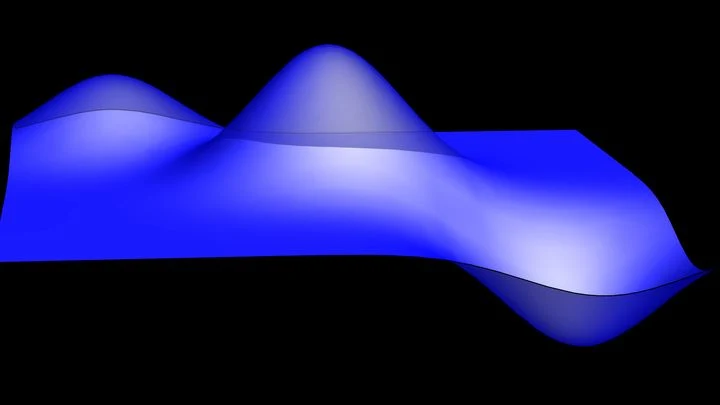
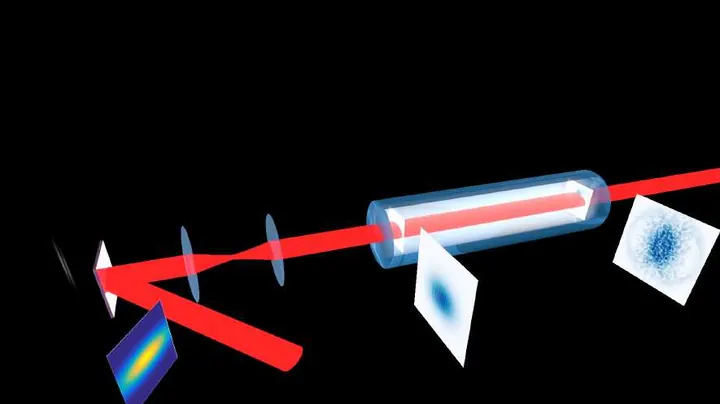
Scientists used a precise laser pulse—a delta-kick—to cool molecules almost to a standstill. The molecules' internal vibrations don't mess with their motion, so they stay intact. Supercold molecules will open the door to ultra-precise tests of gravity.
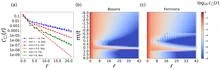
Traditional models of fundamental forces rely on fermions—particles that avoid their neighbors. An experiment with bosons, which, on the contrary, are drawn to each other, unexpectedly revealed a structure with perfectly alternating vortices. This discovery reduces computational costs and brings the
Scientists used a Bose–Einstein condensate (Bose and Einstein) — a state where atoms move as a single wave — to simulate the first moments after the Big Bang. By tuning interactions, they made it mimic the behavior of spacetime at the tiniest scales. This allowed them to observe “Planckian damping”
To control many quantum particles, scientists used trial and error: a computer agent, seeing only part of what's happening, learned to limit the growth of connections between particles. Normally, these connections (entanglement) quickly fill all space, like chaos. But the agent places 'bottlenecks'
Scientists split a cloud of atoms and, by tracking rising disorder, ordered events in one half without seeing the other. This confirms that time emerges from internal changes. Such an approach will help us understand how time flows in black holes and right after the Big Bang.
Using a simulation, scientists studied how the force strings connecting quarks break. The rupture turned out to be more complex: entire families of particles are born, and in a dense environment the process slows down. This discovery will help understand the microworld and can be tested on special d
Physicists simulated a collision of charged particles. Contrary to expectations, instead of chaos, a plasma emerged, expanding as a shock wave and retaining memory of the initial charge clumps. The reason — plasma oscillations akin to a pendulum. This discovery helps understand matter under extreme
Earth drags the fabric of space-time along with it — an effect predicted by Einstein. Scientists propose catching it with superfluid helium and a highly precise detector. The device will notice rotation slower than one revolution in the entire history of Earth.
In a one-dimensional chain of particles with an interaction based on the golden ratio, structures with crystalline order but without periodicity spontaneously emerge. A quasi-supersolid phase has been discovered: it holds its shape like ice and flows without friction. Experiments with cold atoms wil
Hot water sometimes freezes faster than cold—the Mpemba effect. Now scientists have figured out how to control this effect in the atomic world: temporarily increasing 'friction' in the right places so the system settles down faster or slower. The method works for any quantum device and promises to s
When one atom is excited, its neighbors go quiet—this simple rule, known as Rydberg blockade, allows quantum braids to be woven. In such a pattern, the connections are protected from noise by the pattern itself. Scientists have shown how to build such a system by solving an inverse problem—they tail
What it's about: studying the shape of the Fermi sea — a state where particles, following the Pauli principle, fill energy levels like a fluid. What's new: for the first time, the Euler characteristic — a measure of through-holes in this structure — has been experimentally obtained. Why it matters:
An experiment with giant atoms sensitive to electric fields showed how an unstable emptiness transforms into a stable one, forming bubbles. The rate of the process depends on external influences exactly as theory predicts, as long as everything is perfectly calibrated. The slightest imprecision brea
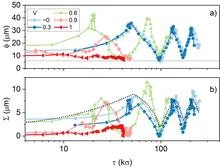
An experiment showed how a pair of vortices in liquid light play leapfrog. At high speed, a shock wave appears, the game breaks down, and the vortices vanish, releasing heat. This helps understand how motion decays in superfluid media.
Scientists have shown that supersolidity—a symbiosis of solid order and liquid flow—can arise from ripples at the boundary between a liquid and a substrate. No need to chemically alter the medium; just the right container size is enough. This opens the door to materials with a solid shell and a flui
Time crystals are matter that pulses in time like a perpetual metronome. Previously, stability was achieved by introducing chaos into the atomic lattice. The new scheme replaces chaos with a smooth electric field in a chain of super-sized atoms, making the crystal more durable and easier to work wit
Scientists created modified gravity conditions (MOND) for a quantum fog and saw that the cloud expands and oscillates according to simple mathematical rules. This opens the door to lab-based tests of gravity theories that replace dark matter.
Physicists modeled the behavior of true vacuum bubbles inside a false vacuum using a simplified particle system. It turned out that a bubble either expands indefinitely or collapses, depending on its initial size and the strength of internal bonds. A similar mechanism could have triggered the Big Ba
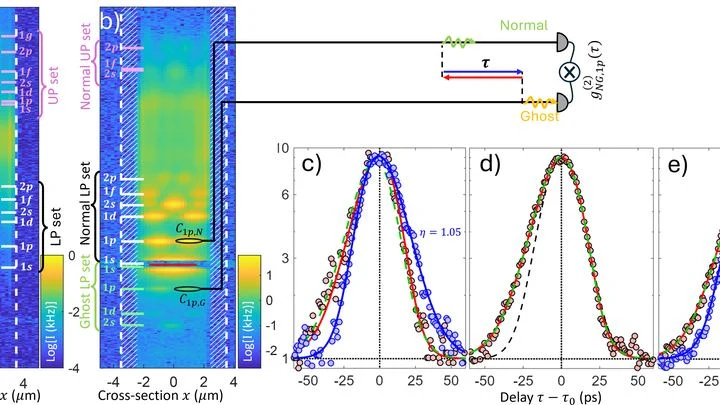
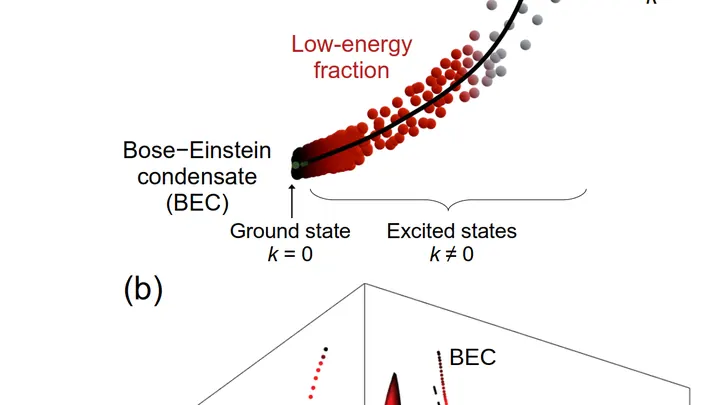
A quantum mix of light and matter — polaritons — was cooled to near absolute zero. The cloud not only became ordered but split into two parts with different temperatures, each obeying the laws of Bose and Einstein. The key surprise: the temperature of such a gas depends not on heating, but on the nu
Conformal field theory describes the universal behavior of systems near quantum phase transitions, where the notion of scale disappears. These predictions long remained unverified. Now, in a chain of Rydberg atoms, physicists tuned to a critical point and recorded the excitation spectrum, finding ch
The experiment showed: contrary to theories, an impurity in a one-dimensional system moves without resistance. After a quick adjustment, the speed becomes constant, no energy is wasted. A breakthrough for quantum communication.
In a mixture of two types of atoms cooled into a joint wave state, quasicrystals form — structures with eight-fold symmetry. This requires equal proportions of components and strong mutual repulsion, not a pre-set 'irregular' lattice.
Atoms were arranged in a honeycomb pattern, their interactions tuned, turning a magnetic crystal into a flowing, boiling broth. In this chaos, hidden order emerged: excitations race like light. Such a 'spin liquid' could become the foundation for future quantum computers.
Adding bosons, nature's social particles, glues electrons into tighter pairs, so superconductivity survives at higher temperatures. The effect holds widely and could be tested with ultracold atoms and layered materials.
An experiment with chilled lithium atoms shows they start emitting light synchronously only at a certain density. The superradiance threshold first drops, then rises, with the minimum coinciding with the condition when the distance between particles equals the light wavelength. This happens because
The bumps of a 'quantum snowdrift' made of cold atoms grow according to exactly the same scenario as a snowdrift in your yard. This universal law works for sand, water, and even cities. The experiment proved: nature is unified from atoms to skyscrapers.
In the quantum world, a system initially farther from equilibrium can settle down faster. Physicists found that suppressing the dominant rhythm of chaos sharply accelerates the growth of disorder and the approach to equilibrium. Moreover, by breaking time symmetry, they achieved an almost instantane
Quantum systems usually quickly forget their initial state, but physicists found a way to slow this process. On an IBM processor, 144 qubits evolved for 5000 cycles, and entropy — a measure of disorder — grew so slowly it resembled a black hole evaporating in slow motion. This proves the ability to
The quantum world is full of surprises: even in perfect emptiness, ghost particles are born, creating a weak attraction. Using strontium atoms and ultra-precise light analysis, scientists have for the first time captured how this force shifts the 'note' of an atom. The result matched calculations pe
In ultra-strong fields, the vacuum births electron-positron pairs. By controlling the delay between laser pulses, physicists turn the birth into chaotic ripples or ordered vortex lattices resembling whirlpools. The pattern of whirlpools is dictated by the particles' spin — as if each whirlpool spins
According to one hypothesis, the cosmos is not monolithic, but made of tiny quantum 'building blocks'. Previously, only their synchronized dance was studied. But new work shows: when you account for their inevitable jitter, something like sound waves emerges. This quantum ripple barely influences th
Scientists have designed an experiment where a laser beam simultaneously passes through two clouds of ultracold atoms, mimicking a detector that is in two places at once. After the beams reunite, the difference in their signals is measured — it will reveal how the quantum field responds to a split r
Time crystals are a state of matter that pulses without external pushes, like a perfect clockwork mechanism. Physicists obtained three varieties of such 'ticking' in a cloud of atoms placed between mirrors. The light emerging from the trap allowed them to see these oscillations directly and distingu
Light can be made to flow in one direction without magnets — just spin a ring resonator and use two amplifier atoms. A tiny frequency shift from rotation, like the change in a siren's pitch, after quantum wave interference creates a strong asymmetry: single photons emerge in one direction, bunched-u
Scientists modeled a flow where sound gets trapped and found that entanglement entropy grows with volume, not area. The reason: pairs of sound particles (phonons), born at the horizon, remain connected throughout the interior. This helps us understand how information might be preserved inside real b
For the first time, a quantum-squeezed state has been created in molecules, suppressing noise and improving measurement accuracy threefold. This trick, akin to squeezing a balloon, shifts noise into a harmless form, making molecules ideal sensors for hunting dark matter and testing fundamental theor
Using a flat metasurface the size of a coin, replacing bulky lenses, scientists trapped 11,000 atoms for the first time. This breakthrough paves the way to quantum computers with tens of thousands of qubits, capable of solving problems beyond the reach of ordinary machines.