Mini

Mirror Labyrinth of Dark Energy: How Galactic Twins Refract Cosmology
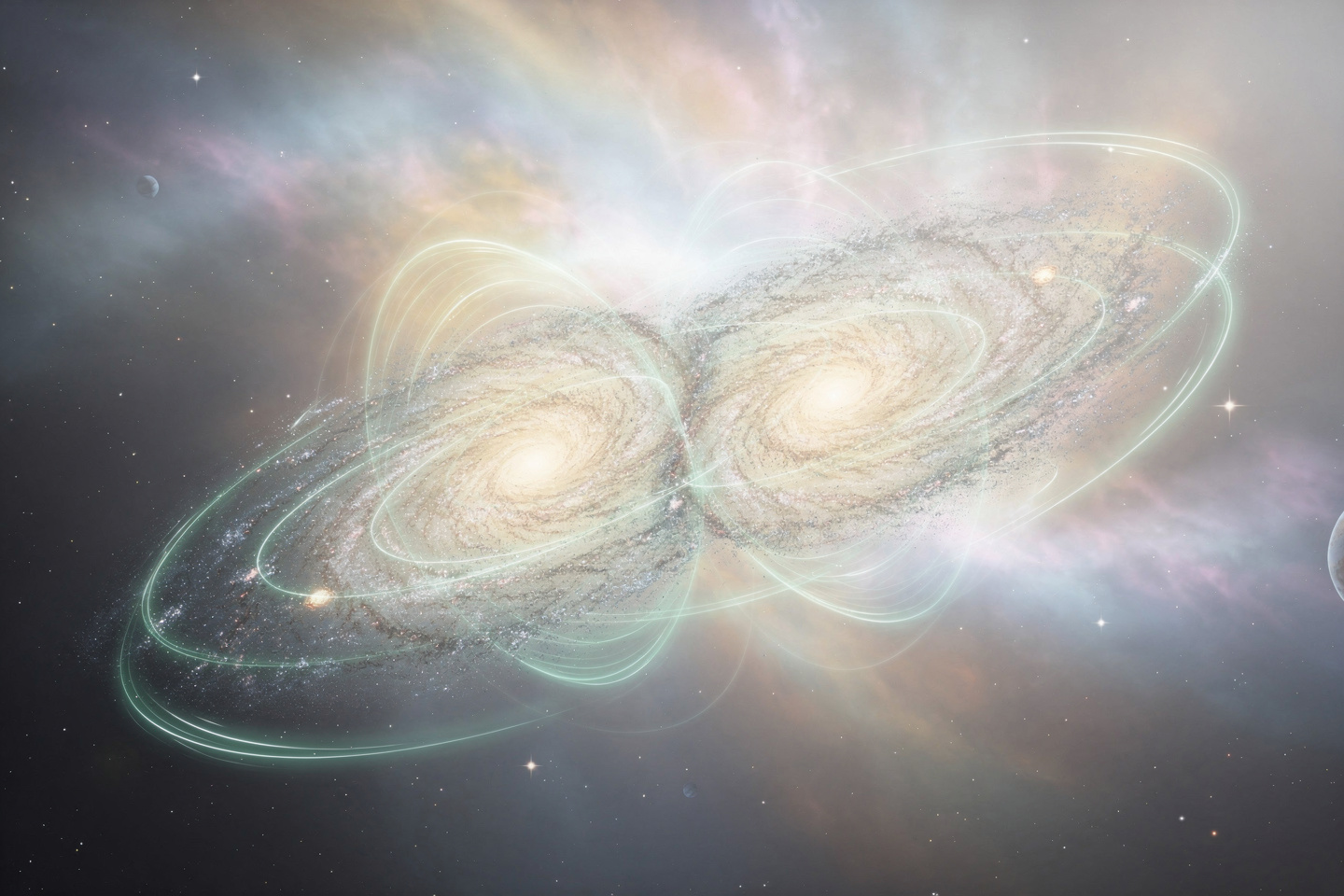
Original: "Strong Lensing Tomography: Double and pseudo multi-source plane strong gravitational lensing to constrain dark energy"
arXiv:2607.01005v1 · 2026-07-01 · CC BY 4.0 · ⏱ 1 min · Cosmology
Astrophysicists have proposed replacing rare double gravitational lenses with pairs of ordinary ones to measure the equation of state of dark energy with record precision.
Links in the knowledge graph 1

The Universe is a funhouse with gravitational mirrors. Dark energy stretches its walls. To measure the curvature, astronomers look not for unique double lenses, but for thousands of twin galaxy pairs that act as identical mirrors. The statistics of reflections yields the equation of state of dark energy more precisely than ever. Space ceases to be a labyrinth when you know the shape of every mirror.

🎯 Mass-sheet degeneracy is like adding a uniform invisible mass sheet across the sky: it leaves the lensing picture unchanged but completely scrambles the estimate of the deflector's real mass. [scientist:Fritz Zwicky]Fritz Zwicky[/scientist], the pioneer of gravitational lensing, could hardly have anticipated such geometric elegance when he proposed using galaxies as lenses in 1937.

\beta = \frac{D_{ds1} D_{s2}}{D_{ds2} D_{s1}}
Geometric factor of distance ratios for a double lens. D_s1, D_s2 are angular diameter distances to the sources, D_ds1, D_ds2 are distances from the deflector to the sources. This quantity depends only on cosmology and does not require knowledge of the absolute distance scale.
\beta_{E,\text{pl}} = \left( \beta - (1-\lambda)(1-\beta) \right)^{\frac{1}{\gamma_{\text{pl}}-1}}
Ratio of Einstein radii for a pseudo-double lens accounting for mass-sheet degeneracy and a power-law density profile. Here λ is the MST parameter, indicating how much we overestimate or underestimate the mass due to the sheet effect; γpl is the slope of the radial density profile in the deflector.
Scientists
Alan GuthAndrei LindeGeorges LemaîtreJames PeeblesAdam RiessBrian Schmidt
Tags
gravitational lensing dark energy galaxy dark matter Hubble Space Telescope spectroscopy supernova
Laws
Friedmann equationsHubble's lawDoppler effectgravitational lensingMaxwell's equationsPlanck's law
Original: arXiv:2607.01005v1 · CC BY 4.0 · bridge42worlds