Mirror Labyrinth of Dark Energy: How Galactic Twins Refract Cosmology ✛
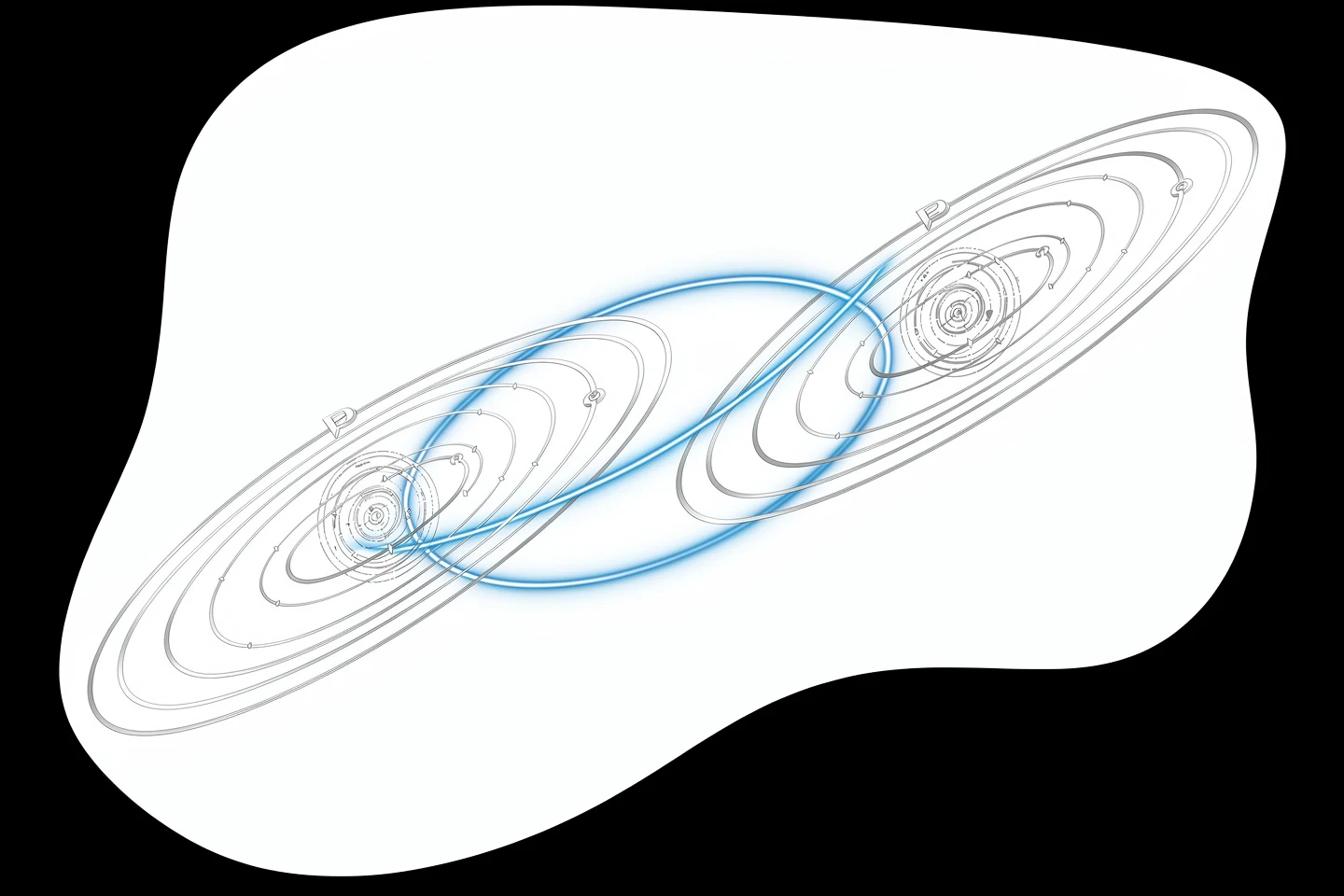
The Universe is a giant labyrinth of curved mirrors. The mass of galaxies and clusters distorts the light of distant quasars, as if toying with our perception of the cosmos. Hidden in this hall of mirrors is the key to the greatest mystery: dark energy, which is pushing space apart ever faster. To catch its breath, astrophysicists have long dreamed of a pair of identical mirrors placed at different distances — by comparing reflections, one could reconstruct the geometry of the hall. But nature rarely offers such coincidences: traditional double gravitational lenses, where one massive object bends light from two sources, are found only a handful of times. So scientists resorted to a trick: instead of searching for a unique cosmic artifact, they decided to gather statistics on nearly identical mirrors — galactic twins that only pretend to be identical.
The idea is bold and elegant: if we take two independent 'galaxy-galaxy' type lenses with deflectors as alike as two peas in a pod (in redshift, size, color, and brightness), they can be considered cosmological twins. Like two mirrors cast from the same mold but hung in different corners of the hall. Such pseudo-double lenses (PDSPL) will be scattered by the millions in future LSST catalogs. Their bulk comparison yields the key geometric relation
\[ \beta = \frac{D_{ds1} D_{s2}}{D_{ds2} D_{s1}} \]
which depends only on cosmological distances and doesn't require absolute scales. And when we add information about the deflector's density profile, a second formula is born — for the ratio of Einstein radii accounting for MST:
\[ \beta_{E,\text{pl}} = \left( \beta - (1-\lambda)(1-\beta) \right)^{\frac{1}{\gamma_{\text{pl}}-1}} \]
Here λ is a measure of the mass-sheet degeneracy, and γpl is the slope of the radial profile. In essence, the statistics of thousands of 'mirrors' free our hands, allowing us to simultaneously refine both cosmology and the intrinsic properties of lenses.
Simulating the full LSST photometric sample over 10 years (about 86,000 selected pairs) yields a precision for the equation-of-state parameter of dark energy w0 of 0.45 in the most general model. If external data on matter density Ωm is added (e.g., from supernova observations or the cosmic microwave background), the precision improves to 0.29. This is already comparable to results from multi-year campaigns of weak lensing, but with fundamentally different systematic errors. Incidentally, the population characteristics of deflectors are extracted: the mean mass-sheet shift and profile slope are determined to about 2% accuracy, and their dispersion with high confidence. The statistical approach triumphs over the piecemeal: a huge photometric sample beats scarcer, expensive spectroscopy.
The prospects are mesmerizing. In the coming years, machine learning algorithms like contrastive learning will be able to match twins by hidden morphological features directly from images. Accounting for galaxy evolution and external convergence will squeeze systematics to the limit. With the launch of Euclid and Roman, the method will embrace hundreds of thousands of lenses. The mirror labyrinth ceases to be a chaos of curved reflections and turns into a map, where each deflector is a milestone on the path to unraveling accelerated expansion. The work directly links mass-sheet degeneracy to cosmology, solving a long-standing problem, and opens the door for gravitational lensing into the world of population statistics. Perhaps this is how we will first hear the whisper of dark energy, caught in a net of thousands of similar but distinct mirrors.
Mass-sheet degeneracy is like adding a uniform invisible mass sheet across the sky: it leaves the lensing picture unchanged but completely scrambles the estimate of the deflector's real mass. Fritz Zwicky, the pioneer of gravitational lensing, could hardly have anticipated such geometric elegance when he proposed using galaxies as lenses in 1937.