Cosmic Twin Lenses to Help Unravel Dark Energy ✛
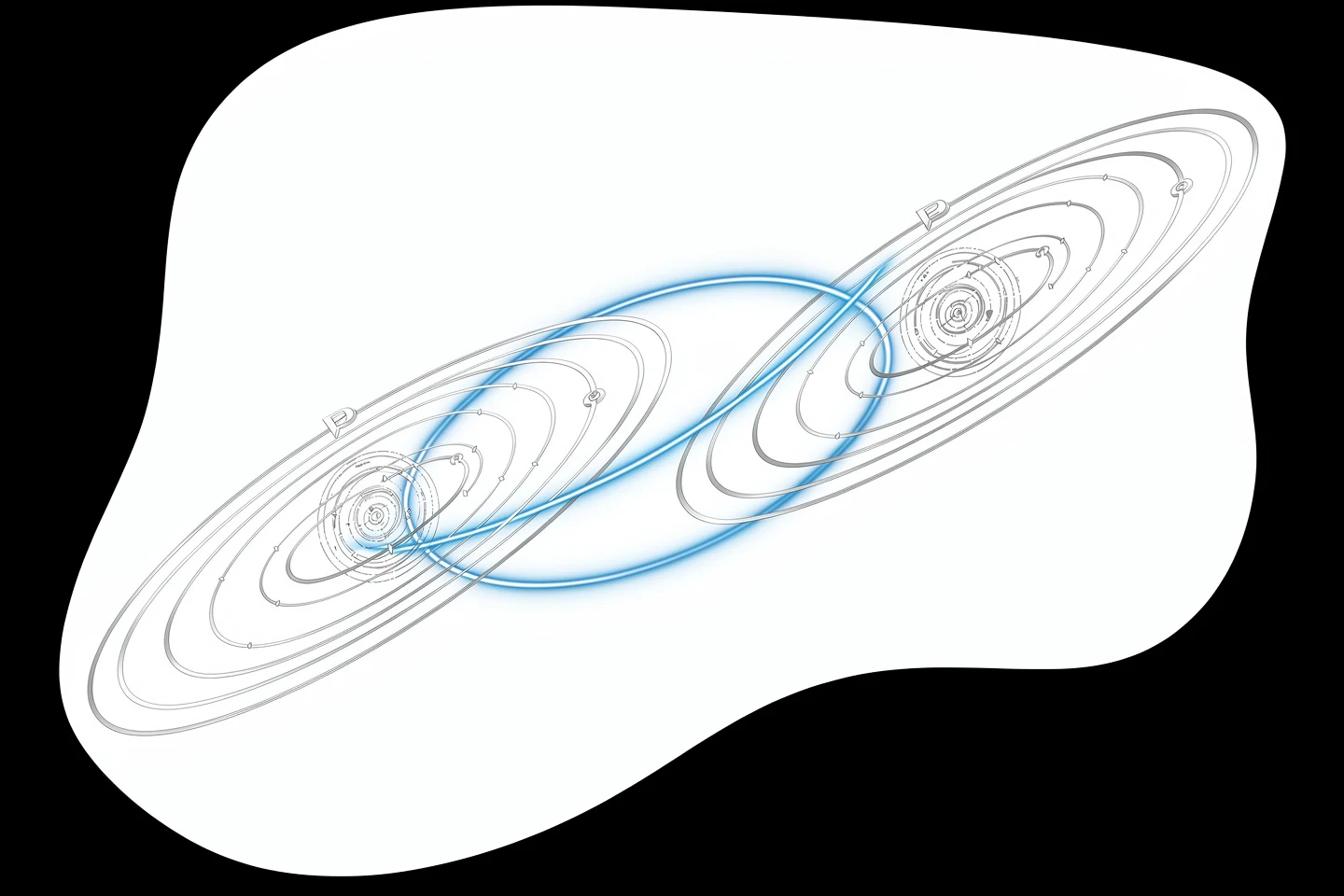
Imagine enormous cosmic magnifying glasses — massive galaxies that bend the light of distant objects with their gravity. This phenomenon is called gravitational lensing. It helps astronomers peer deep into the Universe. Back in the 1930s, Fritz Zwicky proposed using galaxies as lenses, and Edwin Hubble discovered the expansion of the Universe, which today is explained with the help of dark energy.
To precisely measure how fast the cosmos is expanding, scientists need a special configuration: when the same galaxy-lens deflects the light of two distant sources at once. But such double lenses are a great rarity. Astrophysicists have devised a workaround: instead of waiting for a rare event, they look for pairs of almost identical lenses. It’s like needing two perfectly identical magnifying glasses to compare distant objects, but you can’t find a single glass with two different focal points. So you take two separate ones, but made from the same template — and their similarity allows for a precise measurement.
Scientists modeled how many such pseudo-double lenses the future LSST telescope could find. It turned out that over 10 years it will detect about 86,000 suitable pairs. By analyzing these pairs, one can compute the equation of state of dark energy with an accuracy not inferior to other modern methods. Moreover, in the process, the mass degeneracy is resolved — the method self-calibrates the 'extra weight' added by dark matter. The accuracy of such a measurement is comparable to data from supernovae and spectroscopy of distant galaxies, where the Hubble constant is used.
The mass-sheet degeneracy resembles a situation where you add an invisible sheet of uniform mass across the whole sky — the lens picture doesn’t change, but the real mass of the lensing galaxy turns out to be completely different.