Mini

The Voice of Light: How Secret Rings Reveal Themselves in the Disk of CI Tau
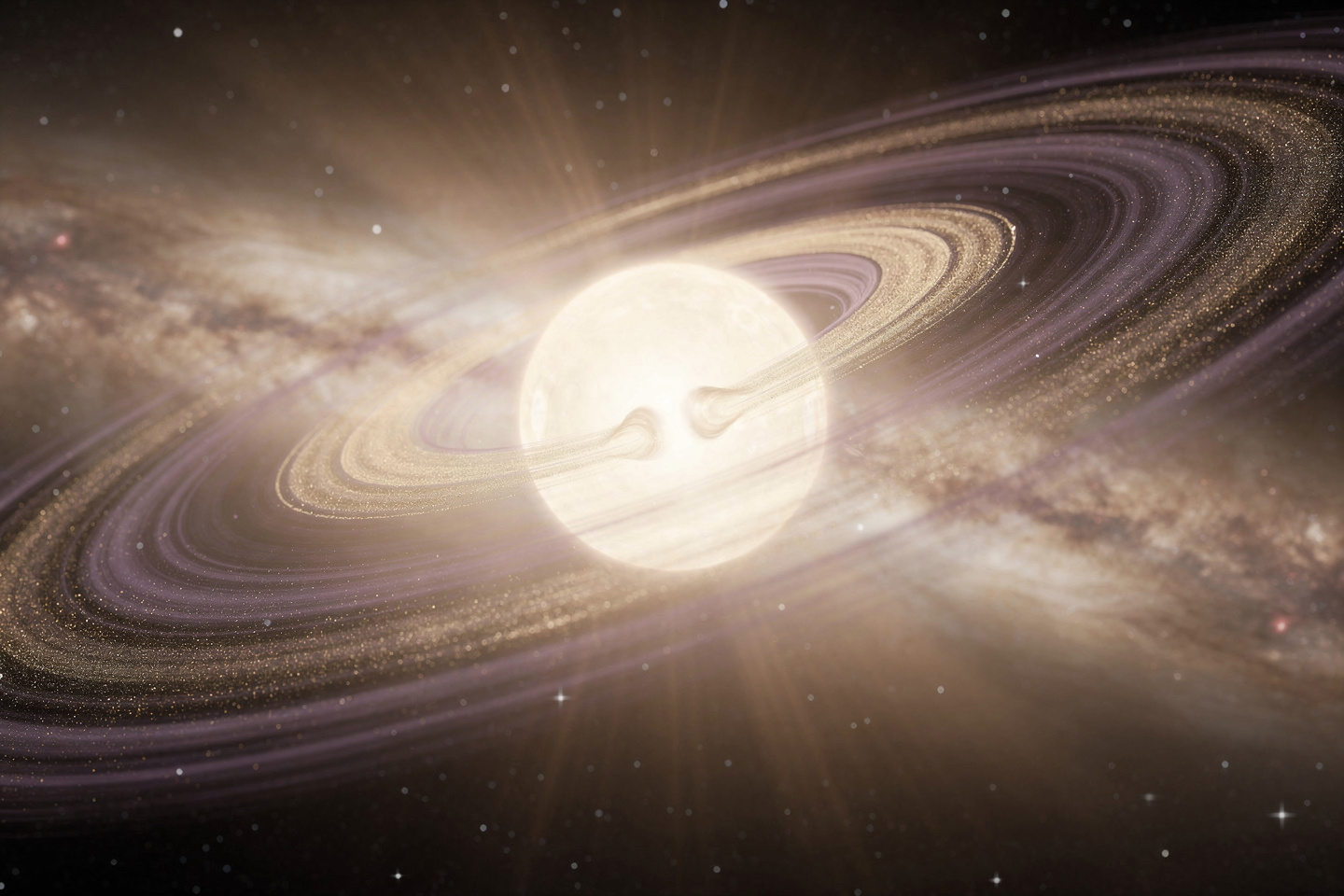
Original: "Azimuthal brightness modulation reveals hidden rings in CI Tau"
arXiv:2607.02660v1 · 2026-07-02 · CC BY 4.0 · ⏱ 1 min · Exoplanets Instrumentation
Astronomers discovered hidden dust rings in the disk of the young star CI Tau using azimuthal brightness modulation in ALMA images.
Links in the knowledge graph 1

They are not visible directly — too thin even for ALMA. But they betray themselves with a double brightness peak, like an echo of an invisible bell. In the disk of the young star CI Tau, astronomers heard the signal of hidden dust rings — cradles of future planets. This is how light, shifting its tonal quality on a tilted disk, paints the architecture of the unseen. Perhaps our Solar System began just like this. Now the 'double echo' method will be applied to hundreds of other disks.

🎯 The age of CI Tau is only about two million years, so planets might be forming in this disk right now. The discovered rings are so narrow that their width is smaller than the ALMA beam size; without the azimuthal trick, they would have remained hidden forever.

\beta = \frac{\mathrm{d} \log \kappa_\nu}{\mathrm{d} \log \nu}
Shows how dust opacity changes with frequency; a value of β~2 is characteristic of small particles.
\tau_\nu = \frac{\kappa_\nu \Sigma}{\cos i}
Determines the transparency of the medium along the line of sight; a key parameter for analyzing brightness modulation.
Scientists
Adam RiessBrian SchmidtEdwin HubbleGeorges LemaîtreMaarten SchmidtSaul Perlmutter
Tags
exoplanet Sun spectroscopy carbon hydrogen helium JWST Hubble Space Telescope galaxy
Laws
Hubble's lawDoppler effectgravitational lensingKepler's third lawCoulomb's lawMaxwell's equations
Original: arXiv:2607.02660v1 · CC BY 4.0 · bridge42worlds