The Voice of Light: How Secret Rings Reveal Themselves in the Disk of CI Tau ✛
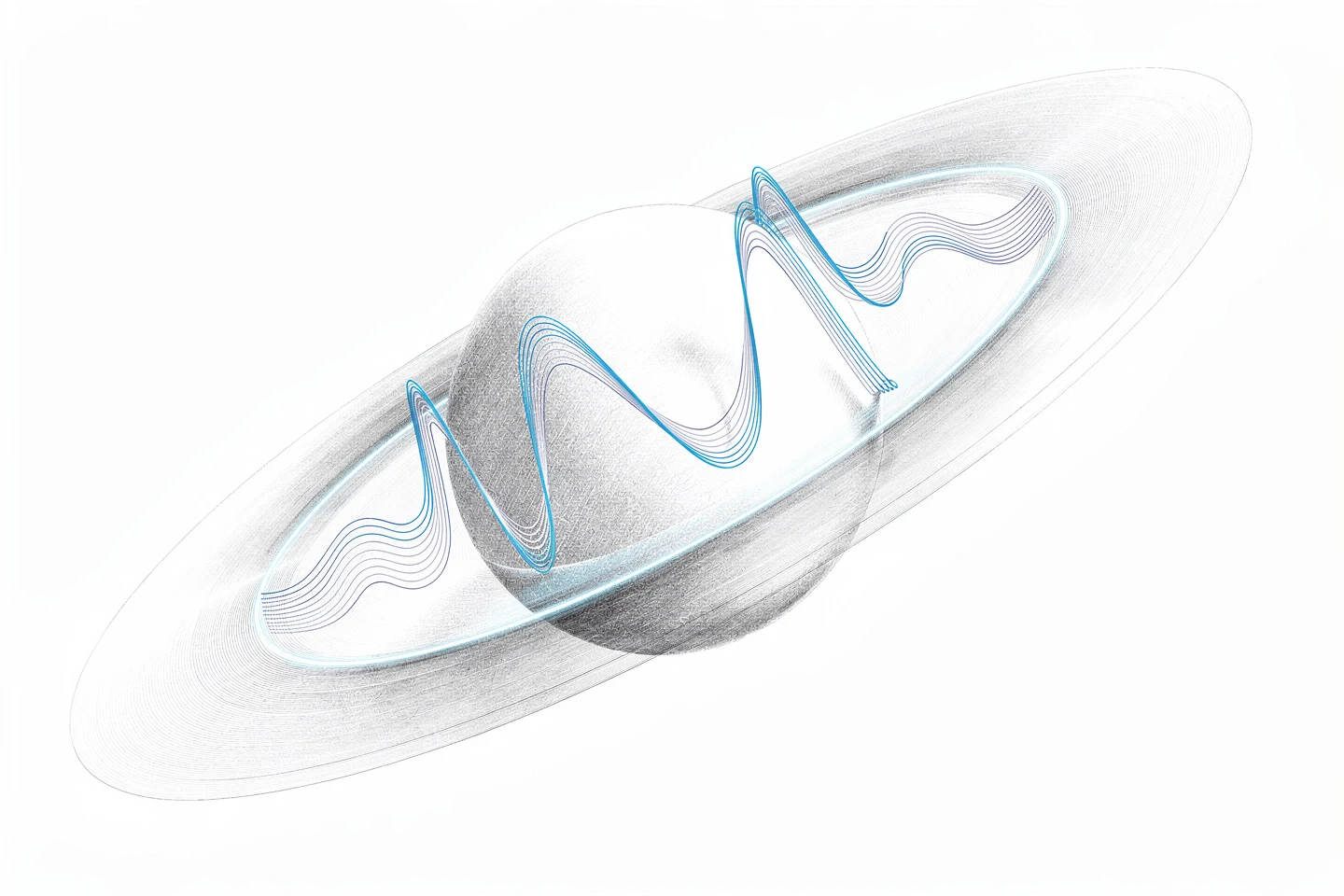
Two million years away, around the young star CI Tau, a gas-dust disk whirls — a protoplanetary cradle. ALMA observations have already shown rings and gaps in it, but the finest details remained invisible: their width is smaller than the instrument's resolution. Astrophysicists devised a way to peer beyond this limit.
The disk is tilted to the line of sight, turning it into a kind of musical instrument. Much like a bell rings at frequencies determined by its hidden shape, the brightness distribution carries 'overtones' generated by concealed structures. If a dense ring is hidden within the disk's transparent material, it creates azimuthal modulation: on the minor axis of the visible ellipse, the radiation travels a longer path, and two intensity peaks betray the ring's presence.
In ALMA images at three wavelengths, scientists indeed registered a double hump. At millimeter wavelengths, the amplitude reached 4 kelvin against a background of 13 — a tiny but distinct signal. Modeling confirmed: these are rings of optically thick dust, compressed by streaming instability. This method essentially turns the disk tilt into a multi-wavelength structure detector.
The double-peak method is not just a trick for one disk. It opens a window into the sub-diffraction world for dozens of already imaged ALMA objects. Joint analysis with data from space observatories like James Webb and Hubble will allow reconstructing a full picture: from carbon chemistry to gas dynamics. Thus, by listening to the 'sound' of light, we will be able to discern the architecture of thousands of protoplanetary systems in our Galaxy.
Each such discovery brings us closer to answering how rocky and icy clumps arise from dust. The theory of streaming instability, long awaiting observational confirmation, gains an indirect but powerful argument. And perhaps it was in such rings that the planets once formed around our Sun.
The age of CI Tau is only about two million years, so planets might be forming in this disk right now. The discovered rings are so narrow that their width is smaller than the ALMA beam size; without the azimuthal trick, they would have remained hidden forever.