Globular Clusters: A Palimpsest of Ancient Gas Clouds
Original: "Globular cluster abundance patterns inherited from giant molecular clouds"
The chemical patterns in globular clusters are not the product of stellar evolution but a legacy from inhomogeneous molecular clouds that preserve a memory of turbulent events in the early galaxy.
Links in the knowledge graph 1
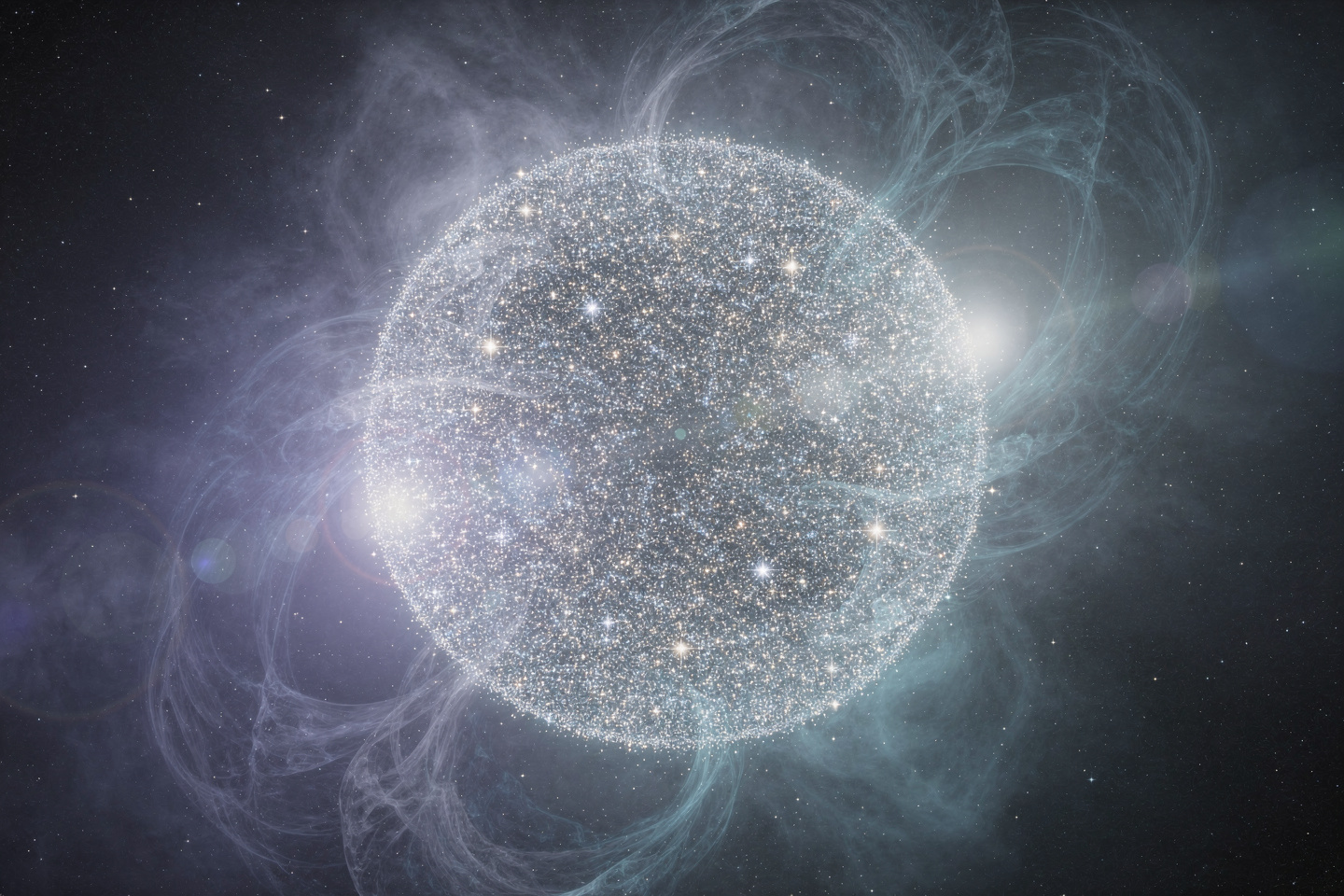
Stellar chemists have puzzled for decades: stars in globular clusters seemed to belong to two different populations, even though they were born at the same time. New research shows that the answer lies in the progenitor gas clouds, which, like a multilayered palimpsest, recorded the galaxy's history before the cluster was born. Perhaps the first galaxies formed in the same way. We are only beginning to learn how to read these ancient texts.
🎯 Globular clusters are so old that they contain virtually no elements heavier than helium produced in previous generations of stars—making them true 'time capsules' from the reionization era.
[\text{N/Fe}] \approx -0.5\,[\text{O/Fe}] + \text{const}
The observed anti-correlation between nitrogen and oxygen in globular clusters indicates that these elements came from different sources. The slope of about –0.5 reflects the balance between enrichment from supernovae (oxygen) and asymptotic giant branch stars (nitrogen).
M_{\text{загрязн}} \approx 10 \times M_{\text{скопл}}
The mass deficit problem: to pollute the second generation of stars, the first generation would need to be tens of times more massive, which doesn't match observations. The new scenario bypasses this contradiction by assuming simultaneous formation from already enriched gas.
Scientists
Alan GuthAndrei LindeGeorges LemaîtreJames PeeblesAdam RiessBrian Schmidtspectroscopy
big bang
hydrogen
dark matter
Hubble Space Telescope
speed of light
black hole
gravitational wavesLaws
Friedmann equationsHubble's lawDoppler effectHawking radiationgravitational lensingprinciple of constancy of the speed of light