The Icy Moons' Double Breath: JWST Unravels the Mystery of Uranus's Carbon Dioxide
Original: "Tracing the source of carbon oxides on the large moons of Uranus"
JWST data have, for the first time, reliably separated radiolytic and endogenous sources of carbon dioxide on four of Uranus's icy moons.
Links in the knowledge graph 1
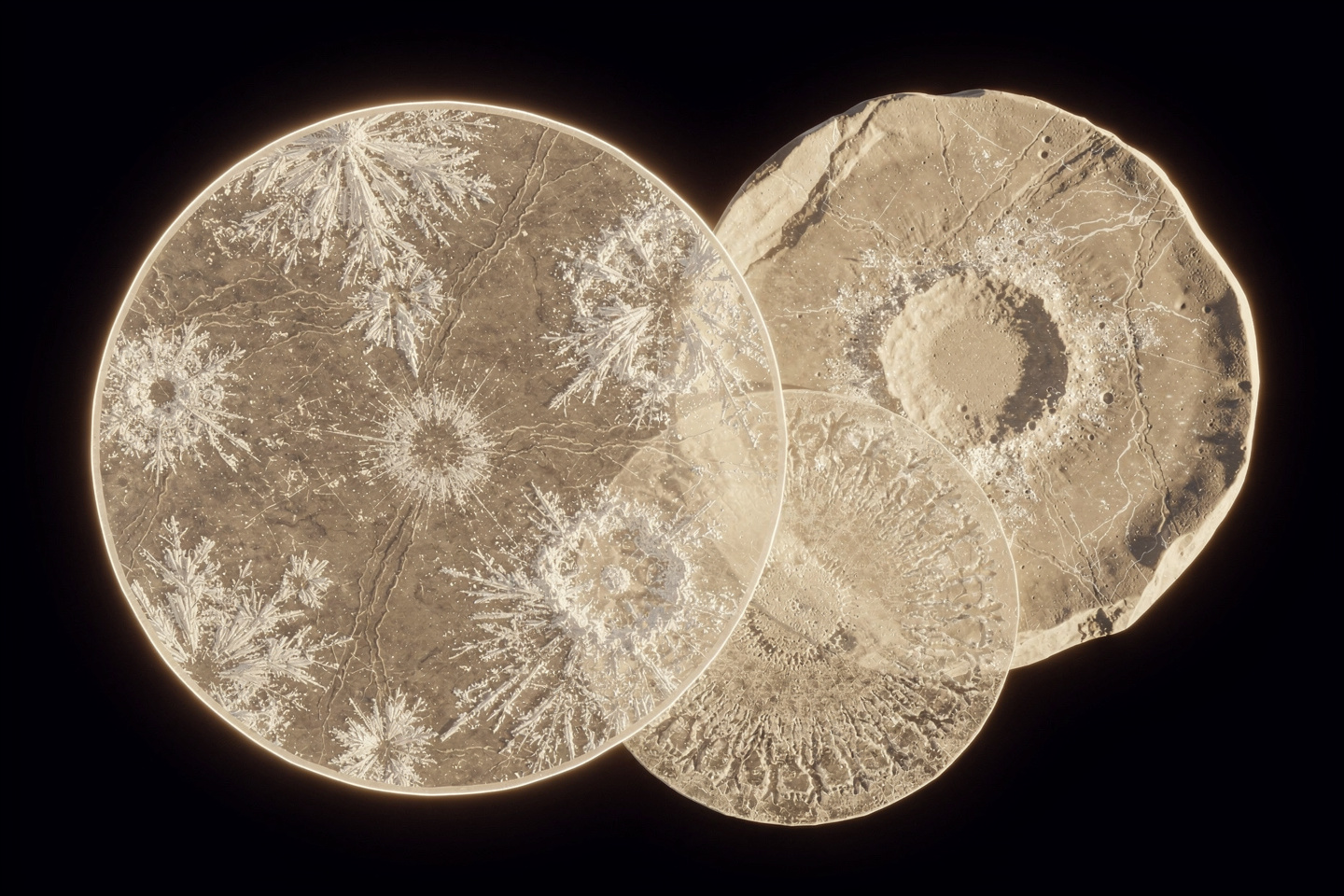
Uranus's cold moons seem frozen, but their surfaces are an arena of chemical transformation. JWST caught a dual source of carbon dioxide: external radiolysis and the breath of the interior. Like two conductors in an orchestra. Someday, a probe will land on Ariel and read the chronicle of the solar system in the layers of that ice.
🎯 If all the CO₂ from Ariel's surface were gathered into an atmosphere, its pressure would be billions of times lower than Earth's, yet its spectral signatures are visible even from 2.8 billion kilometers away.
🎬 In Arthur C. Clarke's '2010: Odyssey Two,' icy moons were seen as potential resource sources. JWST data make that scenario a bit more realistic, at least in terms of the availability of carbon dioxide.
E = \frac{hc}{\lambda}
Photon energy is inversely proportional to wavelength. For λ = 4.27 µm, E ≈ 0.29 eV—a resonance with the vibrations of the CO₂ molecule.
R = \frac{\lambda}{\Delta\lambda}
Spectral resolution shows how well an instrument distinguishes close wavelengths. R~1000 on NIRSpec made it possible to see isotopic details.