Quantum Computer Builds a Spacetime Framework from Entanglement
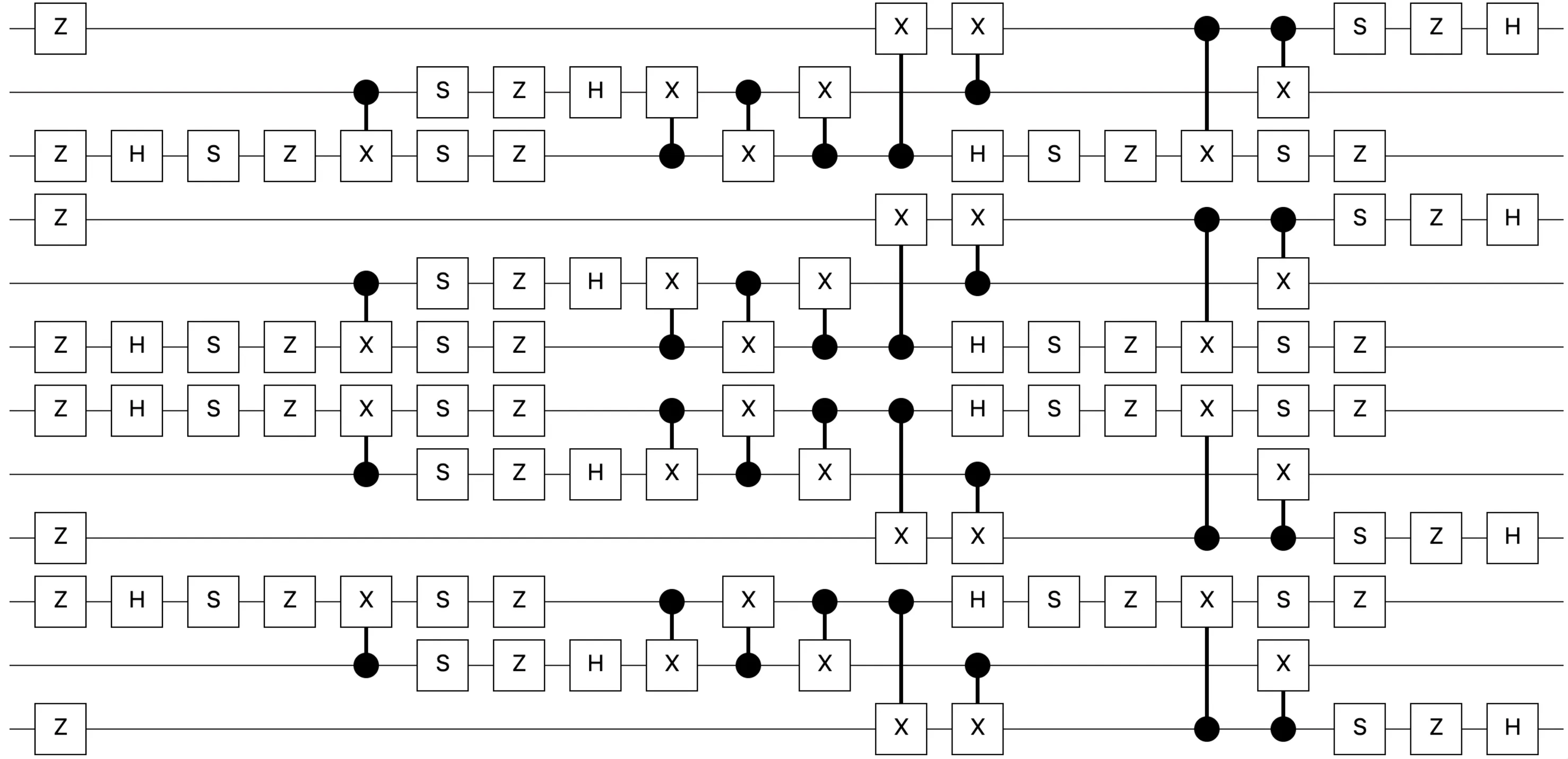
On a quantum computer with 36 ytterbium ions, a model of spacetime was built that fits into a few dozen qubits. The ions are held in a trap and controlled by laser pulses, and their states become entangled so that they form a framework resembling the beams of an invisible building. Each beam is a connection between two qubits, and the more such connections, the stronger the structure.\n\n
\n\nThe experiment tested a formula that was previously known only on paper. In the code without magic, the measured "proto-area" remained equal to two, no matter how strongly the entanglement of the interior qubits changed. This means that the boundary of the code monitors the interior with bit precision: if something changes inside, the boundary immediately updates its information, and the area does not budge.\n\nThen magic was added to the code. In the quantum world, magic is not a trick but a resource that cannot be obtained from ordinary operations, those that cover stabilizer circuits. Shifting the rotation angles of the gates by fractions of a radian activated this resource, and the proto-area began to grow along with the entanglement inside. The more magic, the steeper the slope: at the maximum value, the difference between the extreme points was about 0.2.\n\n
\n\nA second experiment connected two such codes, like two buildings with a common corridor stretched between them. The more the qubits of one code were entangled with the qubits of the other, the smaller the proto-area became. This is similar to how a bridge between two regions of space shortens when it is "stitched" with greater quantum connection. The slopes ranged from −0.17 to −0.91 depending on the size of the circuit and the amount of magic.\n\nThe result brings us back to the image of the framework: entanglement provides the beams, and magic turns them into living connections that allow the building to change shape in response to internal events. For the first time, a quantum computer has shown this in the laboratory, not in an equation.
The experiment used up to 56 two-qubit ZZ gates in a single circuit, and tomography of a three-qubit state required measuring 27 different Pauli bases, each with 2100 shots. In total, more than 10^6 measurements were performed.
The idea that spacetime may be "woven" from quantum entanglement echoes Greg Egan's novel Schild's Ladder, in which physicists discover that the vacuum has a hidden structure, as well as John Wheeler's "It from Qubit" concept, popularized in science fiction.