Gravity from quantum codes: how to catch the shadow of spacetime on an ion processor
Context
The work stands apart: there is almost no one nearby, the nearest neighbor is at a distance of 0.524, and right next to it there are zero works. The thematic group of the map is singularity, event_horizon, gravitational_potential, gravitational_singularity, but this paper is not about singularities; it is about quantum codes as toy models of holography. Neighboring works explore gravitational shadows, chameleon universes, quantum iceberg codes and other aspects of emergent gravity, but none of them implements a holographic code on real quantum hardware with a test of the FLM formula. Here, for the first time, the key relation of AdS/CFT is experimentally confirmed in a finite-dimensional quantum system, which opens the way to laboratory studies of quantum gravity.
Methods
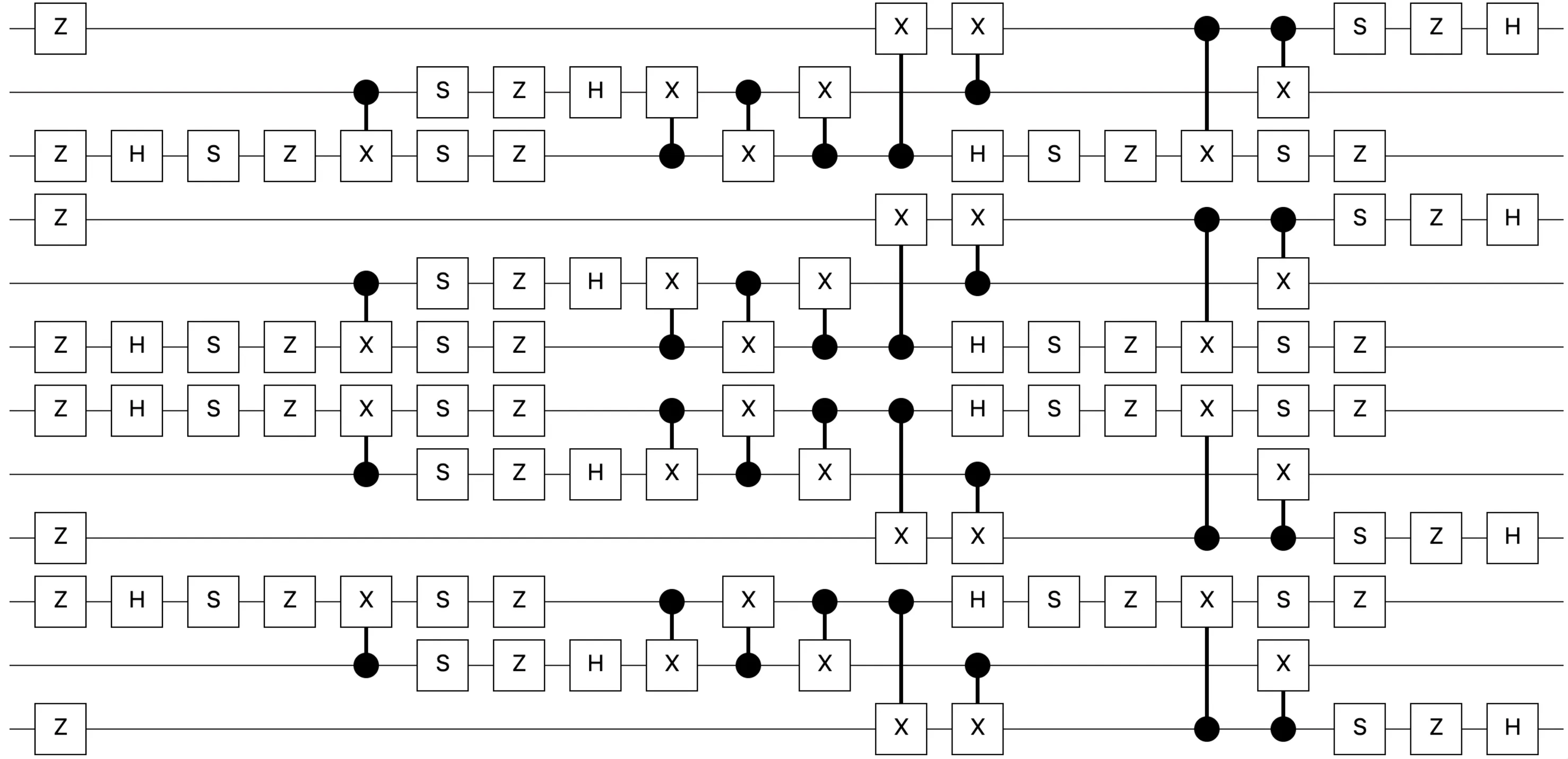
On the 36-qubit IonQ Forte ion processor, they implemented the two-layer HaPPY code [[25,11,3]], a tensor network with a hyperbolic entanglement structure that reproduces the Ryu–Takayanagi formula. To save resources, the code was reduced to [[8,2,3]] while preserving its entropic properties. The encoding circuits were translated into native gates {GPi, GPi2, ZZ}. The entanglement of the bulk qubits was varied with the angle θ in the state cosθ|00⟩+sinθ|11⟩. Entropies were extracted using quantum state tomography with maximum-likelihood estimation. "Magic" (non-stabilizerness) was introduced by shifting the rotation angles of the gates away from their Clifford values by λ radians. In the two-copy experiment, the logical qubits of two codes were entangled and the proto-area of the combined boundary region was measured.
Results
In the stabilizer limit (M=0), the measured proto-area S_PA = S_B − S_b remained constant (equal to 2) as θ varied from 0 to π/4, which confirms the FLM formula: the boundary entropy grows exactly as much as the bulk entropy grows, while the "area" does not change. When magic was added (M=2.23 and 5.79), S_PA began to grow with θ, and the slope increased with magic: for M=5.79 the difference S_PA(π/4)−S_PA(0) was about 0.2 (according to data with optimal recovery, 0.108). In the two-copy experiments (2×[[5,1,3]] and 2×[[8,2,3]]) with magic, S_PA decreased as the inter-code entanglement grew: the slopes of linear fits were −0.17±0.06, −0.31±0.05, −0.37±0.05 for M=0, 1.51, 4.63 in the 10-qubit version and −0.35±0.06, −0.91±0.06 for M=0, 1.95 in the 16-qubit version. This agrees with the intuition that the wormhole shortens as entanglement increases.
Implications
The work differs from its neighbors in that it is the first to move holographic codes from paper to a real quantum device and to test the FLM formula, rather than only the RT formula without quantum corrections (as in the 2019 NMR experiment). In addition, it introduces "magic" as a controllable parameter that turns on the dependence of geometry on the state, an effect absent in purely stabilizer models. This is the first experimental demonstration that non-Clifford resources are necessary for gravitational backreaction, as recent theoretical work predicted. The two-copy construction hints at emergent connectivity, but without a rigorous gravitational dual, which stimulates theory.
Future development
The topic can develop toward scaling: increasing the number of qubits and gate fidelity will allow researchers to approach the regime where semiclassical geometry emerges. More efficient tomography methods (for example, near-stabilizer tomography) will be needed to circumvent the exponential growth in cost. It would also be interesting to study the phase transition of geodesics in two-copy systems at large N, where the crossover may sharpen into a true phase transition. Dynamical schemes in which geometry is extracted from correlation functions without tomography could lower the resource requirements.
Impact
The experiment will influence quantum gravity, quantum information theory and quantum computing: it provides a testbed for checking hypotheses about the emergence of spacetime and the role of magic in gravity.
Next steps
The immediate steps include developing resource-efficient tomography for large codes, optimizing recovery without architecture constraints, and studying multi-copy constructions in search of phase transitions.
Key open problems
The work is directly connected to the unsolved problem of unifying quantum mechanics and general relativity: it provides a finite-dimensional model in which one can test how geometry emerges from entanglement. In quantum information, it raises the question of which resources (besides entanglement) are necessary for emergent gravity, and points to non-Clifford "magic" as a key ingredient. For quantum computing, it stimulates the development of tomography and recovery methods that can scale to hundreds of qubits.
The experiment used up to 56 two-qubit ZZ gates in a single circuit, and tomography of a three-qubit state required measuring 27 different Pauli bases, each with 2100 shots. In total, more than 10^6 measurements were performed.
The idea that spacetime may be "woven" from quantum entanglement echoes Greg Egan's novel Schild's Ladder, in which physicists discover that the vacuum has a hidden structure, as well as John Wheeler's "It from Qubit" concept, popularized in science fiction.
Key numbers
- qubits in the full HaPPY code: 25 physical, 11 logical
- qubits in the reduced scheme: 8 physical, 2 logical
- maximum number of ZZ gates in the circuit: 56
- two-qubit gate fidelity: 0.996 (stochastic angle error ~0.117–0.127 rad)
- number of shots per Pauli basis: from 1000 to 2100