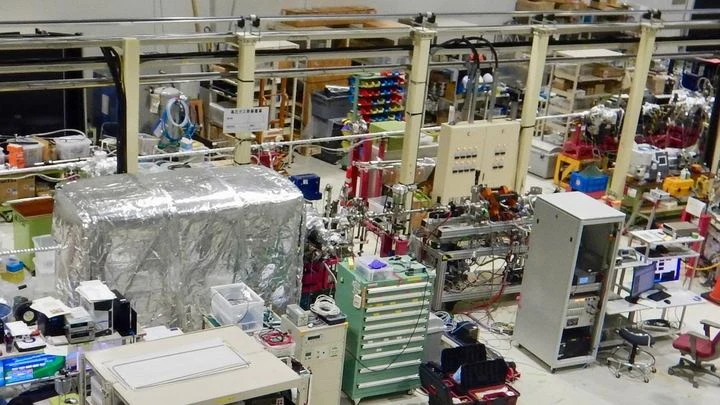
Ytterbium is a chemical element with atomic number 70, a soft, silvery metal that belongs to the lanthanide series. In physics, it is prized for its atomic properties, which make it an ideal candidate for precision spectroscopy. Its electronic structure offers narrow optical transitions that can be used to create highly stable frequency references, making it a cornerstone in the development of next-generation atomic clocks and quantum sensors.
History
Ytterbium was discovered in 1878 by Swiss chemist Jean-Charles Galissard de Marignac, who found it as an impurity in the mineral erbia. Its name derives from the Swedish village of Ytterby, where the mineral was first found.
How it works
The key to ytterbium's utility lies in its two valence electrons and the existence of ultra-narrow optical transitions between certain energy levels. By trapping ytterbium atoms in optical lattices or ion traps and cooling them to microkelvin temperatures, researchers can probe these transitions with laser light. The resulting frequency is so stable that it can serve as a 'ticking' standard, with the atom's quantum state acting as a pendulum that is virtually immune to environmental disturbances.
In practice
Ytterbium is used in optical atomic clocks, which are so precise they would lose only one second in 30 billion years, and in quantum computing experiments as a qubit platform.
Fun fact
Ytterbium atoms can be so precisely controlled that they are used to test fundamental physics, such as whether the constants of nature change over time.
In the layered crystal CrSBr, the magnetic moments of atoms are arranged like notes in a score: within each layer they point in the same direction, but between layers they point in opposite directions. This antiferromagnetic melody plays up to 132 kelvin, beyond which thermal motion destroys the order.
No one has ever seen dark matter, but it should pass through detectors like wind through leaves. Sometimes, very rarely, a dark matter particle bumps into an atomic nucleus, and then the detector must catch that jolt. The trouble is that light dark matter particles can hardly move heavy nuclei: it's like trying to knock down a bowling pin by throwing a feather at it.
The quantum world is full of transformations. Sometimes a system made of one type of particle starts behaving as if it harbors completely different ones. For example, in a chain of bosons, sociable particles that like to crowd into the same state, fermions from the Standard Model may unexpectedly appear, even though they usually keep to themselves.
A pendulum that swings almost half a quadrillion times per second. This isn't mechanics: it's the pulse of light trapped by ytterbium atoms. Instead of gears, there's an optical lattice — a standing wave that holds atoms at its nodes like peas in a pod.
The most precise modern clocks count time by the oscillations of electrons in atoms. But their rhythm can be thrown off, like a mechanical watch's spring gets jolted by shaking. Physicists found a more reliable pendulum: the atomic nucleus.
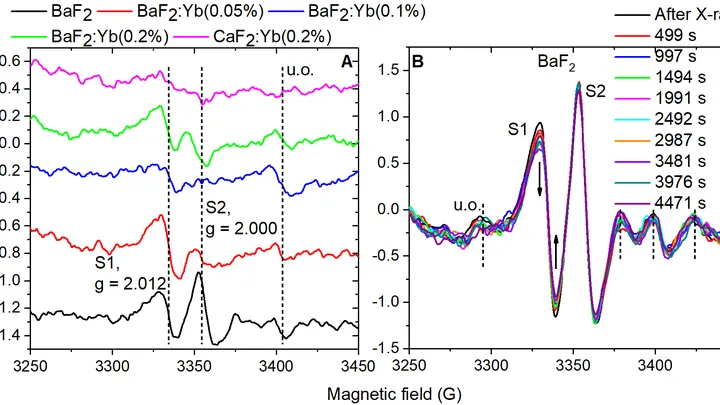
Light passing through a transparent crystal can subtly change color. That's how many lasers work: a tiny addition of a rare-earth metal makes the crystal glow. But the same metal behaves differently in different crystals, and physicists have studied this quirk using ytterbium.
An ordinary kitchen knife made of niobium would suddenly start conducting electricity with zero loss at −258 °C. That's how superconductivity works, and you can "switch it on" right at the metal's surface by blasting it with a laser in a nitrogen atmosphere.
When two neutron stars collide, a kilonova is born — a cosmic explosion that shines not only from heat but also from the decay of freshly created heavy elements. Among them is neodymium, a rare-earth metal that hides in minerals deep within the Earth, but in space, for a brief time, becomes the main conductor of light.
The radioactive isotope terbium-149 acts like a tiny homing bomb: it latches onto cancer cells and detonates with alpha particles that destroy the tumor from within, barely touching healthy tissue. But this bomb has a quirk: it also glows with positrons, and that glow can be captured by a special camera.
Snapping an atom is like photographing a startled butterfly without scaring it off. Scientists use two alternating beams: one holds, the other cools like a gentle breeze. This reduces entropy (the atom's jitter) and chills them to millionths of a degree above absolute zero — colder than deep space.
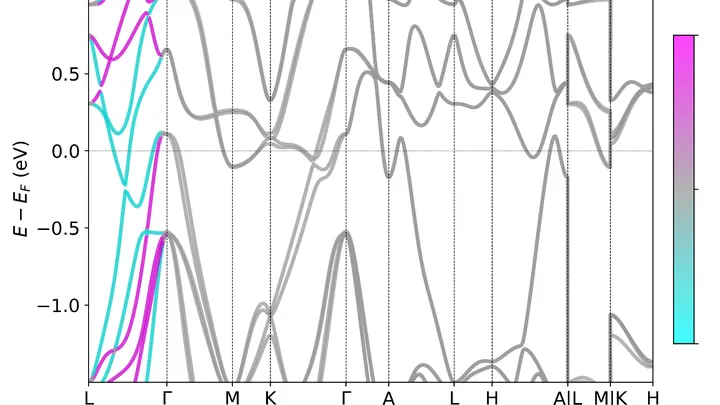
Electrons in a CrSb crystal behave like a school of fish: inside the material, they dart along their "corridors," and at the boundary with vacuum, they arrange themselves into intricate patterns. These patterns are the Fermi surface — a map of all allowed electron velocities. You can't reach out and touch it, but you can "feel" it with a magnetic field.
A tiny cloud of 300,000 ytterbium atoms, cooled to near absolute zero, was shuttled along a light track 34 centimeters long, like transporting a fragile cargo over a bumpy road without shaking it apart.
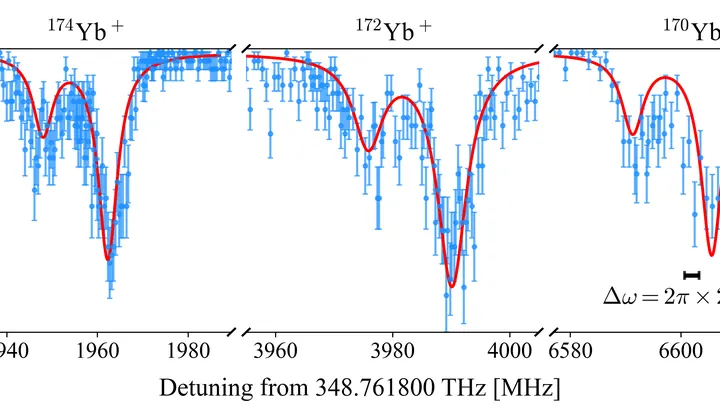
The light an atom emits or absorbs is like a fingerprint: each element has its own pattern of lines. In an ytterbium ion (an atom that has lost one electron), researchers have found three new lines that were previously unused. These lines are very narrow, like thin slits in a fence that let you see far and clearly.
The helium in a party balloon is the very gas that makes it float. But long before balloons, helium appeared in the first minutes after the Big Bang. Its exact abundance in the universe is like a fingerprint: it tells you how many kinds of neutrinos (ghostly particles that pass through walls) exist.
A thermometer that doesn't lie for years. Ordinary resistance thermometers, even very accurate ones, start to err over time: the material ages, contacts oxidize, and readings drift. The new quantum thermometer works differently: it uses the rubidium atoms themselves as a reference.
An X-ray telescope captures light from hot gas around stars, but that light arrives 'blurred'—like a voice over a bad phone line. To make out the words, you need a dictionary of the exact frequencies at which atoms glow. Such a dictionary is written not only with calculations but also with direct experiments.
A tiny magnet made of layers of sulfur, chromium, and bromine sits on a microscope stage. Inside it, like unexpected guests, sit erbium atoms — a rare-earth metal. These atoms can glow when hit with a laser, and their light tells us what's happening around them.
Every atom has its own 'voice'—the frequency of light it emits. For isotopes, atoms with different numbers of neutrons, the voices differ slightly. It's like a choir: if you know the score precisely, the slightest false note reveals external interference. The King plot is a way to compare how harmoniously two notes from different isotopes sing together.
A thin film of thorium dioxide, just 10 nanometers thick, is deposited on a steel disk. A laser pulse strikes it, but instead of the expected glow, the detector catches a stream of electrons.