Holography is a technique that records and reconstructs the complete light wave scattered from an object, including both its amplitude and phase, by capturing the interference pattern between the object wave and a reference wave. Unlike a photograph, which only stores intensity, a hologram stores the full wavefront, allowing a three-dimensional image to be recreated when illuminated appropriately. This makes holography a powerful tool for imaging, data storage, and even sensing, as it can capture subtle changes in the shape or position of an object.
History
Holography was invented in 1947 by Dennis Gabor, who was working on improving electron microscopy. His work earned him the Nobel Prize in Physics in 1971, though practical holography only became possible after the invention of the laser in the 1960s.
How it works
A laser beam is split into two paths: one illuminates the object (object beam) and the other goes directly to a recording medium (reference beam). The two beams overlap on the medium, creating an interference pattern of bright and dark fringes that encodes the phase difference between them. When the developed hologram is later illuminated with the reference beam alone, the recorded pattern diffracts the light, reconstructing the original object wave — a perfect 3D replica of the object's light field.
In practice
Holography is used in security features on credit cards and banknotes, in high-capacity optical data storage, in interferometric testing of optical components, and in medical imaging techniques like digital holographic microscopy.
Fun fact
The word 'hologram' comes from the Greek words 'holos' (whole) and 'gramma' (message), meaning 'whole message', because it captures the entire light field, not just a flat image.
A deck of cards in which each card is slightly rotated cannot lie flat: the backs and faces will never align. But if the cards are flexible, they will start to adjust, shifting by fractions of a millimeter to find the perfect match. Something similar happens inside crystals when two thick layers of MoS2 or MoS2 with WS2 are stacked with a twist of 1–2 degrees.
The laser beam in an optical tweezer is not just a spot of light but a force bag. A particle caught in it usually rolls toward the brightest point, like a ball into a dimple.
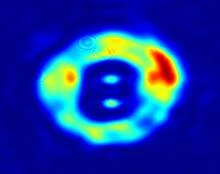
In 2019, the world saw the first image of a black hole's shadow — an orange doughnut on a black background, becoming a symbol of scientific progress. But this image wasn't captured by a camera: it was born from mathematical alchemy, where data from eight radio telescopes, which gathered only crumbs of signal, merged into a single picture.
If you clap your hands in an empty room, the echo will tell you about its size and shape. Every object (a chair, a book, a person) adds its own signature to this echo: sound reflects off it in a particular way. The authors of the paper have figured out how to completely rewrite this acoustic signature. They surrounded a region of space with a closed surface of microphones and loudspeakers.
A thrown stone follows a smooth arc: its path is easy to predict. But if the stone skips across water, the trajectory becomes jagged and far more interesting. Quantum particles behave much the same way when their state is not a calm wave with fixed energy but a turbulent mix of several waves at once.
In a benzene molecule, electrons buzz around the nuclei like a swarm of bees around a hive. But this swarm doesn't just hum: it pulses: every 856 attoseconds, the electron cloud completes a full oscillation cycle. The hive itself, the carbon nuclei, rocks more slowly, with a period of 36 femtoseconds.
Ultrasound penetrates bone like sunlight through frosted glass, but the image comes out blurry. The skull is uneven and dense, scattering sound waves, so hitting a precise spot in the brain is tricky. Conventional devices try to fix this with electronics, but the result is still far from perfect.
A conventional lidar is like an artist who paints a landscape but sees only gray shadows. It measures distances to each point accurately, but can't tell whether it's looking at rock, wood, or plastic. To learn the composition, you need a spectrometer — a separate device that works slowly and can't keep up with a fast scanner.
The new system takes a different approach.
An ordinary sheet of paper looks white because it scatters all light rays chaotically. But a butterfly's wing shimmers blue and green without a drop of paint: its surface is covered with microscopic grooves that dampen some light waves and amplify others. Engineers have long dreamed of replicating this trick: creating a material that colors itself simply by trapping light in the right places.
A flashlight beam in fog breaks into thousands of faint specks. Each speck is light that has bounced off countless water droplets before reaching your eye. To make sense of this mess, physicists construct a special table — the scattering matrix. It records how each incoming ray turns into a set of outgoing ones.
A river flows in one direction, but a wave on its surface travels in the opposite direction. The same splitting happens in hyperbolic materials: the energy of a light wave and its fronts diverge, preventing a sharp lens from being created.
A glass marble in a glass of water is nearly invisible, but if you look through it at a checkered tablecloth, the lines behind it appear distorted. Transparent cells behave the same way: light passes through them but is slightly slowed and changes direction.
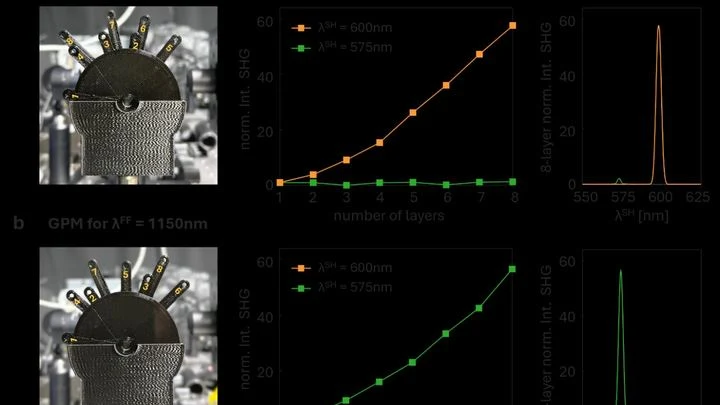
When two light beams meet in a crystal, they can generate a third beam with a different frequency. For this process to be efficient, the waves need to stay in step, like two people walking side by side without breaking stride. Previously, two old tricks were used: either picking a crystal with the right properties, or slicing it into thin layers.
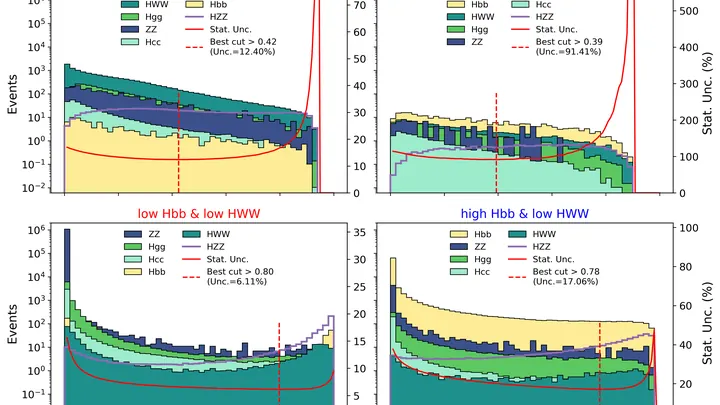
The Higgs boson lives an unimaginably short life — less than a billionth of a second. It cannot be caught directly, so physicists look at what remains after its decay: jets of particles, muons, neutrinos. But some information is lost if you consider only the explicit decay traces rather than the whole event.
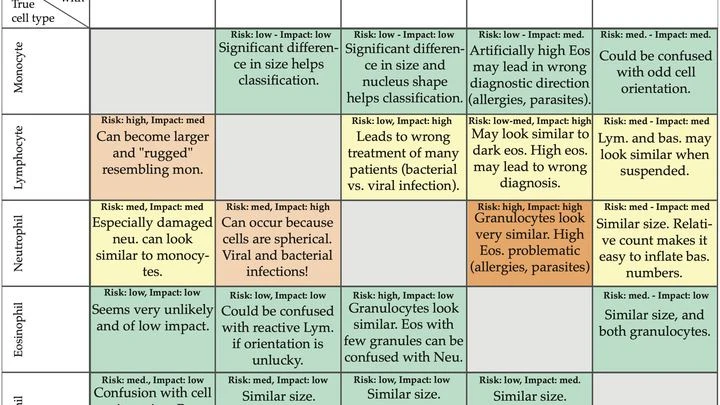
A drop of blood lands on a tiny sensor, and within a minute the doctor knows how many different defenders are in it. That's the future of blood testing, brought closer by Danish engineers.
Instead of a regular microscope with lenses, they built a lensless device. A cell flows over the sensor, which records a pattern of dark and light rings — a hologram.
Infrared light with a wavelength of about three micrometers is the working range for identifying molecules: each molecule absorbs light at its own characteristic frequencies, leaving behind "fingerprints." But until now, instruments for this range could not simultaneously provide broad frequency coverage, sufficient power, and…
Quantum light is not just a stream of particles but an intricate pattern woven from space and time. A single photon can be stretched, squeezed, smeared across different directions.
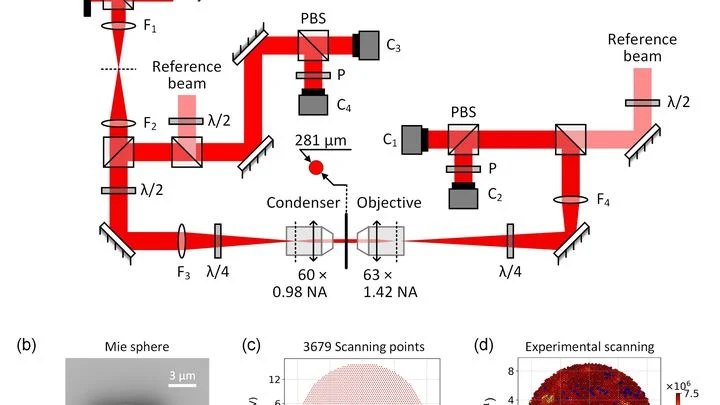
In a dark room, on a table, sit a laser pointer, a piece of glass with tissue, and an ordinary phone camera. Light passes through the sample, and the image shows not cells but a pattern of bright and dark stripes, like the shadow of leaves on a wall.
A typical 3D printer squeezes out plastic like a pastry chef piping cream from a bag. Here, instead of plastic, it's light. A laser beam draws in liquid resin, making it solidify at precise points. This creates parts too small to see without a microscope.
Until now, such printers were slow: the beam crawled across the surface like a pen on paper.
A flashlight beam in fog draws a cone, but it can't carve a figure out of a cloud. A hologram, though, is like a stencil for light: it knows in advance where to gather into bright points and where to remain shadow. Now such a stencil makes liquid resin solidify throughout the entire volume at once, without layer-by-layer printing.
Light is like a many-voiced choir: color, direction of oscillation, and instantaneous changes all intertwine. An ordinary camera hears only one voice, while the rest are lost. Scientists have built a camera that listens to the entire choir at once, and from a single image understands what is happening.
As light passes through a patterned plate, it folds inside a transparent liquid into a three-dimensional pattern. Where the light is brighter, the resin hardens. After 7.5 seconds, a finished part is lifted out of the liquid — complete with cavities, channels, and tiny protrusions.
A regular 3D printer prints point by point or layer by layer.
A laser hits tissue, and the tissue responds with a barely audible click — a sound wave. Sensors pick it up, and from that, an image of what's inside is built. That's how photoacoustic imaging works: light reaches deep, and sound carries the picture out.
In the new scheme, there are no sensors. Instead, several thin light beams are sent through the area where the wave has passed.
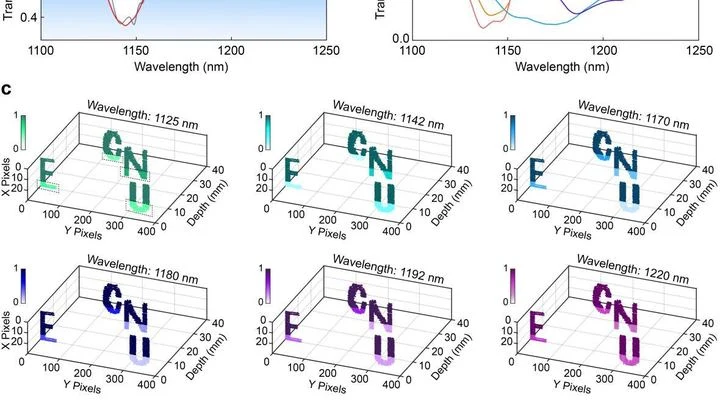
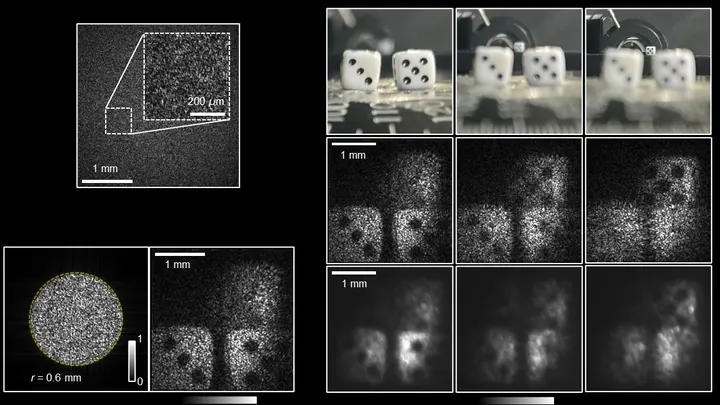
Shine a flashlight through rough glass, and the wall lights up with a speckled pattern of bright and dark dots. Once dismissed as useless noise, this pattern now serves as the key to reconstructing 3D images.
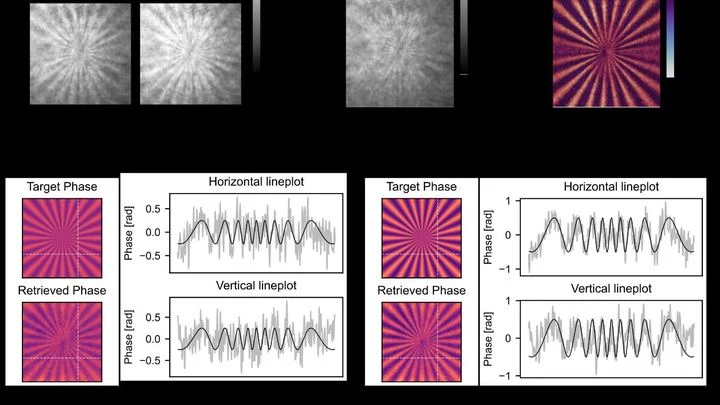
In the new system, light from an object passes through a specially designed plate with known irregularities.
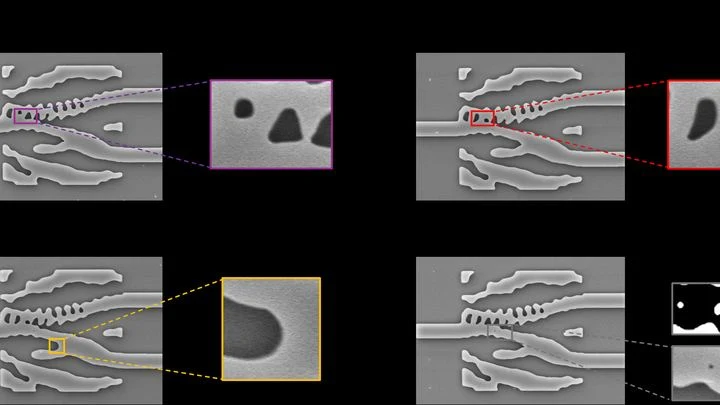
Modern computer algorithms design photonic integrated circuits — light chips capable of separating signals by frequency (color) for spectroscopy. Unlike traditional engineering, light paths in these chips are not straight waveguides but chaotic, almost organic mazes.
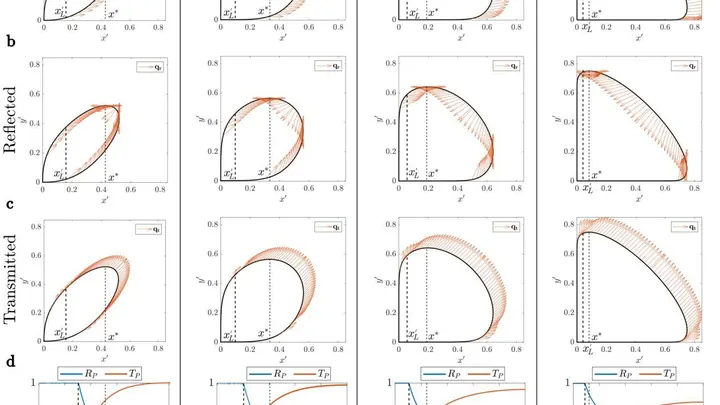
A black hole is not just the universe's trash can; it is more like a safe with a secret code. For decades, it was thought that any signal sent toward the event horizon would be partially reflected back: curved spacetime acts like a funhouse mirror, and some energy always escapes.
When light passes through biological tissue or frosted glass, it scatters and loses the image. Researchers at the Paris Institute of Nanosciences have shown that a scattering medium can be tuned to transmit images encoded in the correlations of entangled photons while remaining opaque to classical light.
Light is a finicky guest. It flies into a cavity but doesn't stay: part of the pulse inevitably reflects and carries away quantum information. Classical single-pass capture schemes hit this limit no matter how much you improve control. Reflection was considered a loss, but the authors of a new study suggest looking at it differently.
Two images of the same place: one taken in the morning from a drone, the other in the evening from a satellite. The first shows shadows from trees, the second shows glints on the water. It's like two accounts of the same event in different dialects: the words are similar, but the grammar is different.