The CPT theorem states that any Lorentz-invariant quantum field theory is invariant under the combined operations of charge conjugation, parity, and time reversal.
The CPT theorem is one of the cornerstones of modern quantum field theory. Its origins lie in the works of Julian Schwinger, Wolfgang Pauli, and Gerhart Lüders, who in the 1950s showed that the combination of three discrete symmetries must be an exact symmetry of any local relativistic field. Later, John Stewart Bell and others gave more general proofs. Despite the fact that weak interactions violate both parity (P) and charge conjugation (C), and even the CP combination, CPT remains unbroken — so far not a single experimental hint of its violation has been found.
History
The theorem was gradually formulated in the 1950s. In 1951, Julian Schwinger showed the connection between CPT and spin-statistics. In 1954, Gerhart Lüders derived CPT invariance within the general approach of quantum field theory. Wolfgang Pauli in 1955 proposed the famous proof and gave the theorem its name. John Stewart Bell in the 1960s generalized the results. Since then, the CPT theorem has been tested in experiments with the highest precision, for example, in antihydrogen experiments at CERN.
How it works
CPT invariance is used for classifying elementary particles and predicting properties of their antipartners. In accelerators, when particle-antiparticle pairs are created, CPT guarantees strict kinematic relations. Experimental limits on CPT violation are ultrasensitive: the relative mass difference between K0-meson and its antiparticle is less than 10^-18. Limits of applicability — within Lorentz-invariant quantum field theory; in theories with Lorentz invariance violation (for example, quantum gravity) CPT may be violated.
In practice
Guarantees that any particle has an antiparticle with exactly the same mass and lifetime; without this theorem, there would be no predictions of antimatter properties.
Fun fact
If CPT symmetry were violated even slightly, particles and antiparticles could have slightly different masses, which might explain why there is much more matter than antimatter in the Universe. But so far all measurements show complete symmetry.
Picture a wind map over a mountain range. The wind mostly blows downhill, following elevation changes. But if you look closely, in some valleys the air swirls into little eddies that keep the wind from simply flowing down. That is exactly what the mutation field in human DNA looks like.
A sheet of paper left on a wet table warps and lifts its edges. No one controls that motion, but it follows the same laws as plant growth: some areas of the sheet shrink more than others, and the flat form becomes three-dimensional. Engineers have long dreamed of taming this process so that a flat blank folds itself into a desired sculpture. In the new work, that trick succeeded with accuracy down to one percent.
Dancers on a stage with moving walls: particles in a finite quantum system collide with each other and reflect off the edges, but the walls can move according to a prescribed scenario. Physicists have long been able to describe such dances only with fixed walls or in an infinite hall. Now there is a way to account for both the motion of the walls and the reflections from them.
Imagine an interferometer as a giant ear listening to the radio whisper of a distant galaxy. Three antennas spread across continents capture the signal, and the difference in their phases combines into a quantity that is immune to atmospheric jitter. This quantity is called the closure phase.
A stone thrown at a wall bounces off. In the quantum world, a particle can pass right through, as if the wall were woven from mist. This is quantum tunneling: it lights up stars, works in microchips, and even operates in the cells of our bodies. But most particles have spin — an intrinsic rotation, like a spinning top.
In the first moments after the Big Bang, matter and antimatter were almost equally abundant. But something tipped the balance, leaving only a tiny excess of ordinary particles — the very excess that makes up stars, planets, and ourselves.
Electric charge is a slippery thing. You can measure how much there is in the entire universe or in a single particle, but try to point your finger and say, 'Right here, in this cubic centimeter, there is exactly this much charge right now,' and you hit a fundamental wall.
The issue is that total charge, which physicists denote by the letter Q, is nonlocal.
The quantum networks of the future resemble the Tower of Babel: each node speaks its own dialect. Some store information in the polarization of a photon — the direction of oscillation of the light wave. Others use time bins: that is, when exactly the pulse arrives.
Clocks in the Universe are tricky things. Usually, in calculations of the birth of the world, a special scalar field plays the role of a clock — something like an invisible fluid filling all of space. It ticks, and physicists watch how the world changes relative to that ticking. But these clocks are man-made, introduced for convenience.
The authors of the new work took a different path.
The early universe grew at a terrifying speed — inflating to gigantic proportions in a tiny fraction of a second. Physicists describe this burst with a single number: the exponent in a formula that resembles the steepness of a hill. The steeper the hill, the faster the ball rolls down: that is, the more rapidly space expanded.
The Standard Model of particle physics is a catalog of all known building blocks of the universe: electrons, quarks, and others. But it is silent about dark matter and doesn't get along with gravity.
Gravity in our world is curved spacetime. That's how Einstein's general theory of relativity describes it. But what happens to gravity at the level of atoms and particles, where quantum mechanics rules? This question has remained unanswered for nearly a century.
Quantum chromodynamics is the theory that describes how quarks and gluons assemble into protons and neutrons. In its equations, there is a strange angle, the parameter θ (theta).
Two synchronized swimmers dive into the sea. One hits calm water, the other a whirlpool. Their movements, perfectly coordinated at the start, diverge. Something similar happens to two quantum particles when one moves in flat space and the other in curved space.
In quantum physics, there are theories where everything follows clear proportions, like a musical rhythm that always returns to the beginning of the bar. But there are also 'irrational' theories where the rhythm breaks and predicting the next beat is nearly impossible. One such theory is the compactified boson: a particle lives on a circle, and its behavior depends on the radius of that circle.
Quantum entanglement often behaves like a synchronized dance visible from only one angle. Change the way you observe it, and the particles appear disconnected. This limits secure communications. Now physicists have created a pair of photons whose 'dance' is flawless from all perspectives.
Building a house on sand is a bad idea. In physics, it was long believed that a quantum theory of gravity could not be built on a fixed "sand"—a pre-existing spacetime.
The expansion of the universe is like an inflating balloon: galaxies recede from each other, and space itself stretches. In such a picture, known as de Sitter space, there is a special point of view: an observer sees only a part of the world, bounded by a horizon beyond which light cannot penetrate.
Quantum electrodynamics, or QED, describes how light interacts with charged particles — for example, electrons. It is one of the most precise theories in history: its predictions match experiment to the eleventh decimal place.
The river of time may not be a smooth flow but a sequence of minuscule steps, like a stop-motion film shot with an unimaginably fast camera. In 1964, Yu. A. Golfand suggested that time moves not continuously but in tiny jumps, and derived an equation that predicted an inevitable increase in disorder (entropy).
A builder checks the strength of an arch not by running through all possible shapes in their head, but by mentally nudging it and seeing how much force is expended. That's essentially how the principle of virtual work works in mechanics. The authors of a new study have applied this approach to the very geometry of spacetime.
They constructed a covariant framework of virtual work for the metric.
A black hole is like a spinning top: the faster it spins, the more noticeable its behavior. It has two boundaries — the outer and inner horizons, the edges beyond which even light cannot return. In the new work, physicists looked inside a rotating charged black hole and multiplied the areas of these two surfaces.
Gravity seems simple: it keeps us on the ground and makes planets orbit. But if it were classical (described by Einstein's equations as the curvature of spacetime, while all matter follows the quantum laws of the Standard Model) then an ordinary quantum bit (qubit) falling freely…
A kitchen sponge soaked in syrup: in some spots there's more syrup, and your finger sticks right away; in others, it barely touches. That's roughly how a catalyst surface works. Molecules don't react everywhere but at especially sticky points — active sites.
Some solutions to Einstein's equations allow closed timelike curves — loops that let you travel to the past. Two well-known designs, the Ori geometry and the Ahmed geometry, do without exotic matter, catching physicists' eyes.
The quantum world is known for uncertainties: for example, you can't measure a particle's position and its speed at the same time. But new research shows that in a 'fuzzy' spacetime, even probability itself — the measure of chance — loses sharpness. A foggy compass doesn't give an exact direction: its needle wavers.
The deepest equations of physics, like the Wheeler–DeWitt equation, contain no time. Past and future are scrambled within them, like frames on a film reel with no arrow indicating which way to play it. This symmetry is not a flaw but a feature.
A translator gets distracted by every rustle in the hall, and a one-hour meeting stretches into two. That's roughly how ordinary quantum mechanics works: a particle evolves in time, while space serves as the stage. But what if we swapped their roles? Then the particle 'moves' through space, and time becomes a static backdrop.
Ever since Paul Dirac theoretically predicted antimatter, physicists have been hunting for the tiniest differences between particles and their antiparticles.
Two entangled photons fly apart in opposite directions but continue to behave as a single whole: measuring one instantly determines the state of the other. That's quantum entanglement. But sometimes it resembles a seasoned spy — leaving no traces detectable by ordinary checks.
Throw a stone into a pond, and ripples spread across the water. Throw two stones nearby, and the ripples intersect, creating a pattern of reinforced and canceled waves. That's interference.
Inside every cell, life is bustling: tiny protein machines tirelessly haul cargo, read genes, and fix errors. But their work is far from perfect: they often 'spin their wheels,' take backward steps, or get stuck in futile cycles. It's like a city traffic jam where cars dart around aimlessly, burning fuel.
An ice cube in a glass of water doesn't just float: it gets pushed. Water molecules bombard it from all sides, and this bombardment gives rise to a force you can measure. In physics, there's a similar force, but it acts not on ice but on anything with mass, and it arises not from molecular jostling but from information. It's called entropic force.
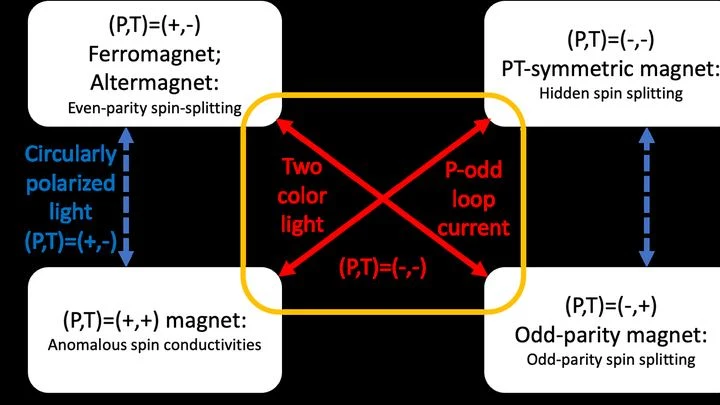
In a piece of ordinary magnet, all electron spins, tiny magnetic arrows, point in the same direction. It's a formation of soldiers facing their commander. This order is called a collinear altermagnet.
A tailor cuts a suit, but the seams pucker and the buttons won't align. In quantum field theory, similar glitches are called anomalies: they appear when a symmetry of the equations breaks down in the transition to a quantum description. Usually, they are fixed by sewing in extra patches, the so-called Bardeen–Wess–Zumino counterterms.
Vacuum is not silent emptiness, but a boiling cauldron of quantum fluctuations, born from nothing and vanishing in billionths of a second. This invisible symphony acts like a constant wind, pressing an atom against a wall — as if a powerful bass note pushes a light ball.
A stone drops into a pond. Ripples spread, fade, and soon the surface is smooth again. But what if the pond has no shores, no bottom, and no characteristic ripple size? That is the world, a scale-free world, where quantum systems live when surrounded by an environment that picks out no particular length or energy.
At the Large Hadron Collider, protons collide, and from the flash dozens of particles are born. Among them may be traces of rare processes — for example, the decay of a Standard Model Higgs boson into two W bosons. But these particles fly apart so quickly that their tracks merge into a single wide jet.
The quantum world loves order, but reality often brings disorder. In this work, physicists study one-dimensional chains of spins — tiny magnetic arrows that can point up or down. Usually, topological phases (stable states protected by symmetry) are defined for pure states, where each arrow is precisely known.
The universe wasn't born alone — alongside it came a mirror twin where everything is reversed: left and right are swapped and time flows from future to past. After the Big Bang, the world, according to Alan Guth's idea of superfast inflation, should have contained equal amounts of matter and antimatter.