A topological quantum code is a type of quantum error-correcting code that encodes information in the global, topological properties of a physical system, such as the braiding of anyonic excitations on a lattice. Unlike local codes, these codes are inherently robust against local perturbations because errors must create non-local excitations to cause logical failures. This makes them a leading candidate for scalable quantum computing.
History
The concept was pioneered by Alexei Kitaev in 1997 with the toric code, and later expanded by others to include color codes and other topological models.
How it works
Information is stored in the ground state degeneracy of a topologically ordered system, such as a toric code on a square lattice. Errors manifest as pairs of anyonic quasiparticles, and the syndrome is determined by their positions. Correction involves moving anyons around and annihilating them, with the logical information encoded in the topological winding of their trajectories.
Topological quantum codes are intimately connected to topological phases of matter, meaning the same mathematics describes both quantum error correction and certain exotic states of matter.
Picture a vast hall where thousands of janitors are sweeping the floor at the same time. Each one knows only their own patch and sweeps debris toward the nearest wall, without asking a manager. It used to be thought that such an approach was impossible for a quantum computer: too many errors, and you need a central brain that sees the whole picture.
Water in a river, flowing around a stone, changes its course: some streams press against the surface, others detach and swirl downstream. A classical computer calculates such flows by dividing the fluid into millions of tiny parcels and tracking each one.
In a mountain range, there are trails that can be contracted to a point if you walk through a flat valley. But there are also loop routes that cannot be shrunk without crossing a ridge.
A quantum computer is like an orchestra where each musician, a qubit, plays their part but keeps hitting wrong notes. To keep the music from turning into cacophony, you need a conductor who instantly hears the off-key notes and corrects them.
A quantum particle moves in a circle, passing through several stations. At each station, something happens to it — for example, its properties change slightly. After completing a full circle, the particle returns, but its state is no longer exactly what it was at the start.
Two transparent sheets with circles drawn on them. If you stack them exactly, the circles align. But give one sheet a slight twist, and a new pattern emerges: in some places the circles bunch together, in others they spread apart. That's roughly how moiré works — an unexpected pattern born from rotating two periodic structures.
Cut a spin chain, and particles without an energy gap appear at the edges. They are called zero modes, and they live only at the boundary. Previously, they were counted using complex topological invariants, but now there is a simpler way.
Quantum chromodynamics is the theory that describes how quarks and gluons assemble into protons and neutrons. In its equations, there is a strange angle, the parameter θ (theta).
A quantum computer is like an orchestra without a conductor: each qubit is a musician, and the slightest slip throws off the entire symphony. To keep the music from turning into cacophony, quantum error-correcting codes were invented.
A quantum computer is like a finicky musical instrument: the slightest change in temperature, humidity, or string tuning, and the melody sounds different.
A quantum spin chain is like a string of beads, where each bead is a microscopic magnet pointing up or down. In the XXZ model, these little magnets interact differently along the three axes, and at special parameter values, roots of unity, the system awakens with a hidden memory.
A sheet of paper with square grid, one with diamond grid, and one with honeycomb — three different universes for an ant. Change the sheet, and the rules of movement change. That's roughly how electrons experience the crystal lattice: geometry dictates whether they become little magnets, superconductors, or something else. In ordinary materials, the lattice is as rigid as if engraved.
A thrown stone follows a smooth arc: its path is easy to predict. But if the stone skips across water, the trajectory becomes jagged and far more interesting. Quantum particles behave much the same way when their state is not a calm wave with fixed energy but a turbulent mix of several waves at once.
Light from an ordinary bulb seems utterly chaotic: its waves oscillate out of sync, like a crowd where everyone walks in their own direction. Such light is called incoherent. For a long time, it was believed that elegant topological structures (knots, rings, links) could only be created in coherent laser light, where all waves march in step.
Two dice always land on the same number, no matter how far apart you toss them. In quantum physics, this behavior is called entanglement, and it's the key resource for future computers and secure communication. The trouble is, not all entanglement is easy to spot.
Two quantum batteries sit far apart, but between them lies a shared cloud of qubits, like a stretched canvas. Alice wants to charge Bob's battery without touching it. Instead of a direct push, she paints a pattern on the canvas, a logical qubit, spending her own energy. Then she sends Bob not the picture itself, but a list of blemishes: where the canvas sagged or warped.
A drop of ink falls into a glass of water, and within a minute you can't tell where it landed. In the quantum world, it's even more dramatic: information about a local event spreads across the entire system so quickly that any point-like sensor soon stops feeling anything. This is called delocalization, and for quantum sensors, it sounds like a death sentence.
A long string of beads settles into a tiny box — some beads press together, others spread apart. That's the puzzle a protein solves when it folds into a working molecule. Except the beads, amino acids, can number in the hundreds, and every contact between them reshapes the whole structure.
If you keep chocolate at the wrong temperature, it turns gray and crumbly. It all comes down to how cocoa butter molecules pack together. At different temperatures, they form six different crystal forms, and only one of them, form V, gives a glossy bar that snaps crisply and melts in your mouth. The other forms are that white bloom and crumbliness.
In a cold cloud of atoms chilled to near absolute zero, energies can behave like threads that weave into braids. These braids are not just a pretty image: their pattern is tied to topology, the branch of mathematics that studies properties preserved under continuous deformations.
A rope braided from a hundred short strands can be twisted to the right or to the left. Each strand individually doesn't know which way the whole rope is twisted, but try to unravel it, and the difference immediately shows. That's roughly how the states physicists call symmetry-protected are arranged: locally they are indistinguishable, but globally they are different.
A special material — a topological insulator — conducts current only on its surface, as if its interior is a perfect insulator. It hosts a quantum effect similar to the one discovered by Klaus von Klitzing, but mathematically it is equivalent to a four-dimensional world.
If you shake a box of sand long enough, patterns appear on its surface — patterns that weren't there when the box was still. It's the same here: physicists took a cloud of cold atoms, trapped them in an optical lattice, and began shaking it periodically. This gave rise to a new state in the atoms, like a new pattern in the sand that doesn't exist without the shaking.
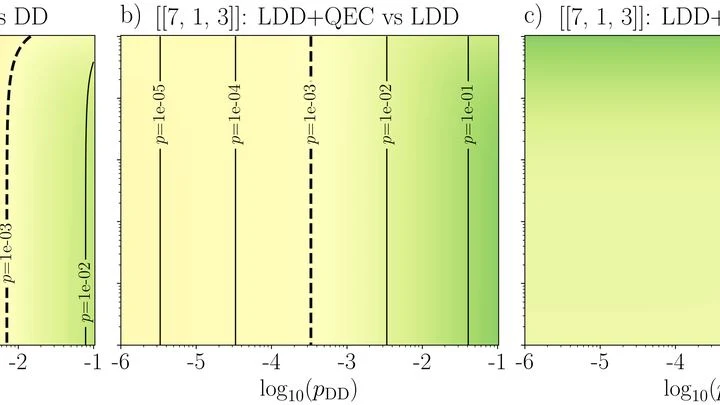
Quantum information is fragile: the slightest noise can destroy it. That's why two protection methods have been devised. The first is dynamical decoupling: rapid pulses are applied to qubits to average the noise to zero. It's like shaking a box of fragile items so they don't bump against the walls.
Quantum dots are tiny traps for electrons, about the size of an atom, but artificially made. They can store and process information, like miniature cells of a future computer. Usually, to change the state of such a dot, you need to run a wire to it and apply a voltage. But in the new work, scientists showed that this can be done without direct contact — simply by acting on a neighboring dot.
A fusion reactor is like an orchestra, where the plasma is the melody and the magnetic coils are the musicians. If one instrument plays out of tune, the whole symphony falls apart.
Imagine a tiled floor whose pattern never repeats, like the famous Penrose tiling. On this floor, magnetic arrows, the spins of electrons, perform a chaotic dance, giving rise to a quantum spin liquid.
Atoms, like strands in a braid, follow a strict rule: if one strand is 'charged', its neighbors must stay silent. This phenomenon, Rydberg blockade, allows stable quantum patterns to be woven.
In such patterns, topological order emerges: a structure where the overall weaving pattern matters more than individual loops.