A collision is an event in which two or more bodies come into contact and exchange energy and momentum over a short time interval. Collisions are fundamental to physics because they reveal the laws of conservation of momentum and energy, and they occur across all scales, from subatomic particles to galaxies. In particle physics, collisions are used to probe the structure of matter and create new particles; in astrophysics, collisions shape planetary systems and drive stellar evolution. The study of collisions also underpins engineering, from car safety design to the dynamics of billiard balls.
History
The modern understanding of collisions dates back to the 17th century with the work of Huygens and Newton, who formulated the laws of impact. The concept was later extended to atomic and subatomic scales in the 20th century with the development of quantum mechanics and particle accelerators.
How it works
During a collision, the total momentum of the system is conserved if no external forces act. The kinetic energy may or may not be conserved: in an elastic collision, kinetic energy is conserved, while in an inelastic collision, some energy is converted into heat, sound, or deformation. The details of the interaction depend on the forces between the bodies, which can be contact forces or long-range forces like electromagnetism or gravity. In particle physics, collisions are analyzed using quantum mechanics and relativity, where particles can be created or destroyed, but energy and momentum are still conserved.
In practice
Collisions are central to particle accelerators like the LHC, where protons are smashed together to discover new particles, and in everyday technology such as airbags and crumple zones in cars, which are designed to manage collision forces.
Fun fact
In a perfectly elastic collision between two identical masses, they simply exchange velocities — a fact used in Newton's cradle, a popular desk toy.
A speed of 7,5 kilometers per second is the threshold beyond which a cosmic collision turns dust grains into a chemical reactor. In the interstellar medium drift tiny cosmic dust grains — the legacy of dying stars.
Water droplets shoot out of a nozzle one after another, like cyclists on a narrow track. The faster ones catch up with the slower ones and merge into larger drops. This simple mechanism is called ballistic aggregation, and until now it had only been observed on cosmic scales: this is how dust particles stick together to form planets.
The birth of planets resembles the workings of a cosmic forge. Rocky blocks collide and fuse together. A powerful impact strikes a spark — material heats to white-hot and glows like cooling metal. Computer simulations show: the flash is visible from days to years, peaking at a tenth of the sun's light.
Two guitar strings are stretched on the same neck. They are almost identical, but one is slightly shorter — and they sound different. That's roughly how the two isomers of ethanimine work: molecules with the same set of atoms but rotated differently in space. Astronomers spotted this molecule in the dense clouds near the center of our Galaxy.
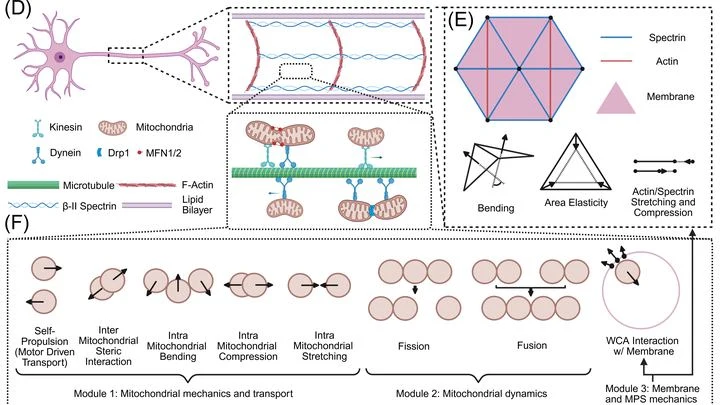
Inside every neuron, there's a long, thin channel, the axon, through which signals travel from the cell body to other cells. To keep this channel working, mitochondria constantly shuttle along it. These tiny organelles produce energy and move in both directions, like cars on a narrow road.
Imagine a tiny coin hidden inside a perfect safe, but the walls are so thin that the coin sometimes slips right through, leaving a barely audible sound. Axions are like those coins — except instead of metal, they're particles, and instead of a safe, they're ordinary matter. They barely notice obstacles, making them incredibly hard to catch directly.
A raindrop falling to the ground strikes with a certain force. But what if the drop isn't round but elongated like a cigar or flattened like a pancake? It turns out that shape is everything: the impact force can vary by more than a factor of ten just because of how the drop looks at the moment of impact.
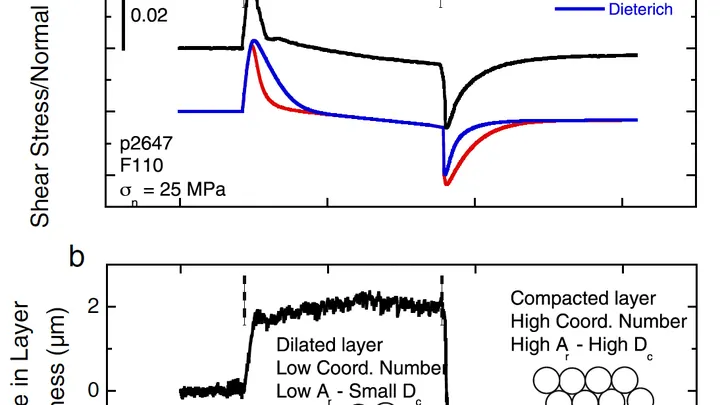
When two tectonic plates grind against each other, a layer of pulverized rock ends up between them, like sand between your palms. This layer, which geologists call fault gouge, behaves not like solid rock but like a thick paste: it can compact, dilate, and slide. Whether a fault ruptures in a devastating earthquake or creeps slowly and safely depends on its whims.