An Oxide Target for Oxygen Fusion ✛
A chef prepares a delicate dish where every grain must be in its place. A single stray crumb of an unwanted ingredient can overpower the subtle flavor of the main product. In much the same way, physicists studying the fusion of oxygen nuclei struggle with impurities in their targets.
The reaction in which two oxygen-16 nuclei fuse determines the late stages of massive stars. But measuring it directly at energies below 6.74 MeV has so far been impossible: the probability of the event drops to 10⁻⁹–10⁻³ barn, vanishingly small values. To catch such a rare signal, you need a target so clean that even the thinnest layer of carbon on the backing becomes a problem.
At Sichuan University, targets of chromium oxide (Cr₂O₃) were made by filtered cathodic vacuum arc deposition. In simple terms, an arc discharge evaporates chromium, and a curved magnetic filter removes large particles, leaving only ions. Deposited in an oxygen atmosphere, they form a film of the desired composition. The thickness and composition were checked by bombarding the target with protons and analyzing how they scatter off the nuclei.
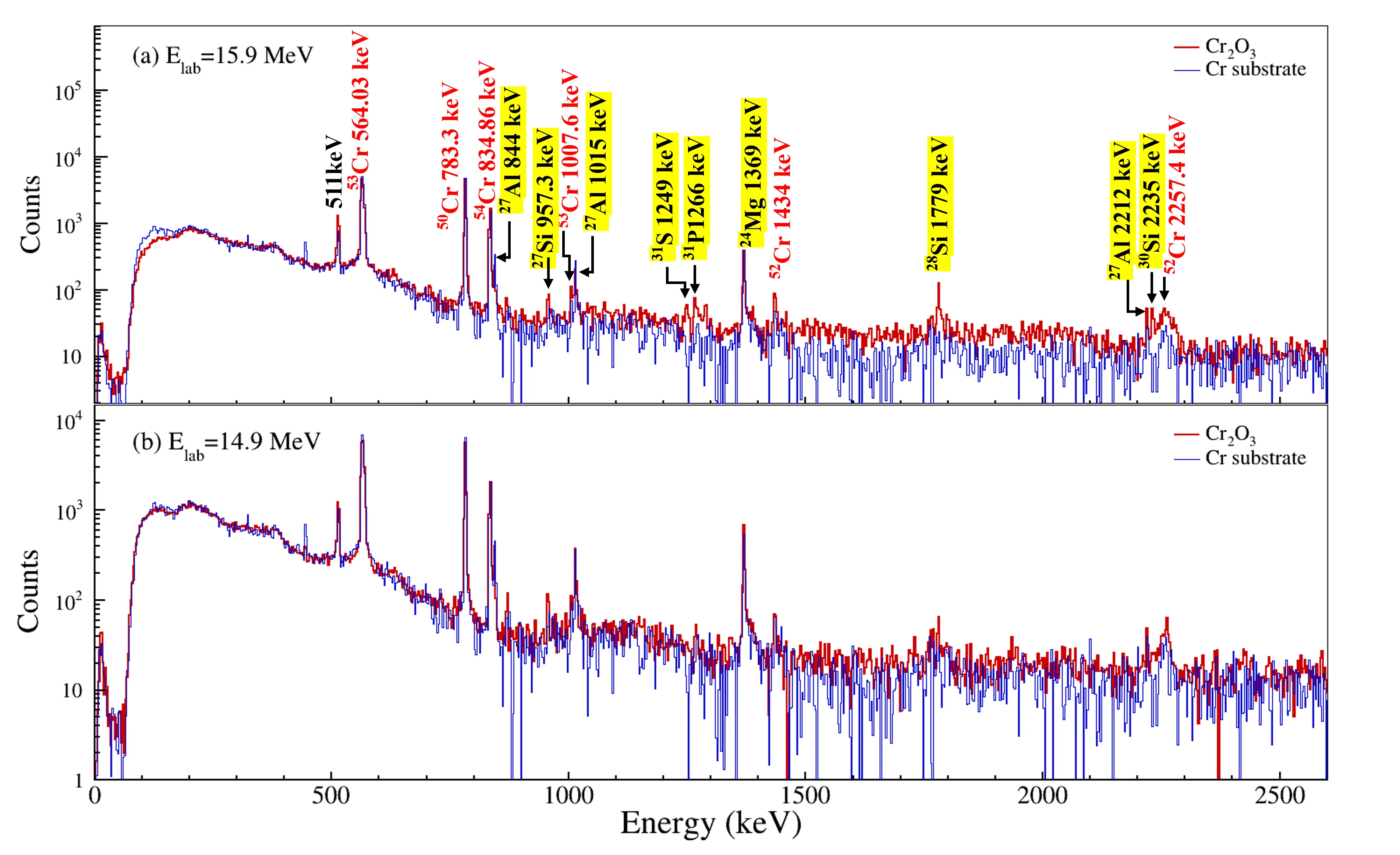
Next, the target was irradiated with an oxygen ion beam and the emitted gamma radiation was observed. It turned out that carbon in the oxide layer itself is low, about 1.25 atomic percent. But on the surface of the chromium backing, it is 40 times more abundant. This carbon reacts with the beam oxygen and creates a strong background that masks some of the fusion channels.
Now that the recipe for preparing and checking targets is known, experiments at lower energies can be planned. Perhaps the backing should be made of tantalum or gold, which accumulate less carbon during polishing and storage. Then the chef can finally taste the dish without fear that a foreign crumb will spoil the whole flavor.
A carbon film just a few atomic layers thick on the substrate produces a gamma background comparable to the signal from the entire target. To avoid this, the setup used a liquid-nitrogen-cooled trap that freezes residual hydrocarbons out of the vacuum.