An Oxide Target for Oxygen Fusion Experiments ✛
Context
The fusion of two oxygen-16 nuclei governs the late stages of massive star evolution and the production of intermediate-mass elements. Direct measurements at center-of-mass energies below 6.74 MeV have not yet been performed because cross sections drop to 10⁻⁹–10⁻³ barn. Related papers in the archive also tackle nuclear astrophysics problems: some study J/ψ decay, others prepare spectrographs for exoplanets, and still others catch neutrons in gas chambers. This article follows the same vein but focuses on a methodological issue: how to make a target that won't spoil the measurement with its own impurities.
Methods
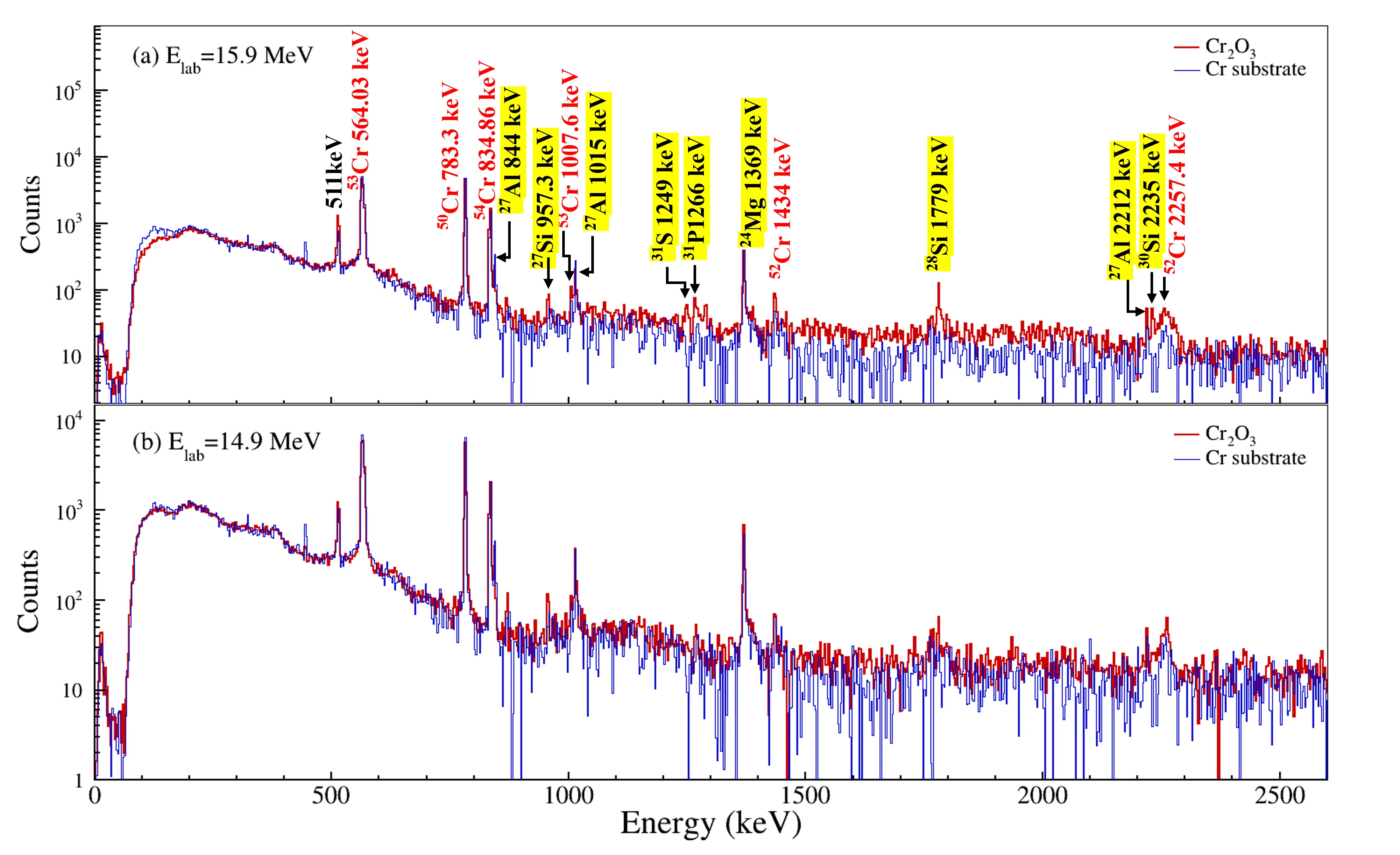
Cr₂O₃ targets were deposited onto chromium substrates using FCVA: a cathodic arc evaporates chromium, and the ions pass through a curved magnetic filter that removes macroparticles before they deposit in an oxygen atmosphere. Thickness and composition were determined by EBS at the 3 MV tandem accelerator at Sichuan University: 2.488 MeV protons were scattered off the target nuclei, and the spectra were analyzed with the SIMNRA code. The targets were then irradiated with ¹⁶O⁵⁺ beams at 14.9 and 15.9 MeV, and gamma rays were recorded with an HPGe detector to identify impurity contributions.
Results
The Cr₂O₃ films were uniform: the oxygen-16 areal density was (3.24–3.25)×10¹⁷ atoms/cm² with an uncertainty of 7.3%. The Cr/O ratio was 0.56–0.60, slightly below the ideal 0.667, indicating a small oxygen excess. Carbon in the oxide layer was low, about 1.25–1.29 atomic percent, but on the chromium substrate surface it was 40 times higher: 2.55×10¹⁷ atoms/cm². In the in-beam gamma spectra, strong lines at 844, 1015, and 1369 keV from the ¹²C+¹⁶O reaction mask channels leading to ²⁷Al and ²⁴Mg. Meanwhile, the lines at 1249, 1266, 1779, and 2235 keV, corresponding to evaporation channels of ¹⁶O+¹⁶O, are free of carbon background and suitable for cross-section measurements.
Implications
This work differs from neighboring studies in that it addresses not an astrophysical problem per se but an instrumental one: it shows how to prepare and verify a target for future measurements. Unlike detector or data-analysis papers, this is the first systematic study of the contribution of carbon contamination specifically in the substrate, rather than in the film itself, for the ¹⁶O+¹⁶O reaction. This gives experimentalists a concrete recipe: clean the substrate or change its material to avoid losing the signal.
Future development
The next logical step is to try substrates made of other materials, such as tantalum or gold, which accumulate less carbon during polishing and storage. One could also vary FCVA parameters to reduce carbon content in the oxide layer itself. In the long run, such targets would allow measurements to go below 6.74 MeV and close the astrophysical Gamow window for oxygen burning.
Impact
The results will directly affect the planning of experiments to measure the ¹⁶O+¹⁶O cross section in the sub-barrier region. They are also useful for any low-background measurements with oxide targets where carbon produces parasitic reactions.
Next steps
Fabricate targets with substrates made of low-carbon materials and repeat EBS and gamma spectroscopy. Then perform a test measurement of the ¹⁶O+¹⁶O cross section at energies below 6.74 MeV to assess the achievable background.
Key open problems
The main unsolved problem in nuclear astrophysics is the cross section of the ¹⁶O+¹⁶O reaction at energies corresponding to oxygen burning in stars. This work does not solve it directly but removes a methodological obstacle: without controlling carbon contamination, it is impossible to isolate the weak fusion signal from the background of the ¹²C+¹⁶O reaction, whose cross section is 2–3 orders of magnitude larger.
The knowledge machine's view
This section is addressed to the author of the paper and their colleagues. Neighbouring works were found by meaning-based search across our archive, not by word overlap. We do not review: we show the field around the work.
What the work does
The study describes the fabrication of Cr₂O₃ targets by FCVA, determines their composition and thickness by EBS, and measures gamma-ray spectra under a ¹⁶O beam. It is shown that carbon contamination in the substrate produces a parasitic background, but the four lines from the ¹⁶O+¹⁶O reaction remain clean and suitable for extracting the fusion cross section.
Where its strength is
A systematic study of the contribution from carbon contamination specifically in the substrate, rather than in the oxide film itself, gives experimenters a concrete recipe for preparing low-background targets.
Where it could go next
- It may be useful to compare the methodology for suppressing background impurities with approaches used in gas-chamber detectors, where reducing parasitic signals is also critical.based on: How to Catch a Neutron in a Gas Chamber arXiv:2601.02841
- It would be interesting to consider the possibility of using isotopically enriched targets, similar to how isotopically pure materials are used in some ion-trap experiments to eliminate backgrounds.based on: How a Silver Ion Traps Oxygen in a Trap arXiv:2601.09862
Worth trying
- Test whether additional cleaning of the chromium substrate (for example, by ion etching) reduces the carbon content on its surface.
- Assess the contribution of carbon from the residual atmosphere during film deposition and the possibility of reducing it by improving the vacuum.
Why this may matter
Preparing targets with minimal background from impurities is critical for future direct measurements of the ¹⁶O+¹⁶O reaction at astrophysical energies, which will make it possible to refine the rates of nuclear processes in massive stars.
Nearby works in our archive
- How to Catch a Neutron in a Gas Chambersimilarity 0.52
- Wind from Cygnus: First Directional Limits from MIMACsimilarity 0.47
- The Galaxy's Halo: How to Weigh the Invisiblesimilarity 0.47
- How to peek into a xenon nucleus without touching itsimilarity 0.47
- A Liquid That Catches Invisible Particlessimilarity 0.47
- Fusion without plasma: a beam instead of the sunsimilarity 0.47
- How a Silver Ion Traps Oxygen in a Trapsimilarity 0.47
The archive is sparse around this work: the closest review is only 0.52, against a usual 0.64. It looks like few have drilled nearby.
A carbon film just a few atomic layers thick on the substrate produces a gamma background comparable to the signal from the entire target. To avoid this, the setup used a liquid-nitrogen-cooled trap that freezes residual hydrocarbons out of the vacuum.
Key numbers
- oxygen-16 areal density: 3.24–3.25 × 10¹⁷ atoms/cm²
- carbon fraction in the oxide layer: 1.25–1.29%
- carbon areal density on the substrate: 2.55 × 10¹⁷ atoms/cm²
- oxygen beam energy: 14.9 and 15.9 MeV
- minimum achieved reaction energy: 6.74 MeV in the center-of-mass system