In nuclear and particle physics, the cross section is a measure of the probability that a specific interaction will occur when particles collide. It is expressed as an effective area, typically in units of barns (1 barn = 10^-28 square meters), and represents the 'size' of a target as seen by an incoming projectile. A larger cross section means the reaction is more likely to happen; a smaller one means it is rarer. This concept is central to understanding everything from neutron capture in reactors to the production of heavy particles like the top quark at the Large Hadron Collider.
History
The concept was introduced in the early 20th century, with the term 'cross section' used in scatteringexperiments by Ernest Rutherford and his colleagues around 1911–1913 to describe the probability of alpha particles being deflected by gold nuclei.
How it works
Imagine firing a beam of particles at a thin foil of target material. The cross section is defined as the ratio of the number of reactions per target nucleus to the number of incoming particles per unit area. It is not a physical size of the nucleus but a quantum-mechanical probability, often influenced by resonances, quantum tunneling, and the energy of the incoming particle. For example, a neutron might have a huge cross section for capture at certain energies due to resonance, making it appear 'large' even though the nucleus itself is tiny.
In practice
Cross sections are used to design nuclear reactors, calculate radiation shielding, and estimate production rates of rare particles in colliders, such as the top quark or Higgs boson.
Fun fact
The unit 'barn' was coined during the Manhattan Project as a slang term for 'big as a barn' to describe the unexpectedly large cross section of certain nuclear reactions.
Units by system: SI: m2 · CGS: cm2 · Planck: l p2 · natural: gev2
Predicting the yield of a chemical reaction is a bit like trying to guess the harvest knowing only the soil composition. Traditionally, chemists have relied on long columns of numbers, quantum descriptors, that describe electron energies but say nothing about molecular shape.
A speed of 7,5 kilometers per second is the threshold beyond which a cosmic collision turns dust grains into a chemical reactor. In the interstellar medium drift tiny cosmic dust grains — the legacy of dying stars.
Ice, water, steam — phase transitions we all know. But what happens if you squeeze and heat an atomic nucleus itself? Theorists think protons and neutrons inside it 'melt,' releasing smaller building blocks — quarks and gluons.
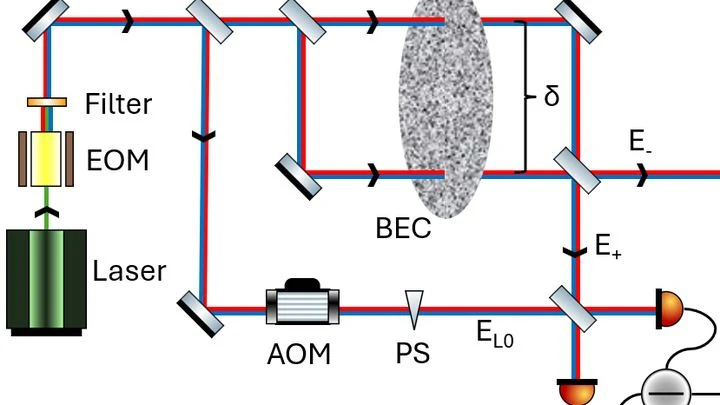
Physicists have proposed an experiment: a laser beam acts as a quantum detector and splits into two beam-ears. Each ear is directed through a tiny cloud of ultracold atoms — in this state, atoms merge into a single wave.
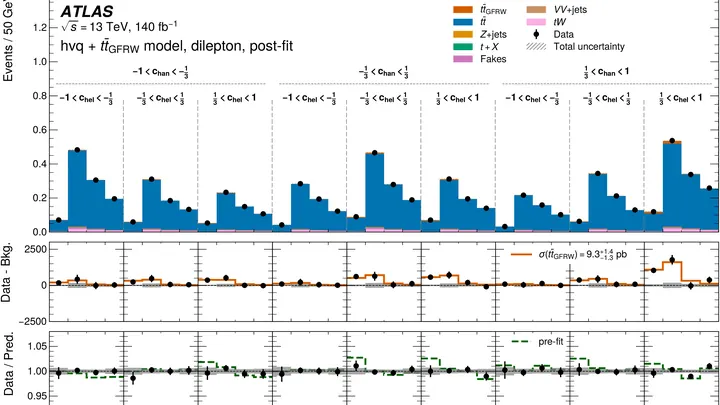
Oil droplets in boiling broth usually scatter apart, but if you bump them together very slowly, they may stick for a moment. Something similar happens with top quarks — the heaviest known building blocks of matter.
When particles collide at enormous speeds, they produce a shower of new particles. Among them are antiprotons — twins of ordinary protons but with the opposite charge. Each of these particles has its own spin, like a tennis ball sent with a twist. But whether antiprotons are actually spun up at birth has never been checked.
Protons accelerated to enormous energies slam into a thick metal plate, like bullets into armor. Inside the metal, a J/ψ particle is born for an instant, which immediately decays into two muons — light relatives of the electron. These muons fly out of the target, and detectors catch their tracks.
The scientists compared the number of caught muons with predictions from a computer model.
When heavy nuclei collide in accelerators, a multitude of particles is produced, and physicists want to understand how electric charge moves through this chaos. Two trains crash into each other: the passengers (quarks) scatter, but their luggage (charge) may end up far from the crash site.
Old photographic plates from a 1950s sky survey held a detective mystery: mysterious flashes kept appearing on them. The first clue — the flashes coincided with days of atmospheric nuclear tests. The second clue — the Earth's magnetic field: the stronger the storm raged, the rarer the spots.
It was as if the suspect only came out in calm weather.
In 2017, protons at the Large Hadron Collider collided with an energy of 5.02 TeV. The CMS detector recorded these collisions, and among billions of events, physicists hunted for a rare occurrence: the production of a single top quark without its antiparticle.
The proton is not a solid ball. Its charge, mass, and other properties are distributed differently in space, and each property has its own radius. Physicists have long been able to measure where the proton's charge is concentrated and where its mass lies.
In a circular accelerator, electrons are accelerated to nearly the speed of light and smash into positrons: their antiparticles. At the collision point, a burst of pure energy briefly appears, from which new particles are born. The BESIII detector, like a high-speed camera, captures the tracks of these short-lived guests.
Hidden in the nucleus of a gold atom lies a potential future cancer treatment. When a gold target is struck by a gamma ray with an energy of about 30 megaelectronvolts, one of the nuclei loses a proton and a neutron, transforming into a rare platinum isotope — platinum-195m.
Inside the Large Hadron Collider, protons are accelerated to nearly the speed of light and smashed head-on. At the collision point, a burst of energy is born for an instant, from which new particles can emerge. One of the heaviest is the top quark.
At the Large Hadron Collider, physicists accelerate protons to nearly the speed of light and smash them together. Usually, the protons themselves take part in such collisions, but sometimes they pass close by without touching, and it is their electric fields that interact.
Two spinning tops are set off simultaneously in opposite directions. If one spins left, the other always spins right — no matter how far apart they fly. That's roughly how quantum entanglement works, except instead of tops, we have top quarks, the heaviest known particles.
Inside protons accelerated to nearly the speed of light, a particle heavier than a gold atom is sometimes born — the top quark. It lives for tiny fractions of a second and decays, leaving a trace in the ATLAS detector. Physicists collected such traces for four years to understand how often the top quark and its mirror twin, the antiquark, appear.
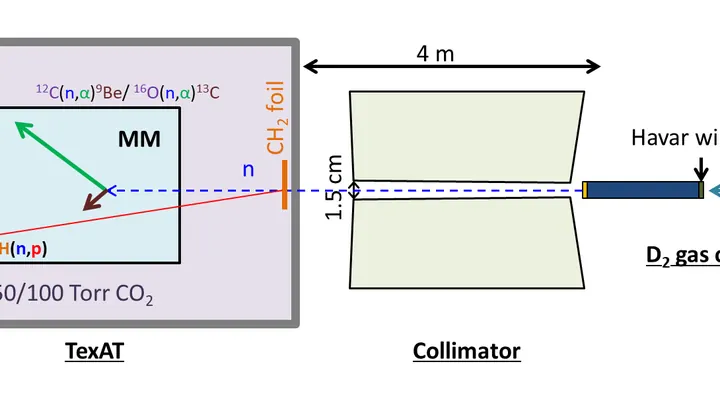
When a neutron slams into a nucleus, it can knock out a chunk — an alpha particle, which is a helium nucleus. Such collisions happen all the time in nuclear reactors, but they are hard to measure precisely: a neutron leaves no track in a regular detector, and you can only catch it by its aftermath.
A snowflake falling from a cloud chooses between a left-handed and a right-handed form. The difference between them is almost imperceptible, like a breath of wind, yet it is that very breath that decides which pattern will grow.