A Copper Probe Finds the Edge of a Magnetic Bubble ✛
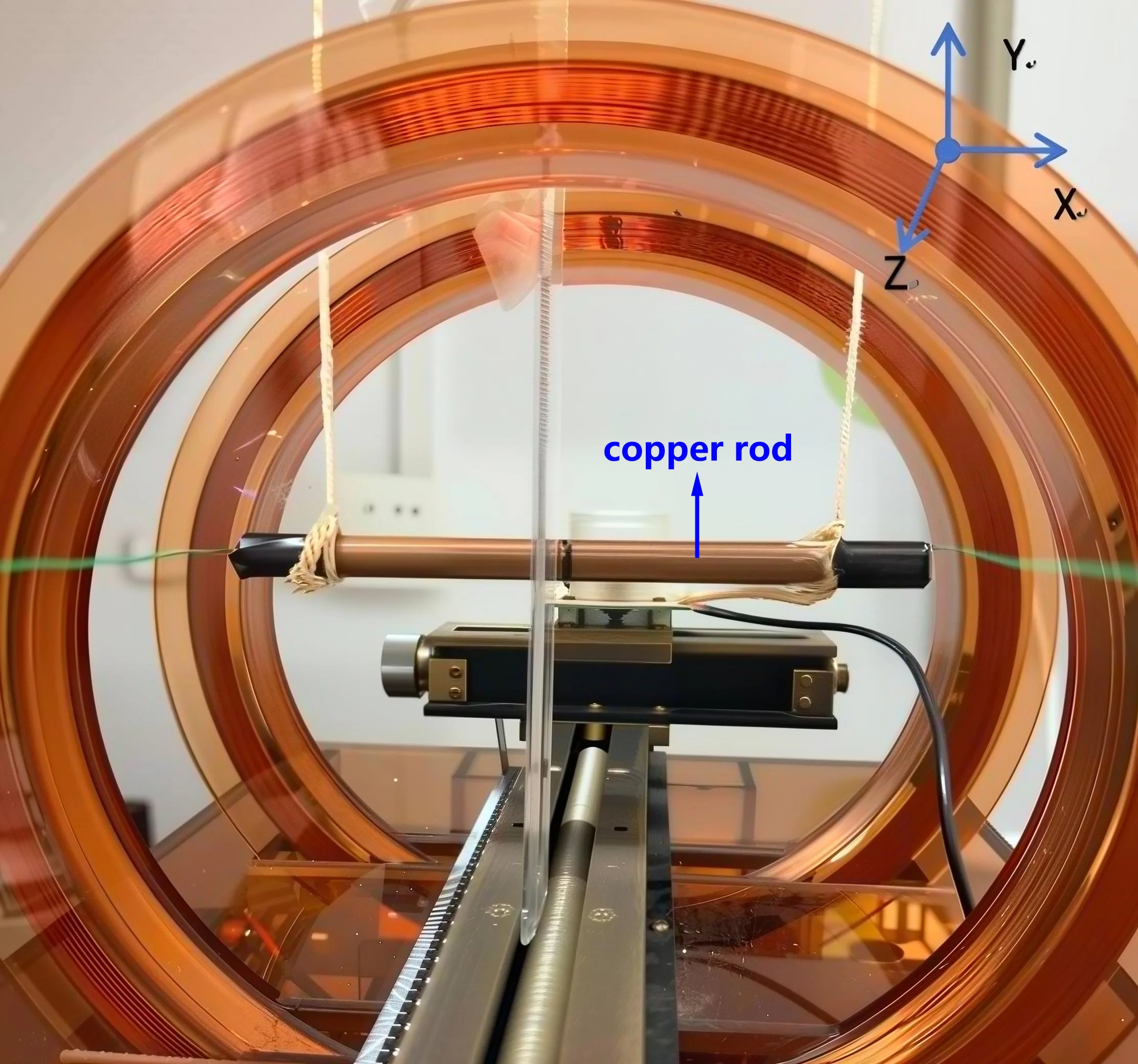
A copper rod as long as your palm moves slowly across an invisible magnetic field created by two identical coils. At the very center of the field, the voltmeter reads zero. Shift the rod just a little to the side, and the needle comes alive: the voltage climbs, hits a peak, and then gently falls. The rod acts like a probe that feels out the edge of an invisible bubble where the field stops being uniform.
Why zero at the center? The alternating magnetic field induces a voltage in the rod. At the center, the upper and lower halves of the rod sense the same field change, so their signals cancel out. When the rod shifts, the halves experience different conditions, creating a difference, that is, a voltage. But if you go too far, the field beyond the coil's edge points the opposite way and interferes with the signal. So the curve first rises and then falls.
The experiment showed that the peak sits at about ninety-three hundredths of the coil radius from the center. That means the rod has almost entirely left the field, but its middle is still inside. This knowledge helps calibrate magnetic field sensors: at the edge the signal is stronger, so the instrument can be tuned more precisely. A simple copper rod becomes a tool that makes an invisible field tangible.
The EMF maximum occurs when the rod is shifted from the center by 93% of the coil radius, meaning its center is almost at the field boundary while its ends are already outside. At this point the signal is nearly three times stronger than at half the radius.