The thermal Hall effect is a phenomenon where a temperature gradient applied to a material produces a heat flow that is deflected sideways when a magnetic field is present. This is the thermal analogue of the electrical Hall effect, where a magnetic field deflects electric current. In the thermal case, the 'charge carriers' are heat carriers—electrons, phonons (quantized lattice vibrations), or magnons (quantized spin waves)—and their trajectories are bent by the magnetic field, creating a transverse temperature difference.
History
The thermal Hall effect was first predicted and observed in the 20th century, with early experiments on metals and semiconductors. It gained renewed attention in the 2000s with the discovery of the thermal Hall effect in insulating magnets, where it is carried by magnons or phonons.
How it works
In a material with a magnetic field applied perpendicular to the heat flow, the heat carriers experience a Lorentz-like force (or a similar deflection due to their magnetic moment). This causes them to accumulate on one side of the sample, creating a transverse temperature gradient. The magnitude and sign of the thermal Hall effect depend on the type of carrier, the band structure, and the magnetic ordering. In some materials, the effect is driven by the Berry curvature of the electronic bands, which acts as a fictitious magnetic field in momentum space.
In practice
It is used as a sensitive probe of magnetic ordering and phase transitions in materials, particularly in the study of exotic magnetic states like spin liquids and topological magnon insulators.
Fun fact
In some materials, the thermal Hall effect can be carried entirely by phonons, which are neutral particles, showing that the effect does not require charged carriers.
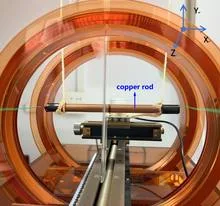
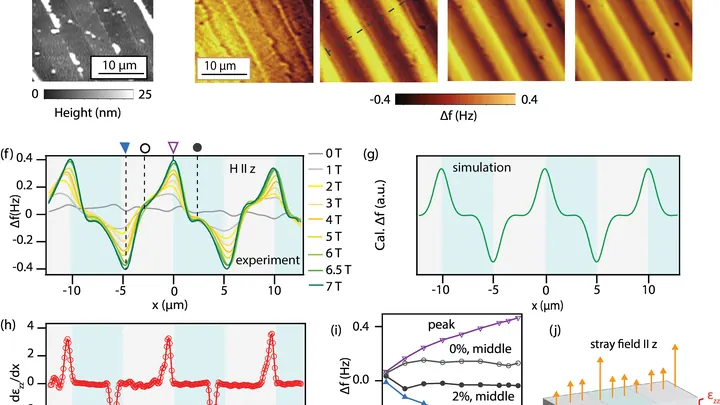
A thin copper rod, fifteen centimeters long, slides slowly across the invisible magnetic bubble created by a pair of coils. At the bubble's center, where the field is uniform and strong, the voltmeter needle sits at zero. Shift the rod toward the edge, and the needle comes to life, rises, peaks, and then falls smoothly.
In a pot of boiling soup, light fat droplets rise to the top, while heavy vegetable chunks sink to the bottom. Particles in the tenuous hot gas around the Sun and other stars behave much the same way — except instead of broth, there's a mixture of charged particles: electrons, protons, and alpha particles.
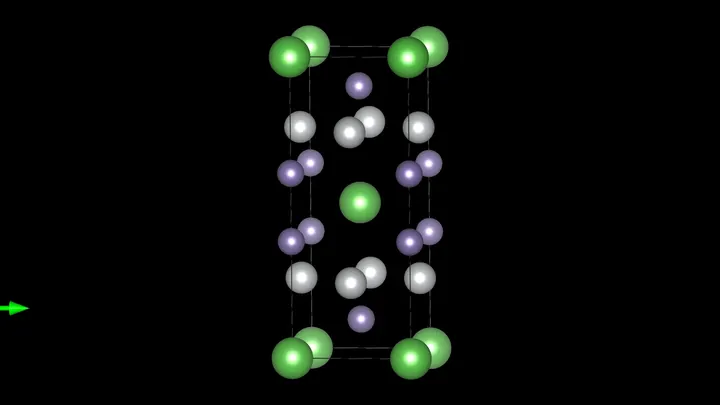
A sheet of paper with magnetic properties: that's roughly what the new material 1T-CrS₂ is like. Its layers are held together by weak forces, like the pages of a notebook, but each layer is a true magnet.
Imagine a quantum phase transition as an intricate dance. Electrons whirl in strict order, each step representing their spatial arrangement, and the rhythm their dynamics. For decades, physicists could only see a blur of motion, unable to tell if the figures were changing or the music speeding up.
In the world of two-dimensional materials, states sometimes emerge that are as extraordinary as they are fragile. One of them — the fractional anomalous Hall crystal (FAHC)—is like a quantum centaur: half ordered lattice, half topological liquid.
The solar wind rushes from the Sun to Earth, but the magnetosphere bends the flow and sculpts it into plasma tails. The same motif plays out at the heart of galaxies: jets from accretion disks around black holes are twisted by the invisible hand of a magnetic field.
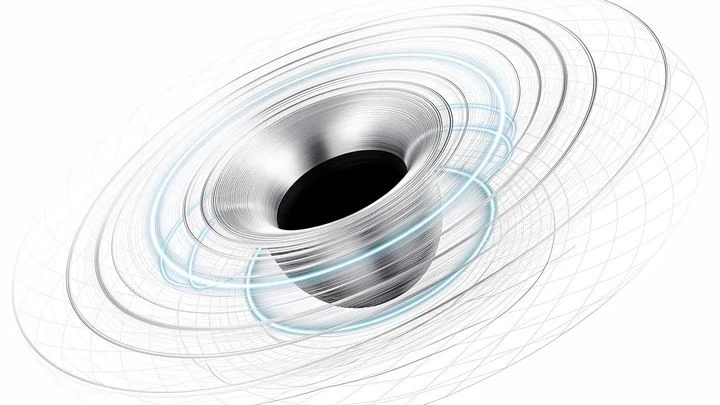
Imagine a river at a rapid: the current accelerates until no wave can go against the flow. So it is with gas near a black hole: reaching the speed of sound, it locks itself in — an acoustic black hole is born, a twin of the gravitational abyss. Here the event horizon is woven from a flow faster than its own sound.
Cosmic rays do not travel in straight lines. Charged particles accelerated to enormous speeds loop through the Galaxy's magnetic field like dust motes in a gust of wind. It's usually assumed that they simply scatter along and across field lines.
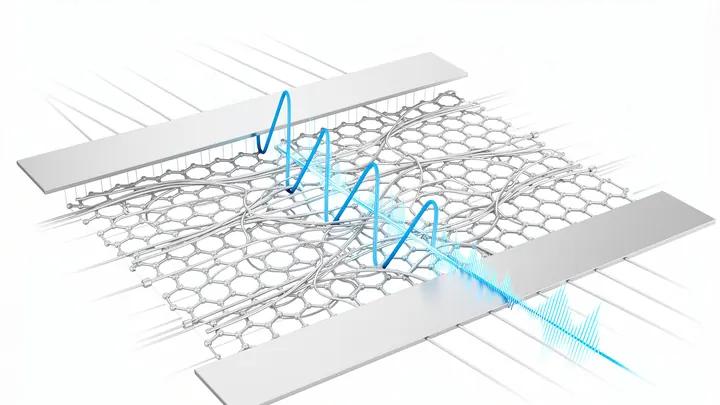
A neat stack of atomic layers lies on a substrate. An invisible beam of terahertz light shines down on it, with a magnetic field applied from the side. After reflection, the beam's polarization rotates slightly.
A tellurium crystal resembles a tiny spiral staircase: its atoms are twisted into a helix. When heat runs through such a crystal, it is carried not by electrons but by sound waves — vibrations of the lattice itself. These waves don't just push back and forth; they also rotate around their axis like a spinning top.
Heat a nail in a fire, and it will lengthen — everyone knows that. But heat only the tip and leave the other end cold, and the nail doesn't just get longer: it bends, because hot metal expands more than cold metal. It's this very bending, but at the atomic level, that physicists have turned into electricity.
Two thin layers of a semiconductor were twisted relative to each other by 2.29 degrees, like two sheets of transparent paper with printed grids. Where the lines nearly align, a large pattern of dark and bright spots emerges. Electrons in this pattern behave very differently from those in a regular crystal.
A lithium-ion battery is like a multi-story building where lithium ions live on every floor. When you charge the battery, the ions move from floor to floor, and the whole building warms up a bit. Usually, this heat dissipates evenly, like from underfloor heating. But sometimes one spot gets too hot, and then the whole building can go up in flames.
A crystal that looks like a stack of pancakes was placed on a smooth substrate of magnesium oxide. The result was a film only a few hundred atoms thick. When they ran a current through it and switched on a magnet, the resistance jumped by nearly a quarter—22.5% in a 9-tesla field.
Inside the film, electricity is carried by two streams of particles.
A mosaic floor made of many small tiles, each turned in a different direction. It seems that any pattern trying to cross such a floor would get scrambled and vanish. That's how people usually think about disorder in crystals: if atoms aren't arranged in a perfect lattice, delicate quantum effects should fall apart.
In a thin semiconductor channel, electrons behave not like lone runners but like a crowd at rush hour. They constantly bump into each other, and these collisions determine how easily heat and electric current pass through the material.
A laser strikes the crystal, and it responds with flashes of light, like a bell ringing after a blow. But if the bell is warm, its sound wavers and fades. Same here: the crystal's atoms constantly jitter from heat, and this jitter disrupts the electrons' smooth flight, making the light dim and blurry.
In an insulating crystal, heat usually flows from the hot end to the cold end. But when you switch on a magnetic field, part of the heat flow veers sideways, like water running down a slope that drifts to the side when the wind pushes it. This behavior is called the thermal Hall effect.
Two sets of swings, rocking in opposite directions, don’t tilt the platform. Yet their motion creates invisible vortices that push a ball sideways. Alternagnets behave just like that: the atomic magnetic arrows are perfectly balanced, but a hidden symmetry bends the heat flow.
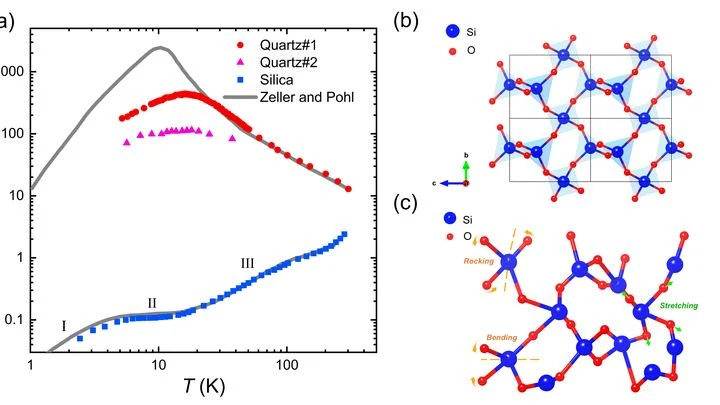
If you push heat through a piece of quartz, it usually goes straight, like water through a pipe. But switch on a magnetic field, and the flow veers slightly sideways, as if the pipe suddenly grew a side branch.
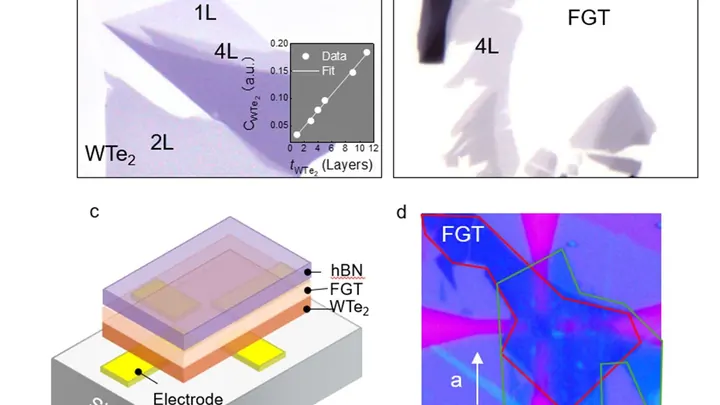
Usually, current in a metal acts like boiling water on ice: it heats the material and destroys magnetic order. But in a layered structure of tungsten ditelluride and the ferromagnet Fe3GeTe2, current behaves differently.
In a thin layer of liquid crystal (a substance that flows like a liquid but has molecules arranged in order, as in a solid) vortices smaller than the thickness of a human hair are born. These vortices resemble tiny spinning tops: they can move without breaking apart and behave almost like real particles.
A thin semiconductor layer at low temperatures behaves like a pot of honey: electrons flow not as individual particles but as a thick liquid. If you run an alternating current through such a layer, the resistance responds with a smooth curve.
The crystal changes its internal geometry like a building frame that slightly twists during an earthquake. In the manganese-gallium alloy (Mn₃Ga), at around 485 Kelvin (about 212°C), a magnetic transition occurs: the atoms align into an antiferromagnetic order, where neighboring magnetic…
A powerful laser strikes a tiny target, and it instantly turns into a cloud of scorching gas — plasma. Within this cloud, magnetic fields spontaneously arise. Like invisible hands, they prevent heat from freely escaping the hot core.
Two layers of a magnetic material, rotated relative to each other by fractions of a degree, like two slightly offset screens on a window. In their normal state, they don't produce anything special, but at a certain twist angle, an unexpected effect emerges.
A special material — a topological insulator — conducts current only on its surface, as if its interior is a perfect insulator. It hosts a quantum effect similar to the one discovered by Klaus von Klitzing, but mathematically it is equivalent to a four-dimensional world.
A piece of gold doesn't attract paperclips. But if you take a thin film of a gadolinium-gold-germanium alloy and start bending it, magnetic regions can appear. Scientists did this not with their hands, but with a beam of helium ions that penetrated the material through a patterned mask.
In an ordinary wire, heat drives electrons: that's the Seebeck effect, familiar from thermocouples. But in magnets, things are trickier: charge carriers also carry spin, their own little 'top.' In some materials, called altermagnets, electrons with different spins interact differently with the crystal lattice, so a…
An ordinary free-electron laser is like a musical instrument with a single string: it can play only one note until you change its design. To get a different wavelength, you have to retune magnets or accelerate electrons harder. That's expensive and bulky.
A thin nanowire of α-Bi₄Br₄ — a compound of bismuth and bromine — conducts current not like an ordinary wire. Inside, electricity moves only along the edges, like water in a trough, not touching the bottom or sides. This behavior is called topological insulation: the interior does not conduct, but electrons glide losslessly along the surface or edges.
A thin film of the compound of manganese, bismuth, and tellurium resembles a layered cake: each layer is an atomic plane, and the magnetic moments within the layer are aligned like compass needles. At room temperature, these needles hold formation, but just heating the sample to 45°C makes the order start to fall apart.
A magnetic material can be compared to a crowd of tiny compasses. In an ordinary magnet, all the needles point in the same direction, and turning them all at once is no easy feat. Physicists have found a way to do this with an electric current.
In layers of molybdenum telluride twisted at a specific angle, electrons behave unusually: they can split into parts. This is akin to a whole pie suddenly being cut into perfectly equal slices, even though there's only one knife. In ordinary materials, the electron's charge is indivisible, but in these layers, under strong cooling, states emerge where the charge splits into three parts.
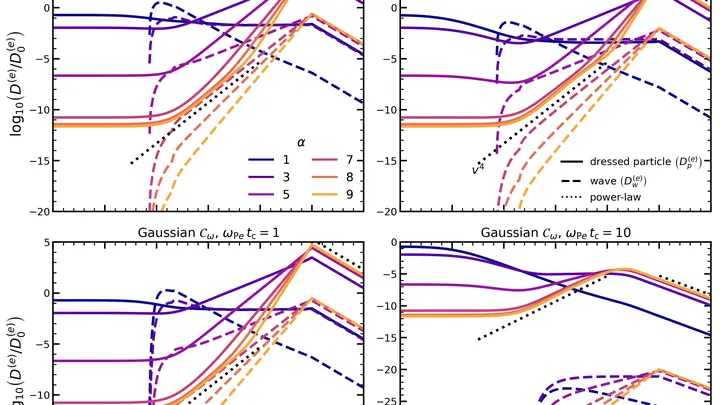
In a hot gas of charged particles — plasma — chaotic electric fields work like a sieve. A slow particle gets surrounded by a cloud of opposite charges, which cancels the external field. A fast one sheds this armor and gets accelerated.
The temperature in a room drops by a few degrees while the refrigerator runs without a single moving compressor. Inside, there is no Freon, but a piece of metal that is alternately magnetized and demagnetized.