Michael Faraday in 1831 long sought a connection between magnetism and electricity. His ingenious experiment with two windings on one iron ring showed: when current was switched on in the first coil, a momentary surge appeared in the second. He described it as 'converting magnetism into electricity.' Later, James Clerk Maxwell put the law into rigorous mathematical form. The essence: any change in a magnetic field over time generates a vortex electric field, even in a vacuum.
History
In the 1820s, Hans Christian Ørsted discovered that an electric current creates a magnetic field. Michael Faraday took on the reverse problem and after years of experiments, in 1831 observed a momentary current in the secondary winding when the primary circuit was closed. The results were reported to the Royal Society. Independently, Joseph Henry in the USA discovered the phenomenon in the same year but published later. James Clerk Maxwell included the law in his system of equations (1861–1862), adding the displacement current term for symmetry.
How it works
The operating principle of generators, transformers, magnetic sensors, hard disk recording. Limits of applicability: works in classical electrodynamics up to relativistic speeds, but at the quantum limit, accounting for fluctuations and charge discreteness requires a more detailed description.
In practice
Electric generators at all power plants, transformers, induction cooktops, and wireless chargers operate on this principle — converting motion into electricity.
Fun fact
If you drop a strong magnet into a copper pipe, it falls surprisingly slowly — induced currents (eddy currents) according to Lenz's law slow it down, as if an invisible hand is holding it.
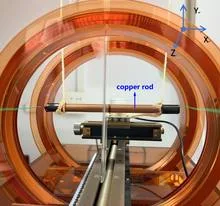
A thin copper rod, fifteen centimeters long, slides slowly across the invisible magnetic bubble created by a pair of coils. At the bubble's center, where the field is uniform and strong, the voltmeter needle sits at zero. Shift the rod toward the edge, and the needle comes to life, rises, peaks, and then falls smoothly.
In some crystals, electrons are not spread uniformly but arrange themselves into a strict checkerboard: one cell has more electrons, the neighboring cell has fewer. Such a pattern is called charge order, and for a long time it was considered something frozen, like a pattern on frosty glass.
A microwave oven heats food, but in the lab, microwaves have done something different: they turned a superconductor into a permanent magnet. A 300-nanometer-thick film of yttrium barium copper oxide, cooled to 80 kelvin, responded to 5-gigahertz radiation.
A magnetic field usually acts like a strict traffic cop: for heat to turn into electricity, it must stand across the road. If the field lies along the heat flow, the effect disappears, or so it was believed for decades.
Scientists took an ultra-thin film of a magnetic oxide — a material where electron spins are aligned in a plane, like compass needles on a table.
A superconductor pushes out a magnetic field like a sponge squeezing out water. This Meissner effect has been known for nearly a century, but it's usually calculated in a flat world — without gravity. In the strong field of a black hole or at enormous speeds, the picture changes.
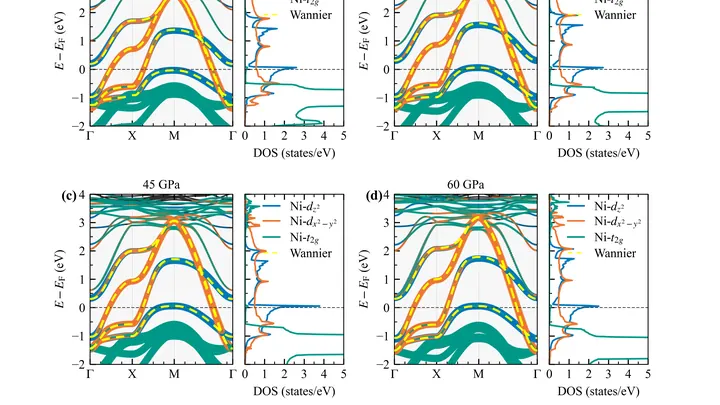
Under pressure, the layered crystal La₃Ni₂O₇ behaves like an orchestra where the conductor adjusts the volume of different instrument sections. Compression increases electron hopping between layers — which, one might think, should boost superconductivity. But at the same time, some electrons become too mobile.
A neuron transmitting a signal is like a tiny battery that quickly discharges and recharges. For nearly 70 years, it was believed that a special "potassium valve," opening with a delay, was responsible for the recharge phase. New work claims this current is a ghost.
A pale green crystal was placed in a magnetic field and cooled below one kelvin — almost to absolute zero. Inside it hide chains of copper atoms that behave like tiny magnetic needles. Usually their orientation is chaotic, but the strong field and cold make the needles align in a unified impulse, like soldiers on a parade ground.
Ion current through a membrane is like a queue at a turnstile. Sometimes the turnstile is free — ions pass through quickly. Sometimes it gets stuck — the flow drops. A weak magnetic field, it turns out, doesn't push ions from behind; it simply changes the number of open turnstiles.
A molecule works like a marketplace: electron shoppers enter through two gates (contacts) and head for stalls with the most attractive goods — the chemically active spots. Previously, current was thought to spread evenly, but it turns out up to 90% of all flow rushes through these 'hot spots'. Reactive centers become superconducting highways inside the molecule.
A Tesla coil crackles, and a beam of light begins to rotate around it. The medium it passes through is still stable, but the field grows, and the rotation intensifies. This is not a trick but the behavior of special materials that couple electricity and magnetism. For such coupling, there is a fundamental limit — the Tellegen limit.
In the quantum world, there is its own dance. Two superconducting toroids, each comfortably holding its quantized magnetic flux, whirl in a synchronous waltz. Between them is a vacuum, not a single field line, yet they mirror each other’s moves without fail.
In the vast clouds of rarefied gas that fill the space between stars, something is always churning. Supernova explosions, colliding streams — all of it shakes the plasma. And in this rippling, as it turns out, hides the mechanism that gives birth to magnetic fields.
Plasma is a gas in which electrons are stripped from atoms.
According to Einstein's general theory of relativity Albert Einstein, a massive rotating body drags the fabric of spacetime along with it, much like a spoon twirled in a jar sets thick honey flowing.
The solar wind rushes from the Sun to Earth, but the magnetosphere bends the flow and sculpts it into plasma tails. The same motif plays out at the heart of galaxies: jets from accretion disks around black holes are twisted by the invisible hand of a magnetic field.
When physicists drive electrons through an ultrapure gallium arsenide channel at helium temperatures, they expect to see a well-behaved, almost ideal fluid.
Space is threaded with magnetic fields. They exist around galaxies, stars, and even in nearly empty voids — the vast empty spaces between galaxy clusters. It's usually thought that fields are amplified from weak 'seed' fields by turbulence, much like a dynamo. But the origin of the seed fields themselves has remained a puzzle.
Light from a distant blazar, an active galactic nucleus whose jet points our way, travels for billions of years. Along the way, it triggers cascades of charged particles that the intergalactic magnetic field deflects sideways. This creates a blurred gamma-ray glow around the blazar: a secondary halo.
A superconductor is like an ideal highway with no traffic lights: electrons race along without hindrance. But apply a voltage, and the picture changes. In a new experiment, physicists found that an electric field penetrates the superconductor and creates a mixed regime inside.
Right after the Big Bang, space was a hot plasma — a mix of charged particles and light. In such a medium, electric currents couldn't flow on their own: a 'potential difference' was needed to push electrons relative to photons.
A neat stack of atomic layers lies on a substrate. An invisible beam of terahertz light shines down on it, with a magnetic field applied from the side. After reflection, the beam's polarization rotates slightly.
Two floats on the waves. Throw a stone into water, and the ripples will spread, rocking both floats one after another — not simultaneously. In the quantum world, such rocking is called entanglement: particles, like floats, begin moving in sync.
A giant drum has just taken a hit. Its membrane is still trembling, but besides the main boom, a fine ripple spreads across it — someone ran a finger over the taut skin. In much the same way, in the first moments after the Big Bang, spacetime vibrated not only with the "roar" of expansion but also with the tension of suddenly emerging magnetic fields.
Many black holes are surrounded by magnetic fields. As it spins, the black hole drags curved spacetime along with it, like a machine's flywheel, and sets the cosmic factory in motion.
Two electrically charged spheres attract each other with a certain force. If you replace their charges with magnetic poles, a spring scale shows exactly the same force. Black holes, it turns out, behave the same way — except instead of springs, the fabric of spacetime itself does the work.
A superconductor is like a perfect electron dance: electrons move in pairs without losing energy, like dancers who never miss a beat. But add a few magnetic impurities, and strangers crash into the dance, disrupting the synchronized motion. The temperature at which this dance begins drops.
A magnetic field in plasma resembles a stretched soap film: pressure from inside pushes it out, while surface tension pulls it in, giving it shape. Here too, magnetic pressure and tension forces balance each other.
Enceladus is a tiny moon of Saturn, covered in a thick crust of ice. Beneath it sloshes a salty ocean, and deep down, a hot, porous core may be at work, like a sponge soaked with water and heat. But how do you see through tens of kilometers of ice? No need to drill: you can use an electromagnetic "echo."
A person with a metal detector walks along a beach.
A juggler tosses clubs while sitting on a spinning chair. If he starts spinning the clubs all in one direction, the chair will rotate the opposite way — otherwise, the conservation of angular momentum would be violated.
Two balls suspended on threads swing side by side. Each moves on its own, but between them is an invisible thread — the attraction of masses. If gravity is quantum, it could bind them into a single whole: nudge one, and the other responds, even without contact.
A light carousel spins not people but electrons. Instead of wooden horses, there are invisible blades of light. This is exactly the kind of 'carousel' physicists built to give electrons a spin.
Usually, to twist an electron beam into a vortex, you need a tiny mask — a stencil with slits carved on the atomic scale. Fabricating it is extremely challenging.
When a massive star explodes as a supernova, its outer layers are blasted into space at thousands of kilometers per second. A shock wave forms — a giant invisible bulldozer that sweeps up interstellar gas and dust. In this maelstrom, particles can be accelerated to energies comparable to that of a flying tennis ball compressed into a single proton.
Magnetic fields on the surface of the Sun appear as dark spots and bright faculae. But they are born deep inside, where flows of hot gas act like a giant dynamo. The question is whether sunspots on the surface can predict what will happen inside the star years from now.
The authors applied a mathematical theorem similar to the rule linking the area of a shape to its boundary.
Two superconducting banks are connected by a bridge of magnetic material. Inside the bridge lies a domain wall: a narrow boundary where the magnetization rotates, like a column of soldiers changing their marching direction.
In a tiny magnetic dot, smaller than a micron, lives a vortex — magnetization swirls like water in a drain. At the center of this swirl is a core that itself orbits in a small circle, like a spinning top that's been given a nudge.
A fridge magnet stays put because the tiny atomic arrows inside it all point in the same direction. But when those arrows start to argue (some pulling left, others right, and some spinning like tops) you get magnetic frustration. That disorder gives rise to whimsical patterns: stripes, spirals, vortices.
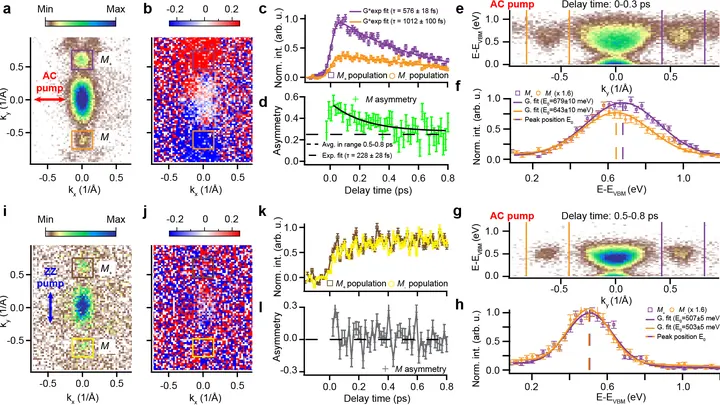
An ordinary sheet of black phosphorus looks like a layered cake of atoms. If you shine a regular lamp on it, nothing special happens: the electrons sit still, like spectators in a dark theater. But a short laser flash lasting millionths of a billionth of a second shakes up that theater.
A compass needle turns slowly, but inside some materials, tiny magnetic moments can flip over timescales that are hard to imagine. A team of physicists has calculated how to make them change direction in a quadrillionth of a second — faster than a lightbulb blinks.
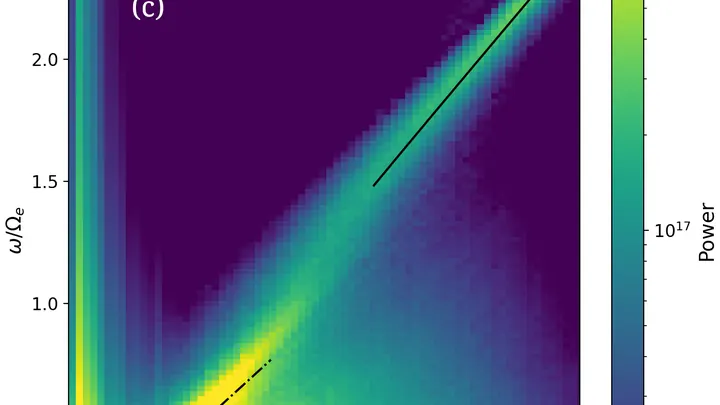
When water boils in a kettle, waves of steam ripple through the kitchen. A similar process happens in space, in plasma — gas so hot that electrons are stripped from atoms. Around black holes and neutron stars, this plasma isn't just hot: its particles zip around at nearly the speed of light.
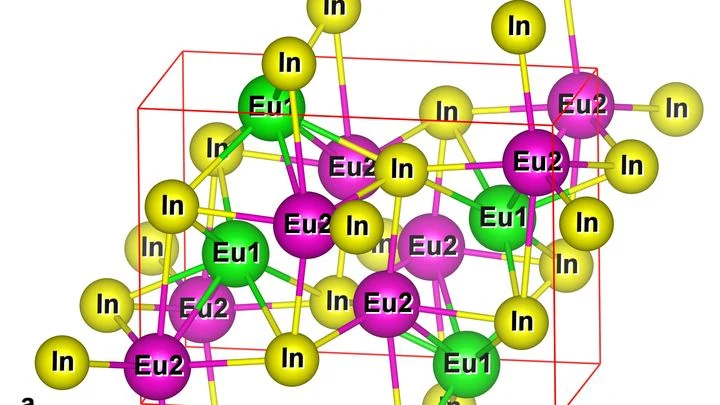
A piece of europium-indium alloy, when cooled in a magnetic field, behaves like water that does not freeze all at once but first in one corner of the glass, then in another.