A Rod as a Probe: Where a Varying Field Produces the Strongest Signal ✛
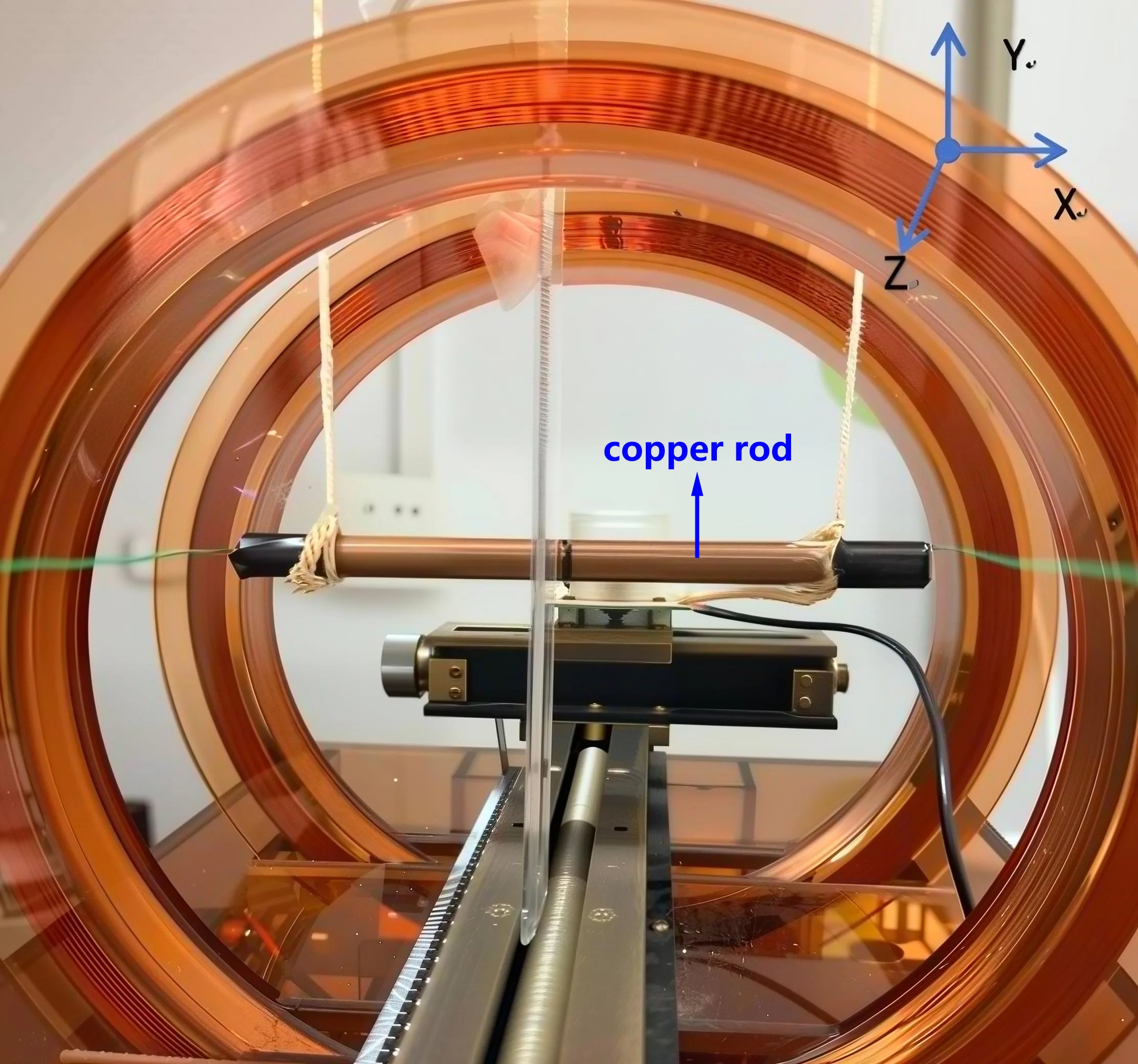
A thin copper rod, fifteen centimeters long, slides slowly across the invisible magnetic bubble created by a pair of coils. At the bubble's center, where the field is uniform and strong, the voltmeter needle sits at zero. Shift the rod toward the edge, and the needle comes to life, rises, peaks, and then falls smoothly. This experiment is like feeling for the boundary of an invisible bubble: the rod acts as a probe, showing where the field stops being uniform.
The Helmholtz coils induce a voltage in the conductor via the varying magnetic field. At the center, where the field is uniform, the upper and lower halves of the rod experience the same field change, so their contributions cancel each other out. When shifted from the center, one half finds itself in a stronger field than the other, and the difference generates a voltage. But when the rod moves far beyond the coil, the field outside reverses direction and starts working against the signal. Hence the curve first rises and then falls monotonically.
To pinpoint where the peak lies, the authors built four simplified models of how the field changes with distance from the center. The crudest model assumes the field is constant inside the coil and zero outside. More refined models allow the field to decay smoothly and even change sign beyond the edge. All four models predict the same thing: the peak sits at roughly ninety-three percent of the coil's radius from the center. The experiment matched this value to within a few percent.
The practical benefit of such a probe is clear for calibrating magnetometers. Typically, sensors are placed at the coil's center, where the field is uniform and the signal predictable. But at the edge, where the signal is maximal, sensitivity is higher, allowing finer adjustment of the instrument. Teaching labs also benefit: this experiment vividly demonstrates how Faraday's law works in a non-uniform field, and it requires no complex equipment.
Let's return to the probe image. The rod, passing through the magnetic bubble, feels its boundary and finds the spot where the bubble starts to "leak": the field outside is no longer zero but points in the opposite direction. It is there, at the junction of the internal and external fields, that the strongest signal is born. Thus a simple copper rod becomes a tool that makes the invisible field tangible.
The EMF maximum occurs when the rod is displaced from the center by 93% of the coil's radius, meaning its center is almost at the field boundary while its ends are already outside. At this point, the signal is nearly three times larger than at half the radius.