An external magnetic field is a magnetic field applied to a material or system from an outside source, as opposed to fields generated internally by the material itself. This distinction is fundamental in condensed-matter physics, where external fields are used to probe and manipulate the properties of materials. The response of a material to an external magnetic field reveals its internal structure, magnetic ordering, and quantum mechanical behavior. For example, the Meissner effect — the expulsion of a magnetic field from a superconductor — is defined by how the material responds to an externally applied field.
History
The systematic study of external magnetic fields began with Hans Christian Ørsted's discovery in 1820 that electric currents create magnetic fields, and Michael Faraday's subsequent work on electromagnetic induction. The concept became central to solid-state physics in the 20th century with the discovery of phenomena like the Hall effect and superconductivity.
How it works
An external magnetic field exerts forces on charged particles and magnetic moments within a material. The field can align spins, induce currents, or alter energy levels, depending on the material's properties. In superconductors, an external field below a critical strength is expelled due to the formation of screening currents on the surface. In other materials, the field can cause magnetization, magnetoresistance, or even phase transitions. The strength and orientation of the external field are key control parameters in experiments.
In practice
External magnetic fields are used in magnetic resonance imaging (MRI) in medicine, in particle accelerators to steer beams, and in magnetic storage devices to write data.
Fun fact
The Meissner effect, where a superconductor expels an external magnetic field, can be demonstrated by levitating a magnet above a superconducting material, a phenomenon often used in science museums.
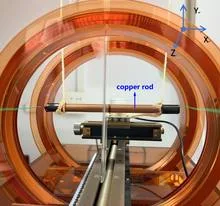
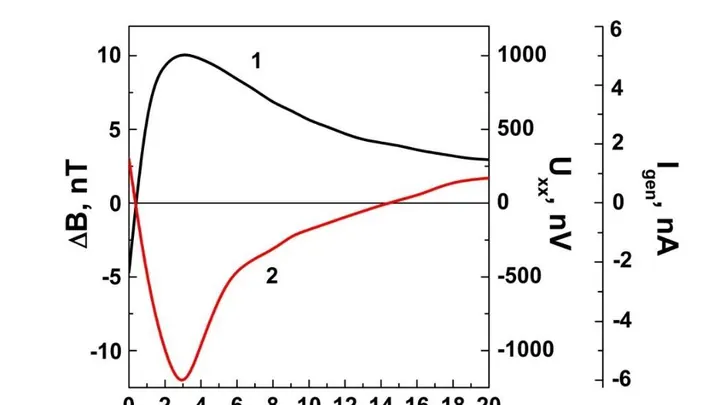
A thin copper rod, fifteen centimeters long, slides slowly across the invisible magnetic bubble created by a pair of coils. At the bubble's center, where the field is uniform and strong, the voltmeter needle sits at zero. Shift the rod toward the edge, and the needle comes to life, rises, peaks, and then falls smoothly.
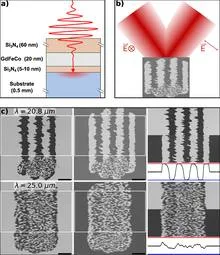
An orchestra without a conductor can sound harmonious if the musicians feel the common rhythm. In the world of solids, phonons play that role: quanta of crystal lattice vibrations. When atoms in a substrate start moving in circles, they can transfer their rotation to a magnetic layer on top and flip its magnetization.
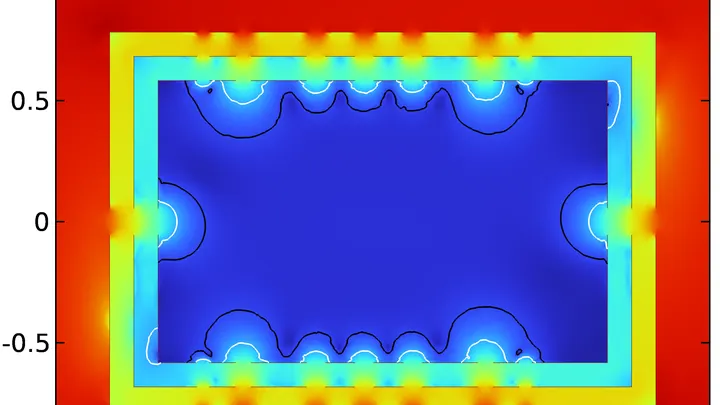
The magnetic field in this setup must be as smooth as glass: the slightest ripple would blur the signal. The engineers built two coils that cancel each other's field externally and packed them in three layers of ferromagnetic plates.
When two black holes merge, ripples spread across the fabric of spacetime — gravitational waves. But what if one of them isn't a run-of-the-mill black hole but something else — an exotic compact object?
A thin sandwich made of two different materials. You run an electric current through it, and the top slice magnetizes in one direction, the bottom in the opposite. This isn't a magic trick; it's the layer Edelstein effect, just described by physicists.
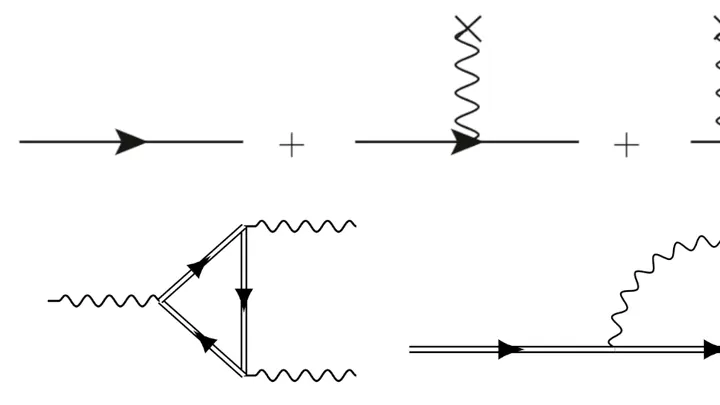
The agony of a solitary black hole lasts forever. But in its final moments, as its mass evaporates according to the law discovered by Hawking, it manages to send a radio farewell signal. Not a quantum whisper, but a classical hum — if only there's a magnetic field nearby.
A lead sphere hangs above another lead sphere. According to the usual laws of gravitation, they attract each other exactly along the vertical — along the line connecting their centers.
A magnetar is a neutron star with a magnetic field hundreds of millions of times stronger than Earth's. If you brought an ordinary magnet near such a field, it would instantly lose its magnetism, and atoms would stretch into thin filaments.
A thin sheet of graphene, just a few micrometers thick, was placed in a weak magnetic field, and it began to push the field out of itself, like a sponge squeezing out water. This effect, known as the Meissner effect, is the hallmark of a superconductor: a material that conducts electricity without loss.
When cooled strongly, a uranium-telluride crystal stops resisting current. Before that happens, at a slightly higher temperature, its resistance can still be measured — and it tells about the shape of the invisible paths along which electrons run.
If you hold an iron nail near a magnet, it will be attracted. Inside the magnet, tiny atomic magnetic arrows point in the same direction, like soldiers in formation. But in some crystals, the formation is different: neighboring arrows point in opposite directions. This order is called altermagnetism, and it is hard to see directly.
A magnet doesn't like its field penetrating a superconductor. An ordinary piece of lead, cooled to cryogenic temperatures, pushes out magnetic field lines, and levitates above a magnet. This is the Meissner–Ochsenfeld effect, discovered in 1933.
A magnetic field is invisible, but you can make it 'glow'. To do that, take a tiny diamond with defects — places where a carbon atom is replaced by nitrogen and a neighboring lattice site is vacant. These defects, like sensitive compass needles, respond to the slightest changes in the magnetic field and emit light of varying brightness.